

Columbia University to pay $220m, undertake major reforms in bid to restore federal funding

Columbia University announced on Wednesday that it would pay more than $220m to the Trump administration to restore federal research funding it lost after being accused of not doing enough to combat antisemitism on campus.
The agreement, months in the making, will see Columbia pay a $200 million settlement to the federal government over three years, and $21 million to settle alleged civil rights violations against Jewish employees.
The agreement will also have the senior vice provost conduct a "thorough review" of the Center for Palestine Studies, the Institute for Israel and Jewish Studies, the Middle Eastern, South Asian and African Studies, the Middle East Institute, the global hubs in Tel Aviv and Amman, the School of International and Public Affairs, the Middle East policy major and other programmes focused on the Middle East.
In addition, the university is not allowed to maintain programmes that "promote unlawful efforts to achieve race-based outcomes, quotas, diversity targets or similar efforts", which could threaten several departments and fellowships.
The university will also be prohibited from implementing affirmative action in its admissions policies.
New MEE newsletter: Jerusalem Dispatch
Sign up to get the latest insights and analysis on Israel-Palestine, alongside Turkey Unpacked and other MEE newsletters
The agreement also asks Columbia to reduce its dependence on international students, and asks for the university to provide, upon request, "all disciplinary actions involving student visa-holders resulting in expulsions or suspensions and arrest records" that the university is aware of.
Claire Shipman, acting president of Columbia University, said in a statement: "This agreement resolves multiple federal agency investigations and protects Columbia's academic mission, research enterprise and independence."
Shipman said the agreement would allow billions of dollars in federal research funding to resume, and that the university would retain control over its academic and operational decisions since the federal government would not dictate what it teaches, who teaches, or which students they could admit.
Shipman also said the university did "not agree with the government's conclusion that it violated Title VI of the Civil Rights Act" but did not deny the "very serious and painful challenges our institution has faced with antisemitism".
She denied the university had capitulated to President Donald Trump's administration's demands.
The university and the federal government are also appointing a monitor to ensure they both stick to their agreements. The new monitor, Bart M Schwartz, is the co-founder and chairman of an organisation that sponsored an event in June about "helping Israel heal and rebuild". Schwartz will provide a report every six months.
The agreement also sees the establishment of a whistle-blower hotline for the university to raise complaints to.
Demands
The Trump administration froze $400m in federal grants in March over its claims that the Ivy League institution failed to tackle antisemitism on campus. Shipman said it also placed the majority of $1.3bn a year in federal funding on hold.
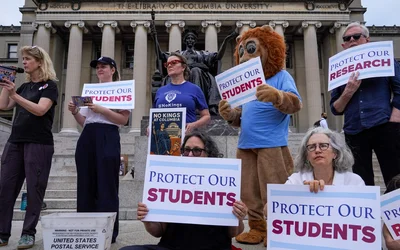
It also issued nine demands to the university, including adopting the controversial International Holocaust Remembrance Alliance (IHRA) definition of antisemitism, which academics and members of the Jewish community have criticised as conflating criticism of Israel with antisemitism.
The university pushed back on some of the administration's demands in March, such as putting the renowned Middle Eastern, South Asian and African Studies (MESAAS) department under academic receivership.
Instead, they put MESAAS under review. They did not abolish the University Judicial Board. Instead, it was moved under the Office of the Provost. They agreed to some demands, such as a mask ban on campus.
Ahead of its deal on Wednesday, Columbia suspended or expelled almost 80 students for pro-Palestine protests.
The suspensions will last between one and three years and will require students to write an apology letter if they wish to return to the university.
Middle East Eye delivers independent and unrivalled coverage and analysis of the Middle East, North Africa and beyond. To learn more about republishing this content and the associated fees, please fill out this form. More about MEE can be found here.