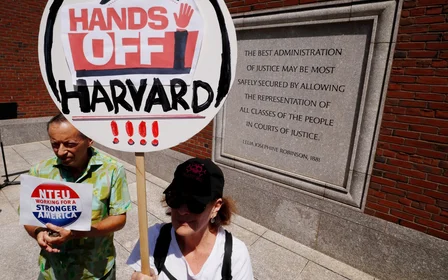
Academics fear Columbia University's deal with Trump has wider ramifications

The US government intends to fine several universities it accuses of failing to stop antisemitism on campus in exchange for federal funding freezes to be lifted, the Wall Street Journal reported on Friday.
The strategy would see Harvard, Cornell, Duke, Northwestern and Brown universities targeted, according to a White House official, with Harvard being the main focus.
All of the universities are currently in talks with President Donald Trump's administration over accusations by a federal task force committee that they have allowed antisemitism to fester on their campuses.
The move comes after the administration successfully extracted $200m from Columbia to settle allegations that it violated Title VI by failing to address harassment of Jewish students, in exchange for restoring its federal grants.
Now, the administration is looking to widen the net to other institutions and reportedly hopes to garner much more money from Harvard, which has an endowment of $53.2bn.
New MEE newsletter: Jerusalem Dispatch
Sign up to get the latest insights and analysis on Israel-Palestine, alongside Turkey Unpacked and other MEE newsletters
Critics believe the agreement with Columbia sets a dangerous precedent, and that these tactics can be used to change the academic landscape.
Former Columbia University law professor Katherine Franke said that Columbia bent over backwards to appease the government by implementing the agreement in advance for months. This included adopting the International Holocaust Remembrance Alliance's definition of antisemitism, circumventing its senate to change the University Judicial Board rules/composition, and creating a new provostial position to monitor certain departments.

"It's an unusual tactic in normal times, to implement the terms of a settlement voluntarily before the full agreement is reached," she said. "But these are not normal times, and Columbia has shown itself more than willing to bend a knee to the Trump administration in the hopes that doing so will make things less bad."
Harvard University has put up more of a fight and is currently suing the Trump administration in federal court, with one lawsuit claiming that the administration's freezing of more than $2bn in federal research money is illegal. Harvard is also being penalised by being cut off from future grants.
Franke warned that the agreement was a slippery slope and that the government would weaponise the spectre of antisemitism to dismantle the institution.
"This agreement is not the end of the story… it is merely the start of the next phase of the administration's campaign to use Columbia as an example for other universities. They won't let up, and the 'agreement' gives them all the power to keep weaponising the specter of antisemitism to dismantle a world-class university."
Undermining the fightback
Columbia's agreement with the Trump administration is also being seen as a move that undermines the fightback from Harvard and students and activists on campuses.
A student, who wished to be anonymous and is a member of the pro-Palestine group Students for Justice in Palestine at Wesleyan College in Georgia, said: "What Harvard has done, at least legally, to combat the Trump administration is now being undercut by Colombia's capitulation. I think that it bodes very poorly for the climate of student activism in the coming year."
'The bottom line is ultimately more important than the purported mandate or principle of learning, freedom of thought and expression'
- Kouross Esmaeli, scholar at Tufts
Kouross Esmaeli, a visiting scholar at Tufts University in the Department of Studies in Race, Colonialism and Diaspora, said that plans to control universities expose the corporate nature of universities.
"The bottom line is ultimately more important than the purported mandate or principle of learning, freedom of thought and expression," Esmaeli said.
In an email he sent to Middle East Eye, he wrote: "The administration's use of federal funds to intimidate and transform higher education into an acquiescence factory is a serious compromise of our basic values and rights.
"The people in charge of the corporate universities will continue to bend the knee to their sovereign in the name of saving their institution. But hopefully this is exposing the universities' complicity not only in the genocide in Palestine, but the larger American capitalist interests."
Esmaeli says that the events demonstrate why universities have been so resistant to divest from Israel, a key demand from pro-Palestine protesters, and the US military-industrial complex.
Middle East Eye delivers independent and unrivalled coverage and analysis of the Middle East, North Africa and beyond. To learn more about republishing this content and the associated fees, please fill out this form. More about MEE can be found here.