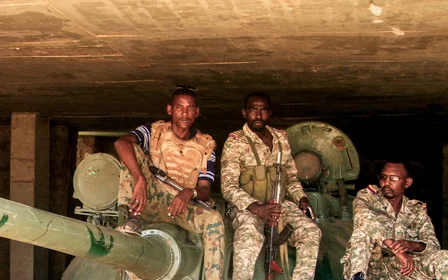
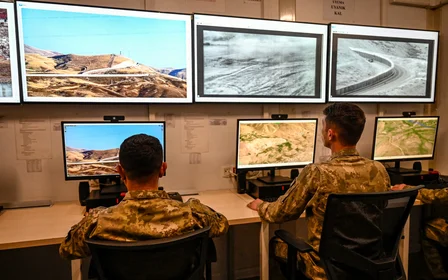
Libya’s GNU strikes smuggling networks with Turkish drones in message to rivals

Libya’s internationally recognised government has begun using Turkish drones to strike people-smuggling networks.
Strikes were carried out on Wednesday in the northwestern coastal cities of Sabratha and Zwara, the Government of National Unity (GNU) announced.
The strikes were “part of a systematic security campaign and comprehensive strategic plan aimed at intensifying operations to degrade and dismantle the criminal gangs and networks trafficking in human lives and people-smuggling into Europe,” Abdulsalam Al-Zoubi, the GNU’s deputy defence minister, said on Thursday.
“These operations, which included the inaugural use of UAVs [unmanned aerial vehicles], demonstrate the determination and zero-tolerance approach of the GNU in tackling these criminal networks and disrupting their illegal activity.”
A source within the GNU told Middle East Eye that the drones were “Turkish UAVs owned and operated by the Libyan Ministry of Defence”.
New MEE newsletter: Jerusalem Dispatch
Sign up to get the latest insights and analysis on Israel-Palestine, alongside Turkey Unpacked and other MEE newsletters
While authorities have previously carried out air strikes against such groups, this was their first use of drones.
The defence ministry said it targeted factories used to manufacture boats and other equipment essential to people and weapon-smuggling schemes.
'No civilian casualties'
For several years, criminal organisations have operated along Libya’s coast, particularly in the northwest, facilitating irregular migration for people trying to reach Europe from the African continent.
The ministry said it issued warnings to residents in Sabratha and Zwara ahead of the strikes, and that no civilian casualties were reported.
Emadeddin Badi, an expert on Libyan security and politics, said Zoubi's involvement in these strikes was significant.
“He recently visited Turkey and is the person that has coordinated these strikes with Turkish support,” Badi told MEE.
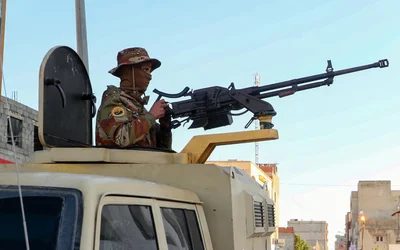
“His involvement, especially from Mitiga, is a signal that he’s asserting operational autonomy, even within the GNU’s own command structure.”
Mitiga is an airport in Tripoli that was the source of tension recently between the GNU and Rada, a powerful armed group.
“Their coordination from this base is a big signal that is key to unpacking [the strikes’] significance,” said Badi.
The analyst added that while some reports, citing GNU officials, had framed the strikes as being carried out by Turkish Akinci drones, he had received information to suggest that Bayraktar TB2 drones had been used.
“Akincis are based between Wutiya and Misrata, whereas the recent strikes originated from Mitiga, which only hosts TB2s,” he said.
Zoubi stated that the strikes sent a clear message to non-state actors in Libya that all measures, including military actions within international law, would be taken to “re-establish border control, strengthen national security, and reaffirm the sovereignty of the state”.
Over the past decade, trafficking and smuggling along the coast has been a key tool used by militias and non-state actors in Libya to wield political and financial influence.
Eastern Libya is controlled by a rival administration dominated by Khalifa Haftar, a military commander.
Two years ago, people smugglers in the east linked to Haftar were accused of involvement in a deadly shipwreck off the coast of Greece that killed more than 500 people.
Badi said that as well as targeting smugglers, Wednesday’s operation also targeted those loyal to Mohamed Bahroun, known as al-Far (the rat), a prominent militia leader and known GNU opponent.
“It also serves as a deterrent message to rivals in the west coast,” he said. “That kind of signalling aligns closely with Ankara’s broader goal in Libya: avoiding another armed confrontation in Tripoli.”
Middle East Eye delivers independent and unrivalled coverage and analysis of the Middle East, North Africa and beyond. To learn more about republishing this content and the associated fees, please fill out this form. More about MEE can be found here.