
US imposes new sanctions on two judges and two deputy prosecutors at ICC

The US imposed sanctions against two judges and two prosecutors at the International Criminal Court (ICC) on Wednesday, and accused the officials of being instrumental in efforts to "investigate, arrest, detain or prosecute" American or Israeli officials.
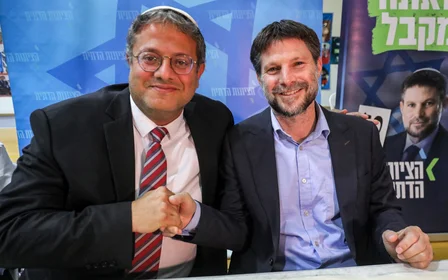
Middle East Eye reported last week that arrest warrant applications against Israel's National Security Minister Itamar Ben Gvir and Finance Minister Bezalel Smotrich on charges of apartheid had been prepared by ICC Chief Prosecutor Karim Khan before he went on leave in May.
Two ICC sources told MEE that the two deputy prosecutors, Nazhat Shameem Khan and Mame Mandiaye Niang, had not filed the applications due to the threat of US sanctions.
When asked by MEE to comment on the status of the Ben Gvir and Smotrich applications, and whether fear of sanctions has delayed their submission, the prosecutor's office, speaking on behalf of the deputy prosecutors, said: "The office cannot provide comments on matters related to ongoing investigations and any specific charges that may arise in relation to situations addressed by the office. This approach is essential to protect the integrity of investigations, and to ensure the safety and security of victims, witnesses and all those with whom the office interacts."
Wednesday's sanctions, which targeted Shameem Khan and Niang, also targeted ICC judges Kimberly Prost, who is Canadian, and Nicolas Guillou from France.
New MEE newsletter: Jerusalem Dispatch
Sign up to get the latest insights and analysis on Israel-Palestine, alongside Turkey Unpacked and other MEE newsletters
Gillou authorised the ICC's issuance of arrest warrants against Israeli Prime Minister Benjamin Netanyahu and former Minister of Defence Yoav Gallant, while Prost authorised the ICC's investigation into US personnel in Afghanistan.
In a statement, US Secretary of State Marco Rubio accused the four officials of being engaged in efforts to investigate, arrest, detain or prosecute nationals of the US or Israel, without the consent of either nation.
He accused the Hague-based court of being "a national security threat that has been an instrument for lawfare against the US and our close ally Israel."
The State Department Press Office told MEE that the US and Israel were not a party to the Rome Statute and had not consented to the ICC's authority.
It added since assuming leadership for the Office of the Prosecutor in May, Shameem Khan and Niang had "continued to support the ICC's lawfare against Israel, including asserting ICC jurisdiction over Israel, and have upheld the ICC's arrest warrants targeting Israeli personnel".
The State Department further said it does not "preview deliberative sanctions actions", but as long as the ICC continues to present a threat to Americans and allies that have not consented to ICC jurisdiction, "all options are on the table".
In its reaction to the decision, the ICC said that US sanctions are an "affront" against the rules-based international order and "millions of innocent victims across the world".
"The ICC will continue fulfilling mandates in strict accordance with its legal framework, without regard to any pressure or threat."
Fears over sanctions
The international justice director at Human Rights Watch, Liz Evenson, told MEE the sanctions showed "complete disregard for victims of serious crimes" and called on the EU to use its blocking statute to protect the organisation.
"The Trump administration, by sanctioning the ICC deputy prosecutors and two additional judges, is again showing complete disregard for victims of serious crimes across the globe in a misguided effort to shield US and Israeli officials from justice," she said.
Deputy prosecutors at the ICC have the power to submit arrest warrant applications to pre-trial judges for examination
If the arrest warrants are filed, it would be the first time that the crime of apartheid will have been charged at an international court.
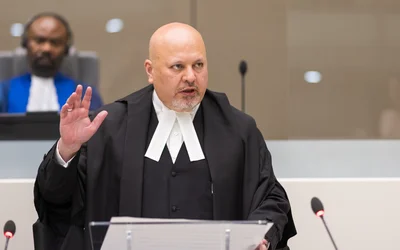
The sanctions are the latest attack on the ICC. Since President Donald Trump's executive order was issued in February, the US has now sanctioned nine individuals at the ICC.
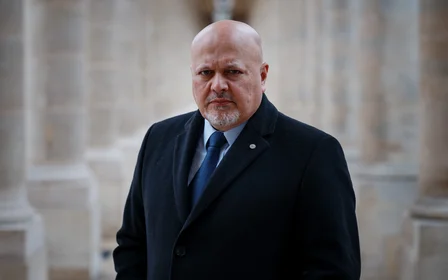
The US administration sanctioned ICC Chief Prosecutor Karim Khan in February, and he went on leave in May amid a UN investigation into sexual misconduct allegations against him, which he has denied.
A major Middle East Eye investigation in early August uncovered extraordinary details of an intensifying intimidation campaign targeting Khan over his investigation into alleged Israeli war crimes.
The campaign has involved threats and warnings directed at Karim Khan by prominent figures, close colleagues and family friends, as well as fears for the prosecutor's safety prompted by a Mossad team in The Hague and media leaks about sexual assault allegations.
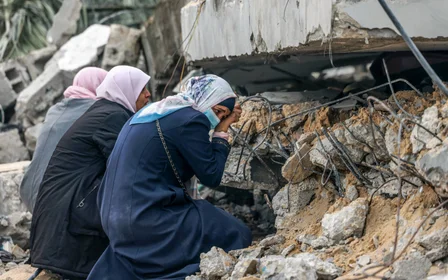
The campaigns took place against the backdrop of Khan's efforts to build and pursue a case against Netanyahu and other Israeli officials over their conduct of the war against Hamas in Gaza and accelerating Israeli settlement expansion and violence against Palestinians in the illegally occupied West Bank.
In June, the US sanctioned four ICC judges over arrest warrants targeting Netanyahu and Gallant. Two of those judges approved Khan's application for arrest warrants for Netanyahu, Yoav Gallant, and three Hamas leaders last November.
"ICC member countries should strongly condemn these blatant attacks on the rule of law and take all necessary steps to ensure the court can continue its critical work for justice. For the EU, this means using its blocking statute, which aims to shield European companies from the effects of extraterritorial sanctions," Evenson from HRW said.
Middle East Eye delivers independent and unrivalled coverage and analysis of the Middle East, North Africa and beyond. To learn more about republishing this content and the associated fees, please fill out this form. More about MEE can be found here.