
Fourth Palestine Action prisoner launches hunger strike over ‘systematic abuse’

A fourth prisoner held on remand in the UK for alleged offences relating to Palestine Action activities has launched a hunger strike over their detention conditions and the government’s proscription of the direct action group.
On Thursday, Jon Cink became the fourth Palestine Action-linked prisoner to refuse food, joining prisoners Qesser Zurah, Amu Gibb and Heba Muraisi in an open-ended hunger strike over what they describe as “systematic abuse” by the prison authorities.
Cink was remanded to Bronzefield prison in connection with a Palestine Action raid targeting RAF Brize Norton air base in June 2025 in which activists allegedly attacked with paint and crowbars two planes they said were "used for military operations in Gaza and across the Middle East".
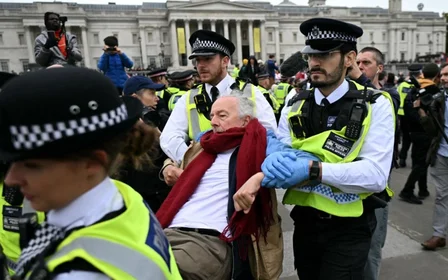
The then home secretary Yvette Cooper cited the alleged attack as the catalyst for proscribing the direct action group in July.
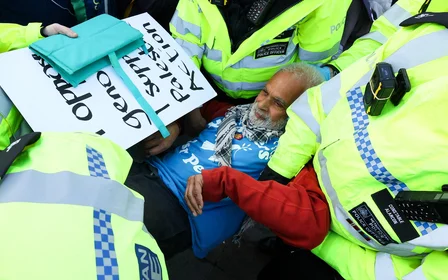
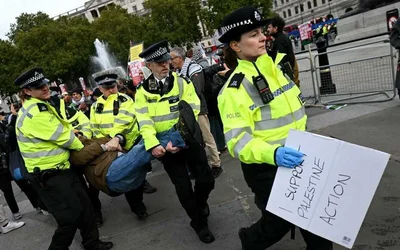
The ban means Palestine Action is akin to the Islamic State group or al-Qaeda in British law, and expressing support or membership of the group is a criminal offence that could lead to a prison sentence of up to 14 years.
New MEE newsletter: Jerusalem Dispatch
Sign up to get the latest insights and analysis on Israel-Palestine, alongside Turkey Unpacked and other MEE newsletters
The campaign group Prisoners for Palestine (PFP) announced the launch of the rolling hunger strike after Home Secretary Shabana Mahmood failed to respond to a letter outlining their demands, including immediate bail and an end to prison interference with their personal communications, as well as the de-proscription of Palestine Action.
More prisoners are expected to join the strike in the coming weeks, although PFP said it could not disclose the total number of prisoners participating in the strike over fears individuals will be further targeted by the authorities.
The group previously indicated that dozens are set to participate and that the action could constitute the largest coordinated prisoners’ hunger strike since the 1981 Irish republican hunger strike led by Bobby Sands.
Refused medical attention
Audrey Corno, a former prisoner and PFP representative, told Middle East Eye that Zurah, Gibb and Muraisi’s repeated requests for electrolytes and medical attention have been refused by the prison authorities.
Zurah reported that she is suffering from stomach cramps, and aching limbs, back and neck as a result of her strike.
When approached for comment, the Ministry of Justice (MOJ) said: “It would be inappropriate to comment on the location or management of any specific individuals within the prison system.”
Sodexo, which operates HMP Bronzefield, said in response to a request for comment that: “ All prisoners are managed in line with the policies and procedures governing the entire UK prison estate. This includes specialist multi-agency processes, led by the Government, to assess individual risks and security status."
It added that: "If any prisoner has specific complaints, we encourage them to raise them directly with the prison, as there are numerous channels available for addressing such concerns.”
When asked by MEE to clarify the guidelines regarding the handling of cases of food refusal, Sodexo pointed to HM Prison and Probation Service's Food in Prisons Policy Framework.
The framework states that “prison catering managers should ensure that catering staff work with healthcare staff to manage the relevant prisoner in accordance with clinical guidance, taking special care in the reintroduction of food and/or fluids".
It adds that staff should “record and consult, on a regular and timely basis, all relevant information regarding any refusal of food and/or fluids by a prisoner and ensure that all such information is made and remains accessible to all relevant staff".
The document does not contain any details regarding the clinical management of prisoners refusing food. When approached by MEE, the MOJ provided guidelines for the clinical management of people refusing food in immigration removal centres and prisons, which, unlike other similar guidelines, are not available online.
The document states that hunger strikers should be given a "full initial medical assessment".
"This includes a brief history of past and present medical problems and a full clinical examination," adding that "specific note should be made of body weight, temperature, pulse, blood pressure and respiration rates as a baseline, so that future observations can be made against this baseline".
The guidance also stipulates that "a minimum screen of chest X-ray, urine microbiology and blood cultures must accompany any suspicion of intercurrent illness or non-specific deterioration in the severely malnourished, with other tests as appropriate".
"A thorough assessment of nutritional status is always needed," the guidance emphasises, explaining that this would consist of establishing levels of recent food intake and usual body weight (from previously recorded measures and/or an individual’s recollection), and performing a specific nutritional examination.
In August, another Palestine Action-linked prisoner launched a hunger strike over rapidly deteriorating detention conditions faced by a number of prisoners affiliated with the group in the wake of the proscription.
The 29-year-old, known as T Hoxha, refused food while held on remand at HMP Peterborough after the prison suspended her recreational activities, withheld her mail and removed her from a role at the prison library.
Despite Hoxha’s health rapidly deteriorating, the prison authorities were slow to initiate health checks and give her electrolytes.
A ‘healthcare decision’
Corno noted the disparity in prison staff’s treatment of detainees who are people of colour and white prisoners.
She reported that when Zurah announced her strike, she was manhandled by five prison guards and “forced” into her cell. She reportedly overheard two prison guards saying they were putting her on “report”.
Prison guards also reportedly instructed other prisoners on her wing not to help her.
By contrast, Corno said that Cink was ignored by guards when he launched his strike.
According to Corno, since announcing her strike on Monday, Zurah has been placed on “basic” status, which limits prisoners’ movements and privileges. This has involved being locked in her cell for long periods, and only being allowed out for short intervals.
Both Zurah and Gibb have been barred from using the gym, with the prison nurses saying this was a “healthcare decision”, according to Corno.
“We know that’s not true, because both of them made it explicitly clear that they were not planning on doing any strenuous activity. They just wanted to do some light stretching in the gym and socialise a bit with others - it's one of the very few social spaces they have,” Corno told MEE.
Zurah and Gibb also suspect that they have been placed under a “non-association order”. While this has not been formally communicated to them, the pair were instructed to stop talking to each other in the visitation hall before a family visit.
Subsequently, Zurah and Gibb's visits were rescheduled to avoid them coinciding with one another.
Corno said that Zurah has long experienced harsh treatment at the hands of prison guards. Like many Palestine Action-affiliated prisoners, her personal communications have been censored and withheld, and she has been issued arbitrary punishments by prison staff.
In one incident on 26 September, Qessar and Gibb were disciplined for running towards each other in the prison courtyard.
On 24 October, a prison officer entered Zurah’s cell without a body cam and tore down decorations she had hung from her ceiling. Corno said prison guards are required to wear body cams when conducting cell searches.
Middle East Eye delivers independent and unrivalled coverage and analysis of the Middle East, North Africa and beyond. To learn more about republishing this content and the associated fees, please fill out this form. More about MEE can be found here.