NYC bids goodbye to beloved Muslim activist and imam, Talib Abdur-Rashid

Hundreds of people packed out three floors of the iconic Malcolm Shabazz Mosque in Harlem for the funeral of social activist and imam, Talib Abdur-Rashid, despite it being held at 9am on a Monday morning.
Abdur-Rashid was a giant in the Black Muslim community of New York City and was the imam of the historic Mosque of Islamic Brotherhood (MIB), where he had worked for over 50 years.
At his funeral, his daughter, Hawwa Minnie Gilmore, told attendees that her father finally got to "rest" after a life he spent tirelessly serving his congregation, the Harlem community, and Muslims across the city and beyond in a tearful tribute.
“Everything that you all think of him, he was so much more as a father,” she said between sobs. “He was so kind, so loving, so caring. There was nothing we couldn’t go to him with. This is such a tremendous loss for us.”
She mentioned how he had taken care of her when she was ill and uplifted her when she was sad.
New MEE newsletter: Jerusalem Dispatch
Sign up to get the latest insights and analysis on Israel-Palestine, alongside Turkey Unpacked and other MEE newsletters
“He was everything to us,” she said. “It was hard sharing him with everybody all the time. All the time. I’ve tried to wrap my head around this, and I know that this is the only way he can rest. He was always doing something for somebody. It’s just never been about him. It was always about all of us.”
Her tribute followed more than half a dozen given by faith and community leaders, academics and politicians in the hour-long service, including co-founder of MIB and professor Halima Toure, Zaytuna College co-founder Imam Zaid Shakir, New York City council member Yusef Salaam, and mayor-elect Zohran Mamdani.
Life of service
People of all generations and walks of life turned out to pay their respects to “a giant” who dedicated his life to service.
Abdul Rahman Bilal, 84, from Harlem, told Middle East Eye that he had known Abdur-Rashid for decades and had met him when he first went to the Mosque of Islamic Brotherhood.
“He was a wonderful, kind, thoughtful, caring individual,” he said. “A very nice man.”
Bilal said he admired him because he was “one of the few people that didn't follow Elijah Muhammad”, the former Nation of Islam leader.
'He loved his Harlem. Harlem loved him. He loved Malcolm. We’re at Masjid Malcolm Shabbaz on Malcolm X Boulevard, so he's home'
- Shaykh Abdul Rashid
Abdur-Rashid converted to Sunni Islam in 1971, at the age of 20, before MIB's brick-and-mortar facility was built. At the time of his conversion, Shaykh Ahmed Tawfiq, a student of Malcolm X, was the imam and a founding member.
In addition to serving his congregation, Abdur-Rashid was a prison chaplain at the state level, serving facilities such as Sing Sing and NYC prisons, including Rikers. According to The New York Times, he started working with prisoners in the 1970s after a member of the MIB was arrested and before there were full-time Muslim chaplains in the city.
Luqman Yunus, 74, told MEE at the funeral that he had known Abdur-Rashid since 1978, when he was a chaplain at the prison where Yunus had been incarcerated.
“He’s always been there for us, you know,” Yunus said. “All I can say is he’s a very good guy, and I was sorry and shocked to learn about his passing.”
Shaykh Abdul Rashid, 73, of Brooklyn, told MEE that he had come “to pay tribute to an icon and legend of the Muslim community in general, but the Black American Muslim community specifically. "He was a bedrock, as you can see by the multitudes who turned out to pray for him," he said.
“He loved his Harlem. Harlem loved him. He loved Malcolm. We’re at Masjid Malcolm Shabbaz on Malcolm X Boulevard, so he's home.”
He then prayed for Abdur-Rashid to be granted the highest levels of paradise and be reunited with his “beloved” El-Hajj Malik el-Shabbaz (Malcolm X).
He said he met Abdur-Rashid almost 50 years ago when they were both students of Shaykh Tawfiq, and then had worked together when they were both part of a chaplains’ association in New York.
‘Everything to everybody’
Batina Bamba, who has worked at MIB for 20 years, told MEE she had first heard of Abdur-Rashid when he was a Sunday school teacher at a Lutheran church before he converted to Islam. She herself had been a member of the Lutheran Church.
“One of the other things that Imam Talib was really big about was interfaith relationships,” she said. She recalled how he maintained relationships with many pastors, including his sister’s pastor, and had once been entrusted to give a Sunday sermon at a Lutheran church in downtown Manhattan as a Muslim imam.
She also believes his positive relationships with other faith leaders meant he was able to collaborate effectively in championing civil rights for people like Amadou Diallo, an unarmed Guinean student who was killed by the New York Police Department, and Yusef Salaam, one of the wrongly convicted "Central Park Five".
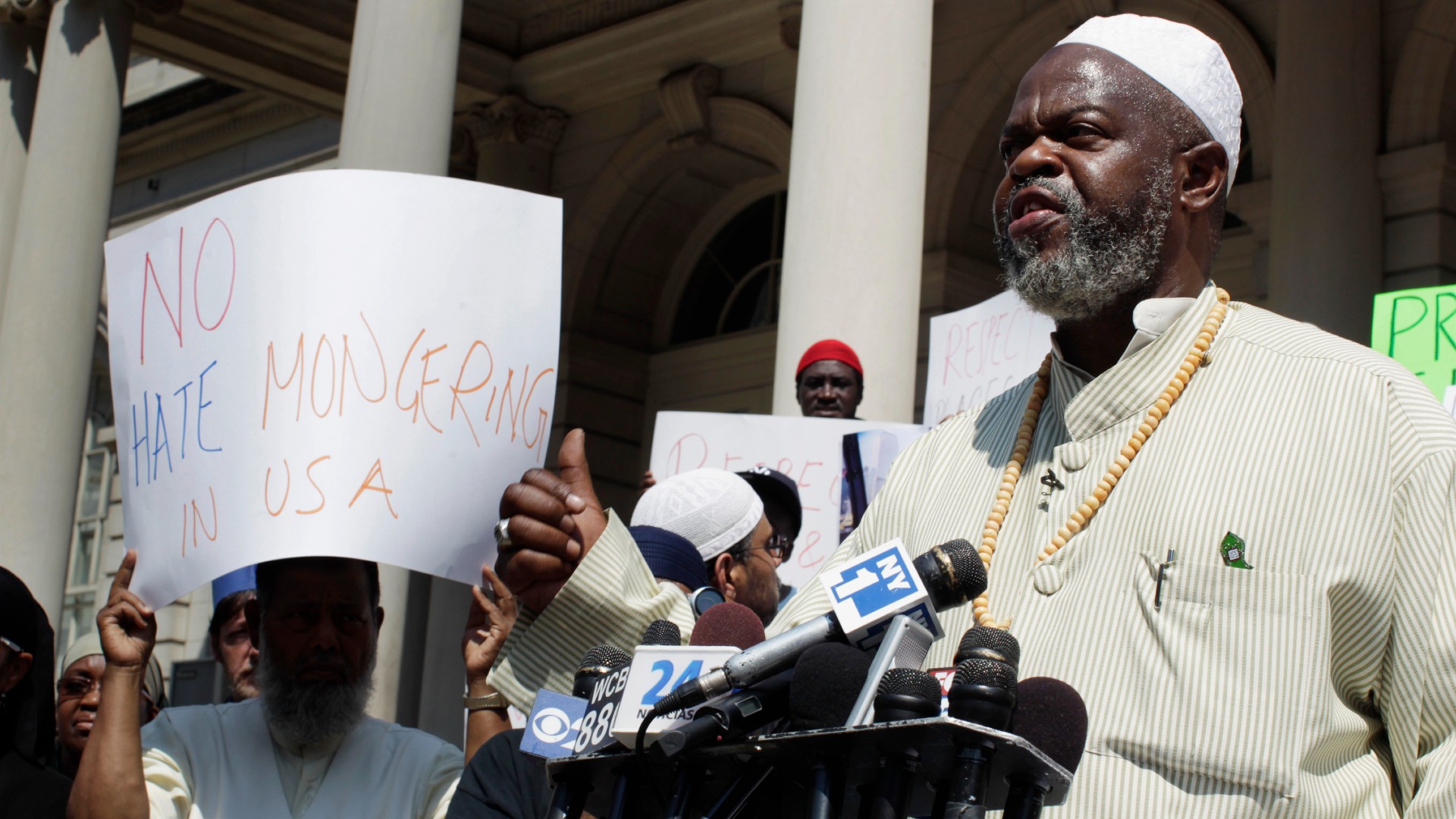

“That's one thing about Imam Talib - nobody else can meet that standard of being able to cross boundaries and reach people's hearts,” she added. “It's a loss, not just to our mosque, but a loss to the world. If there's any hope or chance for interfaith peace, he's the kind of person that could have been a broker of that.”
She recalled how Abdur-Rashid had campaigned for the community at large in city government, including winning the right to have the adhan, or call to prayer, recited on loud speaker at the mosque; for people not to be issued parking tickets on Eid; providing halal options in public schools; and for Eid to be added to the public school calendar of holidays in New York.
She also recalled him issuing a lawsuit against the New York Police Department for invading the mosque’s privacy after 9/11.
“There were a lot of things that he did that people did not know about,” she said.
“He was everything to everybody, and he always made himself available to the point where I'm actually happy for him that he gets a break now,” she added.
'Your mission is complete'
Abdur-Rashid was born in 1951 as Barry Lee Hicks in North Carolina. His family moved to the Bronx when he was a child.
According to historian Rasul Miller, an assistant professor of history at UC Irvine, who was born and grew up in Harlem and flew in from California to attend the funeral, Abdur-Rashid was heavily "influenced" by the era of Black power, the anti-war movement, pan Africanism, and Black nationalism movements that surrounded him in his youth.
Abdur-Rashid was also an actor and dancer and was influenced by the Black Arts movement that sprang up after Malcolm X’s death. He was friends with poet and writer Askia Toure, who Miller said was “a major part of MIB at the time”.

After converting in 1971, Miller said Abdur-Rashid became a dedicated member of MIB, began assisting with imam duties around 1974/1975, and became editor of the Western Sunrise, MIB’s flagship publication.
After MIB was established at its current location on 113th St, Miller also recounted how MIB was welcoming of the arts. And he was told that people like Dr Mutulu Shakur had come to Friday prayers with Tupac Shakur in a stroller. Dr Shakur, Tupac Shakur's stepfather, was a Muslim, according to Miller.
Miller says that Abdur-Rashid continued to uphold the same respect for the arts when he took over as imam of MIB in 1989, and artists like Yasiin Bey (Mos Def) and Q-Tip visited him during his tenure at MIB, earning him the affectionate moniker of the "Hip Hop imam".
Abdur-Rashid also served as president emeritus of the Islamic Leadership Council of New York (Majlis Ash-Shura) and as vice president of the Muslim Alliance in North America.
He was also on the advisory board of the After Malcolm Digital Archive, a university-based repository that documents African-American Muslim contributions to the struggle for justice in the US.
Abdur-Rashid passed away on 15 November at home, the same day that signage for the Malcolm X plaza was being installed to officially designate it as a community plaza in Harlem. He was due to recite prayers at the event.
Bamba said that while Senator Cordelle Cleare organised everything, Abdur-Rashid was “the brains behind it”.
“For him to pass away on the day that they were naming Malcolm X Plaza is so symbolic, and it's also like Allah saying, ‘Your mission is complete’,” she said.
Abdur-Rashid lost his wife, Sanaa Abdul-Halim, in 2014 and is survived by his daughter, Hawwa, and his son, Adam.
Following his funeral, he was buried in Rosedale Cemetery in Linden, New Jersey, on Monday.
Middle East Eye delivers independent and unrivalled coverage and analysis of the Middle East, North Africa and beyond. To learn more about republishing this content and the associated fees, please fill out this form. More about MEE can be found here.