Interceptor shortage could force Gulf states to be selective in their targets: Report

The Trump administration has been informed that its Gulf partners are running so low on missile and drone interceptors that they now need to be selective about which projectiles to target amid the war on Iran.
The report by CBS published on Wednesday follows Middle East Eye’s exclusive report on 2 March about how the US was “stonewalling” requests by Gulf states to replenish their interceptors as early as the first week of the war on Iran.
“Whatever munitions were produced in the last couple of months, we have shot several years' worth of production in the last few days,” a former US official familiar with the requests told MEE at the time.
The situation in the Gulf has only deteriorated since then, with Iran firing thousands of missiles and drones at the US's energy-rich partners.
The UAE alone has destroyed 241 ballistic missiles and 1,385 drones since the start of the war. Bahrain said on Wednesday that it had intercepted at least 106 missiles and 177 drones from Iran since the war began.
New MEE newsletter: Jerusalem Dispatch
Sign up to get the latest insights and analysis on Israel-Palestine, alongside Turkey Unpacked and other MEE newsletters
As a general rule, defenders are expected to fire around two interceptors to down one incoming projectile.
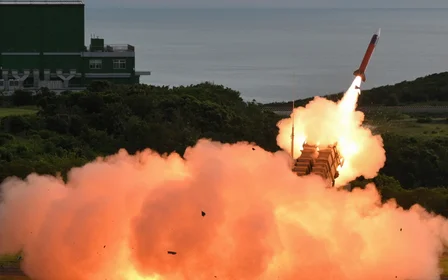
The Gulf states have been firing expensive interceptors from Terminal High Altitude Area Defence ballistic missile defence systems as well as Patriot batteries. The US only produces around 600 Patriot Pac-3 interceptors per year.
Photos on social media show debris that suggests older Pac-2 interceptors are being used in the Gulf. MEE could not independently confirm the reports. Current and former US officials have told MEE that the Pac-2s have been used.
MEE reported on Tuesday that Iranian missiles may have been testing Turkish airspace over the past week to target a crucial Nato radar base in Malatya.
Turkey has hosted Spanish-owned Patriot missile systems in the south of the country since 2015, but the Pac-2 model was considered insufficient for intercepting Iranian ballistic missiles.
A new Patriot system - a Pac-3 model - was deployed to Malatya from Nato’s Ramstein base in Germany, according to reports.
The US has had to pull air defence systems from East Asia, a critical theatre of competition with China, as well.
On Tuesday, South Korean President Lee Jae Myung confirmed the US planned to pull air defence systems from his country despite objections from Seoul.
Middle East Eye delivers independent and unrivalled coverage and analysis of the Middle East, North Africa and beyond. To learn more about republishing this content and the associated fees, please fill out this form. More about MEE can be found here.