Conservatives' Badenoch fails to issue Eid message to British Muslims

The UK's Conservative Party on Friday faced further questions and criticism about its attitude towards British Muslims after its leader, Kemi Badenoch, failed to issue a public message marking Eid al-Fitr.
Eid al-Fitr, which began on Thursday evening and marks the end of Ramadan, is one of the most significant dates in the Islamic calendar and is observed by Muslim communities worldwide.
Political parties and their leaders typically use the occasion to engage with Muslim constituents and to acknowledge their contributions to society.
Prime Minister Keir Starmer and the leaders of most other parties, including the Liberal Democrats and the Greens, all issued Eid messages through social media channels.
Starmer, the Labour Party leader, offered his "warmest wishes to Muslims who are marking the end of Ramadan across the UK and around the world".
New MEE newsletter: Jerusalem Dispatch
Sign up to get the latest insights and analysis on Israel-Palestine, alongside Turkey Unpacked and other MEE newsletters
But by late Friday afternoon, Badenoch, the leader of the opposition, had not posted anything related to Eid on either her X or Facebook pages. Badenoch has previously marked other religious festivals, including the Jewish festival of Hanukkah and the Hindu festival of Diwali.
According to an analysis of her social media accounts, she appears to have last posted an Eid message in 2022, when she served as faith minister.
On Friday afternoon, the Conservative Party shared an "Eid Mubarak" message on its Facebook page.
"Happy Eid to Muslims in the UK and across the world celebrating today," it said.
The Conservative Party had not responded to a request for comment at the time of writing.
Ayoub Khan, an independent MP for Birmingham Perry Barr, a constituency with a sizable Muslim population, called out Badenoch on Thursday evening and said "failing to acknowledge Eid for millions of British Muslims isn’t just an oversight; it sends a message.
"At a time when leadership should unite, your silence speaks volumes. Many in your own party will be questioning what that says about who you choose to represent!"
The lack of acknowledgement of the occasion of Eid by Badenoch comes after Nick Timothy, the shadow justice secretary, earlier this week accused Muslims praying during a public iftar in Trafalgar Square of participating in an “act of domination".
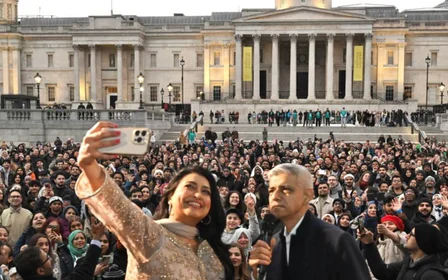
Timothy took to X on Tuesday and posted a video of people - including London Mayor Sadiq Khan - praying in congregation at the event.
"Many are too polite to say this," Timothy said, before declaring that "mass ritual prayer in public places is an act of domination".
"The adhan - which declares there is no God but Allah and Muhammad is his messenger - is, when called in a public place, a declaration of domination," he argued.
Timothy clarified that "I am not suggesting everybody at Trafalgar Square last night is an Islamist."
However, he added, "The domination of public places is straight from the Islamist playbook."
He called the event "an act of domination and therefore division" and asserted that it "shouldn't happen again".
Badenoch supported Timothy's comments and posted an article he had written for the Telegraph justifying his post on Thursday, the day before Eid.
Several parliamentarians, including UK Prime Minister Keir Starmer, criticised Timothy and said the Conservative Party had a “problem with Muslims".
Starmer said if Timony “were in my team, he’d be gone. It's utterly appalling. She should denounce his comments, and she should sack him".
Badenoch responded that Timothy was "defending British values".
On Tuesday, Dominic Grieve, a former Tory MP and attorney general, remarked: "This is a very odd post from a Conservative who says he believes in freedom of expression under law."
Grieve noted that "the use of Trafalgar Square (with permission) for religious events - Christian and other - goes back a long way.
"There have been prayers and hymns, chants and religious events performed there in the past."
Grieve added: "If such an event 'shouldn't happen again' it raises the question of whether this is to apply to all religious events or just to Muslim ones.
"If to all, then we are moving like France to imposing secularism as a norm, and it is contrary to our national tradition and does not seem to have helped develop social cohesion there.
"If [it applies] just to Muslims, then it is an act of discrimination against them without any lawful basis."
Middle East Eye delivers independent and unrivalled coverage and analysis of the Middle East, North Africa and beyond. To learn more about republishing this content and the associated fees, please fill out this form. More about MEE can be found here.