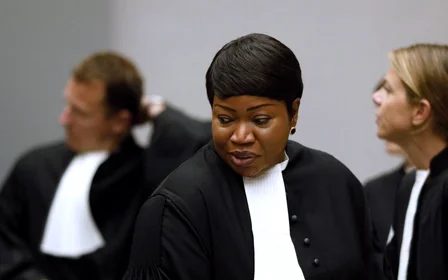
ICC bureau suspends prosecutor Karim Khan pending final vote on misconduct probe

The executive body of the International Criminal Court decided on Monday to suspend Karim Khan, the ICC chief prosecutor, disregarding a judicial panel's opinion that found no evidence of misconduct against him.
According to an official press release published late on Monday, a qualified majority of the 21-member bureau of the Assembly of States Parties (ASP) decided to suspend the prosecutor “with immediate effect” pending the final decision of the ASP as the competent decision-maker on the matter.
The decision was made under rule 28 of the Rules of Procedure and Evidence, which indicates that a two-thirds majority of bureau members present and voting recommended a finding of “serious misconduct”, paving the way for a vote at the larger ASP which first needs to uphold the decision, then vote on whether to remove the prosecutor.
The statement by the bureau emphasised that the suspension is not the final outcome in the disciplinary proceedings, and that it has decided to convene a special session of the ASP as soon as possible to consider the matter.
“The assessment of the Bureau was based on the report of an investigation undertaken by the United Nations Office of Internal Oversight Services (OIOS), the underlying evidence, the advice of an ad hoc Panel of judicial experts, and written submissions,” it said.
New MEE newsletter: Jerusalem Dispatch
Sign up to get the latest insights and analysis on Israel-Palestine, alongside Turkey Unpacked and other MEE newsletters
“The decision of the Bureau and the related documentation will remain confidential. The Bureau continues to call for due respect for the privacy and the rights of all parties concerned, as well as for the integrity of the ongoing process,” the statement added.
According to ASP rules, any finding of misconduct would require a two-thirds majority of the states present and voting at the ASP.
If the ASP votes to find serious misconduct, it would then hold a second vote on whether to remove the prosecutor.
'An executive and political body has purported to substitute its own assessment for that of the independent judges it appointed'
- Karim Khan's lawyers
A vote to remove Khan would require an absolute majority of the 125-member ASP (63 votes).
Khan's lawyers issued a statement on Monday rejecting the bureau's decision "in the strongest terms".
"The decision is unlawful, procedurally unfair and unsupported by evidence," said Khan's legal team.
"It disregards the unanimous conclusion of the independent Judicial Panel appointed by the Bureau itself, which found that the factual findings by OIOS did not establish misconduct or breach of duty under the relevant legal framework.
"That conclusion should have ended the matter. Instead, an executive and political body has purported to substitute its own assessment for that of the independent judges it appointed," the statement added.
"Mr Khan’s legal team will now take all necessary steps to challenge the decision, protect his rights, and ensure that due process is upheld."
Judges report
MEE reported in March that a panel of judges appointed by the bureau concluded that a United Nations investigation had not established any wrongdoing by Khan.
But a few weeks later, a majority of bureau members backed a motion to disregard the judges' report, suggesting that Khan may have committed some form of misconduct.
Legal experts have warned that the bureau's disregard for the judges' opinion risks politicising the misconduct probe.
The investigation has left the court in an unprecedented state of limbo amid uncertainty about Khan's future and media leaks about the allegations he faced.
Allegations of sexual misconduct, which Khan has strenuously denied, emerged in May 2024. The complainant refused to cooperate with the ICC’s own investigative body, prompting the ASP to commission an outsourced UN-led investigation.
The findings of that investigation were then delivered to a panel of three judges, who were tasked with advising the bureau on whether Khan had committed serious misconduct, less serious misconduct or no misconduct at all.

In a report seen by MEE, the panel concluded unanimously that the facts presented in the UN investigation “do not establish misconduct or breach of duty under the relevant framework”.
Khan told MEE in an interview last month that, if the ASP sought to remove him, he would appeal to the International Labour Organization Administrative Tribunal (ILOAT), the body to which ICC staff may appeal employment decisions.
In a legal opinion shared with ICC member states last month, Abdul Koroma, a former International Court of Justice (ICJ) judge, said that the ICC could be ordered by the ILOAT to reinstate Khan and pay up to €1.5m ($1.74m) in compensation if the court's governing body removed or sanctioned him.
The allegations against Khan have unfolded in parallel with a campaign by the US and its allies to disrupt his office's efforts to pursue a war crimes investigation into Israeli officials over the genocide in Gaza.
Khan, a British barrister, was elected in February 2021 by the ASP as the ICC’s chief prosecutor. He is the third person to hold that position since the court’s founding in 2002.
His office has since investigated serious international crimes allegedly committed by state leaders from across the world, including seeking arrest warrants for Russia’s Vladimir Putin, Israel’s Benjamin Netanyahu, Myanmar’s junta leaders and the Taliban in Afghanistan.
His work has prompted retaliatory US sanctions by the Trump administration in February 2025, as well as a trial in absentia and an arrest warrant issued by Russian courts. The US, Russia and Israel are not members of the court, but it has jurisdiction over crimes committed by their nationals on the territory of ICC member states.
The sanctions were later expanded to target two deputy prosecutors and eight ICC judges involved in the Palestine and Afghanistan investigations, the UN special rapporteur on Palestine, as well as Palestinian NGOs that provided evidence to the court.
Middle East Eye delivers independent and unrivalled coverage and analysis of the Middle East, North Africa and beyond. To learn more about republishing this content and the associated fees, please fill out this form. More about MEE can be found here.