
Can Andy Burnham offer Labour a new destiny?


The impending by-election in Makerfield, in the north of the UK, is clearly of much more than mere local significance.
Should Andy Burnham retain the seat for Labour on 18 June, he is likely to launch a leadership challenge against Keir Starmer in fairly short order; last month’s atrocious local election results and growing discontent with Starmer’s leadership of both the party and the country have left him in a very vulnerable position.
Many Labour MPs and grassroots members are placing their faith in Burnham to turn the party’s fortunes around, and to steer the country in a more positive direction.
It takes a charitable reading of Burnham’s political track record to sustain these hopes, but the old saying “any port in a storm” does come to mind. What is certain is that victory for Burnham in Makerfield would leave Starmer’s coat on a very wobbly peg indeed.
Burnham is the clear bookies’ favourite, but winning the Makerfield by-election is by no means a shoo-in. Although Labour has held the seat since its creation in 1983, Nigel Farage’s Reform UK won every council ward that was contested within the constituency boundaries in May’s local elections and almost swept the board across Wigan.
New MEE newsletter: Jerusalem Dispatch
Sign up to get the latest insights and analysis on Israel-Palestine, alongside Turkey Unpacked and other MEE newsletters
Demographically, the Makerfield electorate is on average older and whiter than in Gorton and Denton, where Burnham was rebuffed by the Labour leadership in his efforts to seek nomination as the party’s candidate. Makerfield also voted Leave in the 2016 Brexit referendum.
This poses difficulties for a candidate whose position on Brexit, as on a number of other issues, has been a malleable one. Burnham said last year that he would like Britain to rejoin the European Union within his lifetime, but insists that at present he has no intention of reversing Brexit.
Whether voters in Makerfield regard this as pragmatism or opportunism remains to be seen. Nevertheless, the prospect of Burnham returning to parliament on a white charger to end the reign of the hapless Starmer has galvanised many in the Labour Party.
Burnham's broad church
Burnham has drawn broad support from Labour’s soft left and its enervated socialist left, specifically the remaining members and supporters of the Socialist Campaign Group (SCG). It should be emphasised that this reflects the weakness of the Labour left rather than any real political affinity between it and Andy Burnham.
The nominations threshold for Labour leadership contests now stands at 20 percent of the Parliamentary Labour Party, or 81 MPs, a level of support well beyond what the left can count in its ranks. Nor would it be able to “borrow” nominations from other factions as Jeremy Corbyn did in 2015. This leaves it unable to get its own candidate on the ballot.
The defeat of Corbynism and subsequent purge of the Labour left have left the Campaign Group politically isolated. As a result, Labour’s shrunken band of left-wing MPs and activists has little choice but to support a candidate from another faction who can realistically secure the nominations needed to challenge and dislodge Starmer.
The trouble with Burnham is that his radical-sounding diagnoses lack correspondingly ambitious remedies
But despite rallying to Burnham as the standard bearer of opposition to Starmer, the left, marginalised and depleted as it is, would have little leverage over him as party leader and prime minister. Once in office, the most serious and sustained pressures on Burnham would be coming from his right.
While Burnham has sought to stress his willingness to work with Labour colleagues across factional lines - the fabled “broad church” - there are troubling, and revealing, indications about just who would occupy top jobs under his leadership.
Starmer’s reactionary Home Secretary Shabana Mahmood, who this month blocked American political commentators and critics of Israel - Hasan Piker and Cenk Uygur - from entering Britain, has Burnham’s backing on immigration policy; in fact, Burnham has stated that this crackdown should “go further” and that “greater use” should be made of detention centres.
He has also suggested that departing Makerfield MP Josh Simons, formerly of Labour Together infamy and now reportedly serving as an adviser to Burnham, would be kept on in some capacity.
Burnham’s advocates see his lack of firm ideological convictions as a strength, giving him the ability to build broad coalitions; a quality undeniably lacking in Starmer’s leadership, despite the latter’s initial warm words (hot air, as it turned out) about party unity.
Burnham’s critics, however, point out that his views adapt all too readily to changes in the political weather. Burnham is undeniably more personable than Starmer, but that is, frankly, a very low bar to clear. Differences in tone and presentation notwithstanding, the question is how differently he would govern.
Certainly, Burnham can be rhetorically combative on occasion. On the campaign trail, he has signalled a desire to break with “40 years of neoliberalism”, pointing the finger at decades of deindustrialisation and worsening regional inequality for the despair and alienation felt in Red Wall seats like Makerfield.
But while Burnham’s language suggests a desire for far-reaching change, he remains reluctant to challenge the prevailing economic framework and has indicated he would abide by orthodox fiscal rules as prime minister, while seeking some room for manoeuvre, despite previously making justified criticisms of the anti-democratic power of the bond markets.
This raises obvious doubts as to how transformative Burnham’s programme for government, insofar as there currently is one, would be. Fixing Britain’s housing crisis (a worsening problem in Greater Manchester during Burnham’s mayoralty there, it should be noted), rebuilding its failing public services and modernising its creaking infrastructure would all require large-scale public investment.
Any meaningful redistribution of wealth and power, meanwhile, would necessarily entail a direct collision with entrenched powerful interests. But the trouble with Burnham is that his radical-sounding diagnoses lack correspondingly ambitious remedies.
Position on Gaza
Burnham’s position on Gaza displays a similar reticence. Starmer’s complicity in Israel’s genocide in the territory is one of the primary reasons that so many left-leaning and Muslim voters have ditched Labour; one recent poll found that 53 percent of former Labour voters who now intend to vote for another centrist or left-of-centre party did so at least in part because of the government’s stance on Gaza.
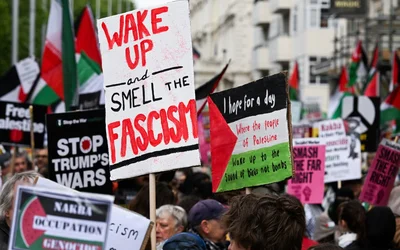
Yet Burnham - previously a supporter of Labour Friends of Israel as well as Labour Friends of Palestine, in typical fence-sitting style - still demurs from calling Israel’s genocide what it plainly is in spite of copious amounts of evidence, including both the endless images of mass murder and destruction live-streamed to the entire world, and also the unambiguous public statements of its own leaders.
The crux of the matter, then, is not whether Burnham would be more charismatic or electorally appealing than Starmer. He almost certainly would. But how far would he bring about tangible change, whether domestically or in the sphere of foreign policy?
There is a fine line between being a smart pragmatist, guided by a solid core of principles but prepared to adapt them to unfavourable circumstances, and a political weathervane. Even political weathervanes can sometimes do decent things at the margin; they are not, however, equipped to deliver any radical transformation of the balance of wealth and power in British society, or on the international stage.
Burnham’s track record is that of a skilled politician well attuned to shifts in the public mood, but one much less prepared for the battle that would ensue from any attempt to alter the deeper economic and political structures that create the social inequalities he laments.
The same flexibility that sometimes produces worthy policies - £2 bus fares in Greater Manchester, for instance - imposes limits on how far he is likely to go. The danger for Burnham’s supporters in the Labour Party is that, in their desperation to dig it out of its current hole, they confuse a change of personal style with a change in political substance.
The views expressed in this article belong to the author and do not necessarily reflect the editorial policy of Middle East Eye.
Middle East Eye delivers independent and unrivalled coverage and analysis of the Middle East, North Africa and beyond. To learn more about republishing this content and the associated fees, please fill out this form. More about MEE can be found here.