
UK Court of Appeal rules Palestine Action ban to be lawful

The Court of Appeal has overturned a High Court ruling and found the UK government’s ban on the direct action group Palestine Action to be lawful.
In February, the High Court found that then Home Secretary Yvette Cooper's decision to proscribe the group was "unlawful" and "discriminatory", following a challenge brought by the group's co-founder Huda Ammori.
It ruled that the ban constituted a breach of the European Convention of Human Rights as it entailed "a very significant" interference with rights to freedom of expression and peaceful assembly. It further held that the ban was not consistent with the home secretary's own policy.
The government immediately stated its intention to appeal the ruling, with Home Secretary Shabana Mahmood saying she was “disappointed” with the outcome, adding that the ban "followed a rigorous and evidence-based decision-making process".
The proscription, which made membership or support for the group punishable by up to 14 years in prison, has since remained in force pending the outcome of the appeal on Monday.
New MEE newsletter: Jerusalem Dispatch
Sign up to get the latest insights and analysis on Israel-Palestine, alongside Turkey Unpacked and other MEE newsletters
Despite noting the ban's potential "chilling effect" on people expressing opposition to the actions of Israel in Gaza, the five-strong panel of judges overturned the High Court's decision.
They ruled that the government's move to ban the group "struck a fair balance" between the individual's rights to speech and freedom of assembly and the interests of "national security".
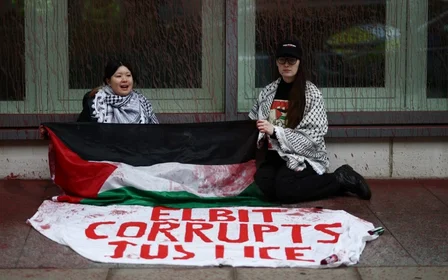
Reading the written ruling, Lady Chief Justice Sue Carr said that the proscription would “not prevent public expressions of support for the Palestinian cause or opposition to Israel and to the Israel Defence Forces, or demonstrations targeted at Elbit”, referring to Israel's largest weapons manufacturer.
'The state is trying to rewrite history and justify these attacks on our rights'
- Huda Ammori, Palestine Action co-founder
She added that the lower court had "materially understated" the home secretary's latitude to make proscription decisions, concluding she is "in the best position to assess... future threats and risks" posed by the group to "third party individuals and property".
The judgement concluded that the proscription decision was a "justified and proportionate interference with individual rights" and that it is a "fundamental mistake to overlook the fact that Palestine Action overtly promotes unlawful violence amounting to terrorism.
“It is not, as it claims, a direct action civil disobedience protest group like the suffragettes operating transparently in the open.
"It is a covert organisation that operates using secret cells to avoid the detection and prosecution of those using violence to destroy the property of third parties.
"Palestine Action’s activities have caused injury as well as property damage.”
The group's co-founder Huda Ammori told Middle East Eye that the ruling is "political", saying that the judges' reference to suffragettes as operating in the "open" shows "how the state is trying to rewrite history and justify these attacks on our rights".
'A tactic from... dictators and autocrats'
Ammori said in a statement following the ruling that she will "fight proscription all the way" to the Supreme Court and European Court of Human Rights in order to overturn “one of the most extreme attacks on free speech and the right to protest in modern British history”.
She added that the court's judgement recognised the ban as "highly controversial" and that there is "widespread support" for the group, but justified it on the grounds of "damage to the property of arms companies like Elbit Systems, whose weapons are being used to slaughter Palestinian people”.

“Throughout these proceedings, the government accepted that this proscription was based on property damage, not violence against people," she said.
Responding to the court's decision, Greenpeace UK's co-executive director Areeba Hamid said that "rebranding direct action as terrorism is a tactic from the playbook of dictators and autocrats".
Hamid noted that people holding placards in support of the group now represent "90 percent of terror-related arrests".
"How does that make our country safer?" she demanded.
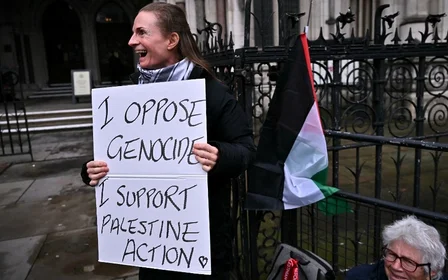
Outside the court, police began arresting people for holding signs that read: "I opposed genocide, I support Palestine Action," as hundreds gathered in defiance of the ban.
Since the ban was introduced, thousands of people have been arrested for terrorism offences for holding signs in support for the group in silent vigils across the UK.
According to the campaign group Defend Our Juries, around 700 people have been arrested for displaying support for the group since the ban was deemed to be unlawful. Some 3,400 people had been arrested by the time of the High Court ruling.
A 'company pursuing lawful business'
Former government lawyer, Tim Crosland, said that the court's judgement omitted the wider context of Israel's genocide in Gaza.
"We know the reason for Palestine Action's existence is stopping drones getting to the Israeli forces to be used to kill Palestinians in violation of international law," he told MEE.
"You would like to think a court of law such as this would consider that relevant, but obviously it does not," he said, adding that as a result, they will "really lose credibility for decent law abiding people".
In its written judgement, the court described Elbit Systems as a "company pursuing lawful business".
In July 2025, Nato suspended 13 contracts linked to Elbit Systems and banned it from procurement amid a wide rainging corruption probe.
'They acted like Elbit was Tesco'
- Huda Ammori, activist
Nato said the action was taken due to “serious allegations indicating that Elbit may have engaged in criminal practices, including irregularities in the awarding of contracts.”
"They acted like Elbit was Tesco," Ammori told MEE. "It is an insult to every single Palestinian Israel massacred in Gaza, every Palestinian who has lost their home, every health worker attacked because of Elbit's weapons.
"It is clear that Palestine Action aimed at shutting down the Israeli weapons industry, that is the opposite of terrorism," she said, "but it doesn't fit their narrative so they chose to omit it."
Saeed Farouky, a Defend Our Juries spokesperson, said the characterisation is "the biggest lie you have heard today".
"Elbit Systems is playing a central role in Israel's genocide," Farouky said.
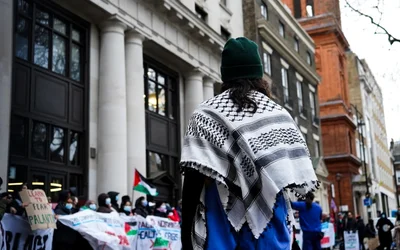
Addressing crowds outside the court, Crosland said: "This judgement is based on a completely false legal premise that Elbit Systems is a lawful business. These judges need to go back to law school."
He warned that the ban will nonetheless "fall" at the European Court of Human Rights, noting that UN rights chief Volker Turk had pronounced it "disproportionate and unnecessary".
A report by UN Special Rapporteur Francesca Albanese investigating the corporations profiting from Israel's genocide in Gaza alleged that Elbit has "cooperated closely on Israeli military operations" and embedded "key staff in the Ministry of Defence".
"International partnerships providing weaponry and technical support have enhanced Israeli capacity to perpetuate apartheid and, recently, to sustain its assault on Gaza," the report stated.
The judgement came after four Palestine Action activists were sentenced as terrorists by a judge at Woolwich Crown Court, who handed them custodial sentences ranging from four to eight years for a raid on an Elbit Systems factory in Filton, near Bristol, south-west England, in August 2024.
The unprecedented ruling came despite jurors convicting them of criminal charges not connected to terrorism.
Ammori noted the timing of the sentencing which was handed down just days before the Court of Appeal's ruling.
"In order to proscribe us they needed to accuse people of terrorism offences," she said.
"It was a complete set up from the start, orchestrated and manipulated in order to justify the ban. The Filton case has been caught up in a political agenda."
Middle East Eye delivers independent and unrivalled coverage and analysis of the Middle East, North Africa and beyond. To learn more about republishing this content and the associated fees, please fill out this form. More about MEE can be found here.