For Gaza’s Palestinians, Israel’s ever expanding ‘buffer zone’ means endless displacement

Jamal Abu Sukran, aged 32, and his three children have had little time to catch their breaths and thoughts following their latest displacement.
Their 25th displacement since the start of Israel’s genocide in Gaza in October 2023 followed Israel’s latest announcement of the expansion of its “yellow line” in June, which now encompasses 70 percent of the besieged Palestinian territory.
Despite an ostensible ceasefire in Gaza in place since October last year, Israel has slowly tightened its noose around the area’s 1.8 million remaining residents, packing them into a smaller and smaller area.
Abu Sukran first lost his home in the Shujaiya area in the east of Gaza City after it was destroyed in an Israeli air strike at the start of the war.
He immediately sought refuge in a tent nearby and since then has been repeatedly displaced, moving from one camp to another as Israeli offensives expanded.
New MEE newsletter: Jerusalem Dispatch
Sign up to get the latest insights and analysis on Israel-Palestine, alongside Turkey Unpacked and other MEE newsletters
His old home was located within the so-called “yellow line”, an area that Israel was expected to hold temporarily in the first stage of the ceasefire but has refused to relinquish, as it refuses to proceed with the second stage of the deal, which requires its withdrawal.
“Even after the ceasefire, the shooting and shelling never stopped,” Abu Sukran told Middle East Eye.
“Life [in the displaced camps] was unbearable. We used to wait for the gunfire to stop just to go to the toilet.”
The father-of-three says that gunfire usually begins in the morning, both by the Israeli army and the Palestinian gangs that serve as local collaborators.
In many cases, he said, displaced civilians were directly targeted.
Initially after the ceasefire he lived away from the yellow line, but eventually his temporary dwelling fell into what is called the "orange line" - territories that Israel expanded control into after the ceasefire.
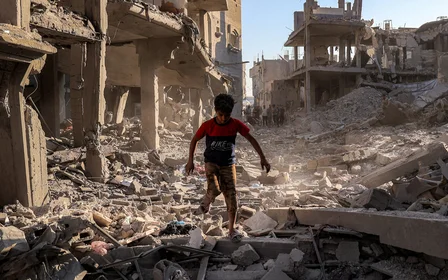
“It was terrifying,” he recalled. “There were random shootings, stray dogs, rats and shells everywhere. Nothing was left but rubble.”
Levelling to the ground
Elsewhere, 68-year-old Nabil Abu Armanah and his family had pitched a tent on the ruins of their second home after their first house in Rafah was destroyed by Israeli bombardment.
They were forced to flee once again because of persistent gunfire, Israeli military harassment and the advance of Israeli tanks, which had approached to within 700 metres of the yellow line.
When Abu Armanah recently returned to his home, he discovered that the newly expanded yellow line now ran directly through his land.
'I was hoping to return home soon, but now we are homeless. The land means everything to me'
- Nabil Abu Armanah, Palestinian in Gaza
“It’s extremely dangerous there now. Everything is gone. Nothing remains,” he said.
Israel appears to be following a policy of making land inside its yellow line permanently uninhabitable for Palestinian residents.
Since the ceasefire was signed in October, Israeli bulldozers have been hard at work reducing buildings to rubble, while demolition teams bring down larger structures.
Israeli ministers, such as Belazel Smotrich, have repeatedly announced their aim of levelling the Palestinian territory with the aim of encouraging Palestinians to “voluntarily” leave.
“I was hoping to return home soon, but now we are homeless. The land means everything to me.” Abu Armanah said.
“These are barbaric actions. We are innocent people. All we want is to live with dignity,” he added with a trembling voice.
“I have lived through countless Israeli wars, from the 1967 war until today. They have destroyed everything I built throughout my lifetime.”‘
A Pretext for reoccupation
Abdel Nasser Abu Aoun, a political analyst, told Middle East Eye that Israel is using the concept of the yellow line as a media narrative to justify the reoccupation of parts of Gaza.
It does this while implementing a scorched-earth policy aimed at depopulating areas, demolishing buildings and committing what he described as war crimes.

He said Israel has continually been expanding the yellow line and introduced what is now called the orange line to annex additional territory inside Gaza.
According to Abu Aoun, Israel has established military observation mounds over ancient Palestinian cemeteries.
From their tents, displaced Palestinians can see these positions overlooking the remains of their destroyed homes.
“This is one of Israel’s methods of psychological warfare,” he said, arguing that the objective is to punish Palestinians.
He added that Israel’s strategy appears aimed at forcing residents into the al-Mawasi area, despite the severe destruction of the remaining infrastructure there.
According to the analyst, the area cannot accommodate the growing number of displaced people, raising the prospect of long-term humanitarian and environmental collapse.
“Israel is proving to the world that it respects neither agreements, mediators nor international law,” he said. “It only understands the law of the jungle.”
Water and sanitation system devastated
Maher Salem, general director of planning and investment at Gaza municipality, said that around 35 percent of Gaza City's water sources have been lost because they fell within the yellow line and were subsequently destroyed.
He said Israel has reduced water supplies entering Gaza from 20,000 cubic metres per day to approximately 12,000 cubic metres.
The water is paid for by the Palestinian Authority, yet the reduction has created a severe shortage, leaving residents with an average daily share of only about 10 litres per person.
Salem also pointed to the destruction of the main desalination facility in the Sudaniya coastal area, which previously produced around 10,000 cubic metres of water per day.
Despite the harsh conditions imposed by the Israeli blockade, and daily strikes across the strip, Palestinians in Gaza are finding ways to watch the World Cup. pic.twitter.com/jDEyi5OlXd
— Middle East Eye (@MiddleEastEye) June 12, 2026
He also said approximately 150 kilometres of water infrastructure networks were destroyed by Israel during the war, alongside sewage pumps and sanitation infrastructure throughout Gaza City.
Israel has additionally prevented access to the Strip’s main landfill sites located near the border inside the yellow line, forcing municipalities to store waste within residential areas, according to Salem.
As a result, an estimated 400,000 cubic metres of garbage have accumulated inside Gaza City, creating what he described as a major environmental and public health crisis.
The United Nations Office for the Coordination of Humanitarian Affairs said in April that over 80 percent of more than 1,600 Gaza’s displacement camps reported frequent sightings of rodents and pests, triggering outbreaks of disease, with skin infections or rashes reported.
Middle East Eye delivers independent and unrivalled coverage and analysis of the Middle East, North Africa and beyond. To learn more about republishing this content and the associated fees, please fill out this form. More about MEE can be found here.