Even if Netanyahu is voted out, Israel's ethnic cleansing agenda will continue apace


Naftali Bennett, the former Israeli prime minister and aspirant for the top job in this year’s election, was upset.
He slammed Benjamin Netanyahu after the recent announcement of a deal between Tehran and Washington, arguing that the current prime minister had squandered a unique opportunity.
Bennett praised the “extraordinary performance” of the Israeli army and security forces on the front lines during the war with Iran, “and the courage of the Israeli public on the home front”.
But in the end, Bennett said, “the government is once again incapable of turning all of that into lasting security achievements”.
The political era of Netanyahu has been the longest in the country’s history. His vision for the occupied West Bank and Gaza has been to crush the ambitions of the Palestinian people, forcing them to accept second-class status in perpetuity.
New MEE newsletter: Jerusalem Dispatch
Sign up to get the latest insights and analysis on Israel-Palestine, alongside Turkey Unpacked and other MEE newsletters
He has long wanted a military campaign against Iran; former US Secretary of State Hillary Clinton confirmed that he had “obsessed” for decades about defanging Tehran and reshaping the Middle East, with Tel Aviv as the most dominant state.
In some ways, Netanyahu has succeeded on those terms. But Israel’s security environment remains precarious, and support for the country has collapsed globally.
It’s hard to make friends, apart from fascists and the far right, when millions of people have watched a live-streamed genocide in Gaza.
Status-quo politics
Some pro-Israel commentators fear that the US-Iran deal will ensure years of instability for Israel. One, Haviv Rettig Gur, writes with feigned hubris: “Dust off the nukes. Maybe test one somewhere far away from anywhere. Quadruple the interceptor production lines, double the size of the Mossad and the Air Force. And no, don’t let Hezbollah breathe, not for a second.
“It’s the 1960s again. And Israel will have to defeat a couple more enemies before it can once again eke out a few decades of peace.”
A more delusional post from another user suggests: “I think Israel should cut off America completely. No more intelligence sharing. No more technology sharing. Nothing. Clean break.”
Based on these bare facts, you could imagine any potential successor to Netanyahu wanting to envision a different future. But you’d be wrong.
Amid all of the political hot air, it's important to never forget the precarious situation for Palestinians in Palestine
The forthcoming Israeli election is still far too early to call, as political posturing continues, with few mainstream voices elucidating a coherent argument against maintaining the status quo - but the likely post-Netanyahu era, if indeed he loses, may look remarkably similar to today.
Yair Golan, the leader of the supposedly leftist Democrats party, seemingly has nothing to say about a different future for the country, beyond condemning Netanyahu for failing to destroy Hamas, Hezbollah and the Islamic Republic of Iran.
Bennett, meanwhile, recently gave an interview to the Israeli outlet Zman Yisrael, and his worldview was little more than reheated Netanyahuism. “Conflict management” was the kindest way to describe his views towards Palestinians, as if decades of occupation could simply be ignored with platitudes.
As a former director of the settler group Yesha Council, he’s hugely sympathetic to the Israeli settler movement, and at best may slightly rein in some of their most egregious and violent activities.
But there’s no pathway towards any kind of Palestinian independence or sovereignty. The ultimate goal, as succinctly explained by Haaretz journalist Amira Hass, is the full expulsion of Palestinians to Jordan, Lebanon and Syria. That’s the role of the “Jewish Ku Klux Klan”, she writes - and Bennett is fully onboard with their vision, even if he occasionally condemns the most extremist elements.
Extremely high stakes
Amid all of the political hot air, it’s important to never forget the precarious situation for Palestinians in Palestine. I recently visited the occupied West Bank and Israel, conducting research for my next book, and found Palestinians often scared, with no political leadership, and worried about displacement - or worse.
One day, I met the Makhmari family in the southern West Bank, with famed journalist Gideon Levy and photographer Alex Levac. The community of al-Mirkaz is incredibly remote, and it took us an hour to reach it by car on a rocky, hilly track from at-Tuwani in the area of Masafer Yatta.
Four farming families, about 40 residents, live there in caves, and they experience daily attacks and harassment from Israeli settlers who reside in nearby illegal outposts. I saw some of these long-haired extremists up close as they drove up to us, smiled, laughed and sped away.
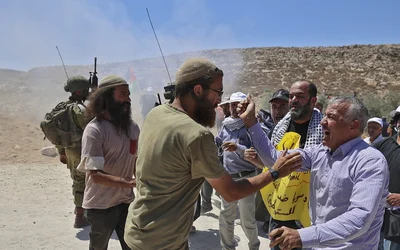
The Palestinian residents recounted, as we sipped piping hot tea, how settlers routinely come to beat their sheep, destroy property and warn them to leave. This violence started before 7 October 2023, but it has intensified dramatically since then.
One of their dogs was recently beaten by a settler, the abuse captured on a video that went viral in Israel - and as a result, there was rare Israeli concern towards the dog (but not the Palestinians). The Makhmari family was both pleased and mystified. They knew that their existence didn’t register in the mainstream Israeli consciousness.
The landscape is dry and arid, and water has to be trucked in at a substantial cost, often getting stopped by settlers. It was eerily peaceful when we arrived, guided by field researchers from the Israeli human rights group B’Tselem. Families here have set up cameras to alert them when settlers strike, but they are essentially unprotected and highly vulnerable.
Like so many Palestinian villagers in the last few years, they’re unlikely to be able to withstand extensive settler assaults, and may eventually be forced to leave.
This is happening across the occupied West Bank: a committed strategy to ethnically cleanse Palestinians from their land. The stakes couldn’t be higher in this accelerating catastrophe.
Will there be any Palestinians left in Palestine in the coming decades?
The views expressed in this article belong to the author and do not necessarily reflect the editorial policy of Middle East Eye.
Middle East Eye delivers independent and unrivalled coverage and analysis of the Middle East, North Africa and beyond. To learn more about republishing this content and the associated fees, please fill out this form. More about MEE can be found here.