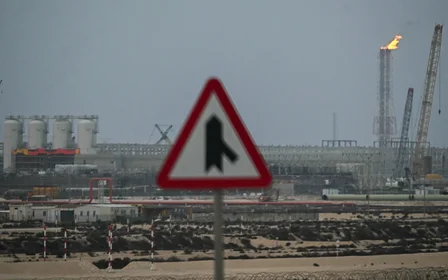
Qatar gas hub explosions kills 13 and injures 66

An explosion at Qatar’s main liquefied natural gas processing facility has killed 13 people and injured at least 66 others, Qatar's energy minister said on Monday.
The incident occurred on Sunday at Ras Laffan Industrial City, around 80km from Doha, in what was described by the interior ministry as a “technical accident” at the Barzan factory within the complex.
Saad al-Kaabi, the energy minister, said that the explosion was an accident and not caused by an aggression or sabotage.
He said that an investigation was under way to determine the cause of the blast, adding that it had not impacted Qatar's export capabilities.
The state-owned QatarEnergy, which administers Ras Laffan, said that emergency response teams had been immediately deployed after the explosion, and that a fire had been brought under control at Barzan factory.
New MEE newsletter: Jerusalem Dispatch
Sign up to get the latest insights and analysis on Israel-Palestine, alongside Turkey Unpacked and other MEE newsletters
Authorities said that there had not been any leakage from the facility, and there was no danger to public safety or the environment.
Ras Laffan spans 295 square kilometres - roughly a third of the size of New York City. It is the centrepiece of Qatar’s lucrative gas operation.
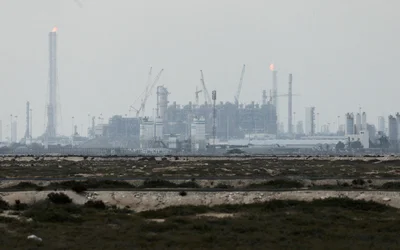
The site processes the Gulf state’s vast gas reserves from the offshore North Field, turning it into LNG, liquefied petroleum gas (LPG), liquid fuels, petrochemical feedstocks and other byproducts.
In March, Iranian missile strikes caused significant damage at the facility, as Tehran struck Gulf countries that host US bases in response to the US-Israeli war on Iran.
Strikes damaged two of Qatar’s 14 LNG trains and one of its two gas-to-liquid facilities, wiping out 17 percent of LNG export capacity.
The disruption was set to sideline 12.8 million tonnes of LNG annually for three to five years and cost $20bn in lost annual revenue, Saad al-Kaabi, chief executive of QatarEnergy, said at the time.
Almost all of the output from Ras Laffan is transported via the Strait of Hormuz, the narrow waterway between Iran and Oman’s Musandam peninsula that Tehran has effectively shut in response to the US-Israeli war.
The combination of the attacks on Ras Laffan and the closure of the Strait of Hormuz stifled Qatar’s main export.
Middle East Eye delivers independent and unrivalled coverage and analysis of the Middle East, North Africa and beyond. To learn more about republishing this content and the associated fees, please fill out this form. More about MEE can be found here.