Sanctioned ICC judges sue Trump in US over 'attack on judicial independence'

A federal court in New York has summoned US President Donald Trump to respond to a lawsuit brought by three sitting judges of the International Criminal Court (ICC), who accuse his administration of punishing them with sweeping sanctions for their work on investigations involving Israel and the United States.
The summons, issued on Thursday by the US District Court for the Southern District of New York, requires the government to respond within 60 days to a complaint filed a day earlier by judges Kimberly Prost of Canada, Solomy Balungi Bossa of Uganda and Reine Alapini-Gansou of Benin.
The case names Trump as the lead defendant, along with Secretary of State Marco Rubio, Treasury Secretary Scott Bessent, and Acting Attorney General Todd Blanche.
It also names the Treasury's Office of Foreign Assets Control, which maintains the sanctions list, and its director, Bradley Smith.
It is the first time that ICC judges have personally gone to court to challenge their designation under Executive Order 14203, which Trump signed on 6 February 2025.
New MEE newsletter: Jerusalem Dispatch
Sign up to get the latest insights and analysis on Israel-Palestine, alongside Turkey Unpacked and other MEE newsletters
The order declared a national emergency over the court's investigations into US and Israeli nationals and authorised asset freezes and travel restrictions against foreign officials who take part in or support them.
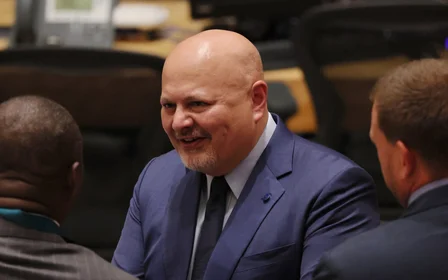
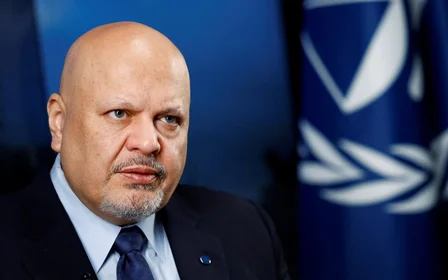
The three judges are among eight on the court who have been sanctioned, alongside ICC prosecutor Karim Khan, his two deputies, the United Nations special rapporteur for the occupied Palestinian territories and three Palestinian human rights organisations.
Each of the three has served on judicial panels dealing with alleged crimes in Afghanistan (in the cases of Prost and Bossa) or in Palestine (in the case of Alapini-Gansou).
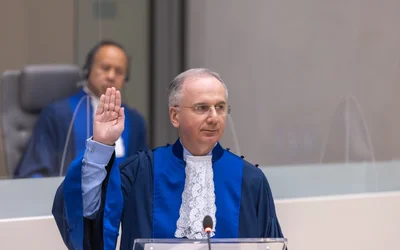
James Goldston, executive director of the Open Society Justice Initiative and co-counsel for Prost, said the sanctions were "an unprecedented attack on judicial independence and the rule of law".
He said the measures had inflicted concrete and severe harm on judges who had done nothing other than carry out their duties.
The complaint describes the sanctions as "tantamount to the financial death penalty."
Prost has had her US bank account frozen, can no longer use credit cards, and has seen her accounts with American companies such as Amazon, Google and Expedia limited or cancelled, Goldston told Middle East Eye.
She has also effectively lost access to health insurance after her provider refused to pay out medical claims and other insurers declined to cover her.
Before joining the ICC in 2018, Prost served as a prosecutor at Canada's Department of Justice and as ombudsperson for the UN Security Council's al-Qaeda sanctions committee, overseeing the kind of measures now being used against her.
"She knows a great deal about sanctions, and in some ways it is rather extraordinary that she is now being subjected to these severe sanctions, really solely for undertaking her job as a judge seriously and professionally," Goldston said.
What are the judges' arguments?
The lawsuit sets out three core arguments for why the sanctions should be struck down.
The first is that the order exceeds the authority Congress delegated to the president under the International Emergency Economic Powers Act (IEEPA), the statute Trump invoked to impose the measures.
'The sanctions seek to compel these judges to refrain from their sworn oath, to decide cases on the basis of an impartial assessment of the facts and the law'
- James Goldston, Prost's co-counsel
The judges contend the sanctions conflict with another act of Congress, the American Service-Members' Protection Act (ASPA), passed in 2002 to address the prospect that the court could investigate US nationals or those of allied states outside the Rome Statute.
ASPA permits the president to respond to such a scenario only in narrow ways, by providing legal representation, presenting exculpatory evidence or defending US interests before the court. It does not authorise sanctions, Goldston explained.
Even in the extreme case of an American being detained by the ICC, he said the law expressly bars the executive from using "inducements" to sway the court's decisions.
The sanctions are precisely that, Goldston argued.
"They are trying to induce judges to refrain from deciding on the basis of facts and law, and instead take into account their own personal interests, that is, the threats to their own financial and personal well-being imposed by these sanctions."
The plaintiffs also dispute that any genuine emergency exists.
Goldston said the IEEPA may be used only against an "unusual and extraordinary" threat, but Washington's objection to the court's jurisdiction over non-party nationals is decades old.
President Bill Clinton raised the same concern when he signed the Rome Statute in 2000, and, in January, a US official at the UN stated that none of the concerns was new and that Washington had been making the same point for nearly three decades.
Both Afghanistan and Palestine are ICC member states, and the Rome Statute has long allowed the court to act over crimes on a member's territory regardless of the perpetrator's nationality.
The second argument is that freezing the US-based assets of Prost and Bossa breaches the Fifth Amendment in two ways: depriving them of property without due process and taking private property without compensation.

The third is that the designations violate the Administrative Procedure Act because they are "arbitrary, capricious and an abuse of discretion".
The complaint says the administration has produced no specific evidence to justify them and failed to weigh the damage to international accountability efforts, including ICC investigations the US itself supports, such as those in Sudan, Libya and Ukraine.
Goldston said underlying all three is an attempt to make judges weigh their own welfare against their oath of office.
"The sanctions seek to compel these judges to refrain from their sworn oath, to decide cases on the basis of an impartial assessment of the facts and the law," he said.
"That is a fundamental threat to the rule of law."
Middle East Eye delivers independent and unrivalled coverage and analysis of the Middle East, North Africa and beyond. To learn more about republishing this content and the associated fees, please fill out this form. More about MEE can be found here.