
Why Britain must sanction Netanyahu


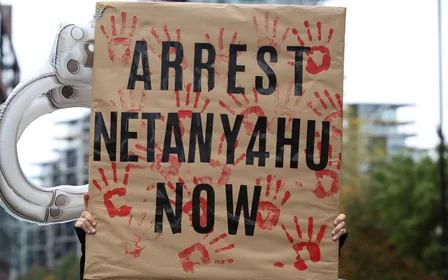
Last week, a group of British MPs despatched an open letter to Foreign Secretary Yvette Cooper calling for sanctions on Israeli Prime Minister Benjamin Netanyahu.
The case is clear cut. For nearly three years, Netanyahu has presided over what most experts, including the United Nations, describe as a genocide in Gaza.
This year alone, he’s launched an illegal war on Iran, while killing more than 4,000 people in Lebanon and displacing hundreds of thousands of others.
Netanyahu has also given licence to Israeli settler gangs to rampage across the occupied West Bank, in a terrifying campaign of ethnic cleansing.
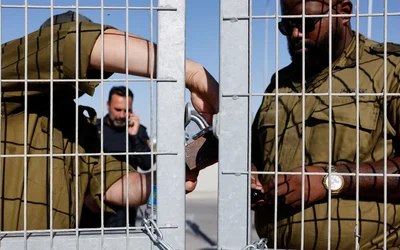
The primary focus of the MPs’ letter, however, concerns none of the above. They concentrate on the horrifying treatment of Palestinians in Israeli prisons.
New MEE newsletter: Jerusalem Dispatch
Sign up to get the latest insights and analysis on Israel-Palestine, alongside Turkey Unpacked and other MEE newsletters
The letter cites a February UN report, which found that “torture has become integral to the domination of and punishment inflicted on [Palestinian] men, women and children, both through custodial abuse and through a relentless campaign of forced displacement, mass killings, deprivation and the destruction of all means of life”.
Needless to say, the letter has been all but ignored in mainstream British media. That does not mean it is not pregnant with consequences.
Burnham's biggest incentive
We can expect dramatic changes in British policy towards Israel and Palestine with Andy Burnham, the presumed next prime minister, in 10 Downing Street.
There are many reasons why policy will change, and charge fast - but above all else, Burnham’s biggest incentive is naked self-preservation.
Remember this: Prime Minister Keir Starmer leaves 10 Downing Street haunted by the possibility that his reputation will be destroyed forever if and when the International Court of Justice (ICJ) adjudicates that Israel committed genocide in Gaza.
It turns the rule of law into a buffet, where we can pick and choose what rules to apply, according to our relationship with the delinquent state
It would be foolish and presumptuous to second-guess the decision of the court, but chances are that the ICJ will come down against Israel.
As I demonstrated in a previous article for Middle East Eye, the defence against genocide charges put up by Israel’s lawyers at the ICJ in January 2024 has already disintegrated.
If the court decision does go badly for Israel, it will also be a disaster for Israel’s close ally Britain - and in particular, for Starmer.
Crucially, the facilitation of genocide is an offence not just under international law, but also under British domestic law. Section 52 of the International Criminal Court Act 2001 prohibits conduct ancillary to genocide, crimes against humanity and war crimes.
Under the Starmer premiership, Britain has sold arms to Israel, and supplied diplomatic protection and aerial surveillance. This military and diplomatic alliance explains why the Starmer government never once accused Israel of war crimes.
If the ICJ rules against Israel, lawyers will find it easy to construct a prima facie case that Starmer aided and abetted a genocide.
Cost-free change
As I explained in my book Complicit: Britain’s Role in the Destruction of Gaza, the same consideration applies to former Prime Minister Rishi Sunak and certain other ministers, both Conservative and Labour.
Burnham, in sharp contrast, enters office with clean hands. He has been innocently running Manchester and carries no responsibility for any of the foreign policy decisions of the outgoing Starmer administration.
He has political and personal reasons for wanting to keep it that way.
Starmer split the Labour Party, driving millions of traditional Labour voters into the arms of the Greens. Burnham must win some of them back if he is to have a chance of winning the next general election.
Changing Britain’s policy towards Israel will bring condemnation from Israel, its friends and allies, and the United States.
Crucially, however, there are no implications for the national budget. Most of the decisions Burnham faces in office involve agonising fiscal choices: spending more on defence, for example, means less money for welfare.
The Treasury won’t blink if he shifts the dial on Israel.
If he is wise, Burnham will order an urgent review of British security and military cooperation with Israel, in light of the fact that so many legal experts today maintain that Israel is committing genocide.
Burnham will also be well-advised to consider sanctioning Netanyahu. It is actually puzzling that this has not happened earlier.
As last week’s letter to the foreign secretary points out, “the government has yet to sanction members of the Israeli government for the systematic torture and ill-treatment of Palestinian detainees, including children”.
The letter goes on to note that Netanyahu, as the prime minister of Israel, is ultimately responsible for these grave crimes.
Mockery of justice
Thus far, however, the only Israeli ministers sanctioned by Britain are Netanyahu’s subordinates, National Security Minister Itamar Ben Gvir and Finance Minister Bezalel Smotrich.
Is it not strange that the inferiors are sanctioned, but not the superior? Would it have made sense to sanction Russian President Vladimir Putin’s ministers, but not Putin himself, after the invasion of Ukraine?
It is this inconsistency which makes the Starmer government’s approach to sanctions hard to understand.
Remember that Netanyahu has had an International Criminal Court (ICC) warrant out for his arrest since November 2024. Britain is a party to the Rome Statute and formally recognises the ICC’s jurisdiction.
All 125 states that are parties to the Rome Statute are required by law to arrest and transfer to the ICC any suspect who sets foot in their countries, and to cooperate fully with the court.
Yet after almost two years of Netanyahu being an international fugitive from justice, Britain has refused to punish him with sanctions - even though our government had no trouble sanctioning Putin and his foreign minister, Sergey Lavrov, within days of the invasion of Ukraine.
This is a mockery of justice. It turns the rule of law into a buffet, where we can pick and choose what rules to apply, according to our relationship with the delinquent state.
The views expressed in this article belong to the author and do not necessarily reflect the editorial policy of Middle East Eye.
Middle East Eye delivers independent and unrivalled coverage and analysis of the Middle East, North Africa and beyond. To learn more about republishing this content and the associated fees, please fill out this form. More about MEE can be found here.