
‘We just disappeared’: Palestine Action defendant recalls ‘horrifying’ arrest

A defendant facing charges in connection with a Palestine Action raid on an Israeli arms factory said that she and her co-defendants “still have PTSD”, following their arrests by counter-terrorism police.
Hannah Davidson, 53, along with her co-defendants Ian Sanders, 47; Aleksandra Herbich, 41; Teuta Hoxha, 30; Sean Middlebrough, 33; Julia Brigadirova, 33; and Madeleine Norman, 31, face charges of violent disorder and criminal damage in connection with a break-in to an Elbit Systems plant in Filton, near Bristol, in August 2024.
On Monday, William Plastow, 35, was acquitted of violent disorder by the presiding judge, Patrick Field, who concluded that the prosecution had not produced enough evidence against him. He continues to face criminal damage charges.
The eight defendants are accused of coordinating the break-in by carrying out reconnaissance and purchasing equipment, but are not alleged to have gone into the factory premises during the raid.
They are being charged under ‘joint enterprise’, meaning that, while they are not alleged to have committed the offences themselves, they are facing the same allegations as the defendants who broke into the site.
New MEE newsletter: Jerusalem Dispatch
Sign up to get the latest insights and analysis on Israel-Palestine, alongside Turkey Unpacked and other MEE newsletters
All eight defendants deny the charges.
Giving evidence at the Old Bailey on Thursday and Friday, Davidson wept as she recalled how, following her arrest on 7 August from her home in Edinburgh, the day after the raid, she was transferred to a counter-terrorism unit in Newbury, where she “just disappeared” and was held “four to six days without any contact”.
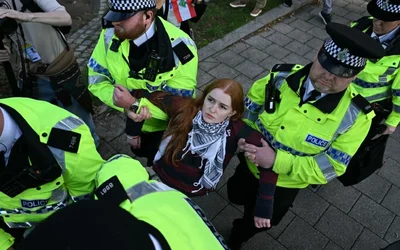
“They didn’t call a lawyer for me. I think we all just have really chronic PTSD about that period. We just disappeared,” she told the court, weeping.
“We didn’t know what had happened. We couldn’t have known that that would be the response to the situation. It was just horrifying.”
Davidson initially told jurors that she didn’t see a lawyer until the fourth day of her detention.
But when cross-examined by prosecutor Deanna Heer, who pointed out that Davidson had spoken to a lawyer 31.5 hours after her arrest on 8 August, she acknowledged that her “perception was skewed”.
Heer then asked her if she had decided to give a no comment interview in order to “wait to see what the police would come up with”. Davidson responded that she “wasn’t in a mental state to decide very much” and that she was having an “autistic meltdown” and finding it hard to breathe at the time.
She denied her involvement in coordinating the raid.
‘I felt completely helpless’
Davidson recalled growing up on a “pretty rough” council estate in west London.
“I struggled a lot. With the school environment, with other children, just with life really,” she said.
She left school at the age of 12 and subsisted on odd jobs like babysitting and car washing before learning to ride horses and finding work with the Metropolitan Police and a charity that provides riding lessons to vulnerable people.
She said that during the Covid-19 pandemic in 2019-2020, her work with horses dried up, and she lost her flat. She moved to Edinburgh and managed to relaunch her career as an artist.
“In the latter half of 2023, I felt I’d recovered and was proud of myself,” she told jurors.
“But come October, I find I’m watching a live-streamed genocide on my phone,” she said, describing the experience of watching videos of Israel’s assault on Gaza on social media platforms as “completely devastating”.
'It just made me realise that all of this letter writing was not going to work, it wasn’t going to happen'
- Hannah Davidson, defendant
“I remember seeing mothers scrape up their children, and a stray dog with a toddler’s arm in its mouth,” she said.
She couldn’t function, she told the court, and was forced to hand in her notice at a storage unit job, as she was “in tears for hours and hours a day”.
Davidson turned to volunteering with a local group called the Gaza Genocide Emergency Committee, which involved letter writing to government ministers and lobbying her local council to divest from Israel.
The turning point came in February 2024, when British Prime Minister Keir Starmer ordered his MPs to vote against a motion tabled by the Scottish National Party (SNP) calling for a ceasefire in Gaza.
“I felt completely helpless,” Davidson told the court. “It just made me realise that all of this letter writing was not going to work, it wasn’t going to happen.”
The court heard that Davidson subsequently signed up for and attended a Palestine Action training day in Edinburgh in April 2024.
Barrister Hamish McCallum, who represents Davidson, noted that following the training day, she was involved in a few other actions which don’t relate to the Filton raid.
Davidson said that around June and July 2024, she received a call from Palestine Action asking whether she would like to be involved and, if so, in what capacity.
“I didn’t feel confident to start trying to coordinate any actions,” Davidson told the court, saying that she preferred to remain “behind the scenes”.
Davidson said she had attended a meeting in Manchester on 29 July 2024, relating to various actions, including the planned Filton raid.
When McCallum asked whether, at that stage, she had intended to be involved in the action, she responded, no, as she assumed it would take place in the future.
‘Desperate, sad, angry’
Days before the raid on 6 August, someone in a Palestine Action chat group said they were short of a driver for the planned action at Filton.
“I thought I’d be running errands for the weekend, helping people with whatever they needed help with.”
She said that, at that stage, she did not know much about the plan. Once she agreed to be a driver, she was given access to planning documents, but she only read in detail the ones pertaining to her role.
When asked by McCallum if she anticipated that the raid would involve causing criminal damage, she responded: “Yes, there was no secret about that.”
She told the court that at the time, she felt “desperate, sad, angry, wanting to help”.
On 4 August, Davidson drove with her co-defendant Maddie Norman to the "safe house", an Airbnb rental in Bristol. She recalled that there were around 20 other people there, but that she only knew a couple of them.
“As an autistic person who doesn’t like crowds, it was a bit of an issue for me,” she told the court.
When asked by McCallum if she understood the roles of the red team- the group of activists who broke into the factory itself - and the black team, whose purpose was to distract any security guards present at the site, Davidson said that the black team’s role was to fire “smoke and fireworks in the air and stand in a line so that the van could drive and crash in without security approaching”.
“My understanding…was that security would be unlikely to approach,” Davidson said.
She said she had limited interaction with members of the black team and that she was not privy to any discussions about their role.
When asked by Heer whether she recalled seeing a document drawn up in preparation for the raid detailing a kit list that included kebab skewers and whips, Davidson said the spreadsheet “wasn’t populated” at the time.
“If I had seen that I would have raised it, or I wouldn’t have gone,” she said.
Heer said that Davidson knew before setting off to Bristol that she “would be involved in an action breaking into a factory, causing as much damage as possible”.
“Were you not concerned to understand precisely how that was going to happen?” Heer asked.
“Not beyond that there is a red team going in and a black team,” Davidson responded. “It sounds terribly naive considering the trouble we’re in now, which I could not have foreseen.”
Heer suggested that Davidson was sent the preparation documents “in the form that we see them… because you were involved not just as a driver, but in the planning of this incident”.
Davidson denied the allegation.
‘The straw that broke the camel’s back’
Taking the witness stand on Friday, defendant Teuta Hoxha asked to sit as her “legs felt like jelly”.
When questioned by her legal representative, barrister Raj Chada, Hoxha told the court that prior to her involvement with Palestine Action, she wrote to the Home Office, Foreign Office, and her local mosques, as well as setting up fundraising stalls to support Palestinians in Gaza in the aftermath of 7 October 2023.
“I felt I was raising money for people who were going to be killed anyway,” she said.
The court heard that Hoxha joined a Palestine Action training day after she saw a video on social media of a Palestinian man in Gaza holding his children’s dismembered bodies in plastic bags.
She wept as she recounted the experience, describing it as the “straw that broke the camel’s back”.
Hoxha told jurors that on the training day, she learned that Elbit Systems “isn’t an Israeli-linked but Israeli-owned weapons supplier”.
When asked by Chada if she understood Palestine Action would “act violently against individuals”, she responded, “I did not”.

The court heard that, prior to the Filton action, Hoxha had participated in a number of actions coordinated by Palestine Action involving "lock-ons" - a non-violent direct action tactic where protesters physically attach themselves to other people, buildings, objects, or the ground.
The prosecution accuses Hoxha of organising the Filton action, as she is said to have conducted reconnaissance of the Filton site ahead of the raid. While Hoxha admits she performed reconnaissance prior to the action, she denies knowing they were specifically related to the Filton action and that she had a hand in coordinating the raid.
She told the court that she joined a Palestine Action "recce" Signal group, as “there was an escalation in the genocide” and that she felt like she “wasn’t doing enough”.
She described the chat as a "general group" for actionists willing to conduct recces for multiple actions and sites around the UK.
She told Chada that any recces she conducted “would be used for a number of actions”.
Between 29th July and 2 August, Hoxha said she received a call asking whether she could help manage GoPro cameras for an action.
When asked by Chada if she knew at this stage that the request related to Filton and the recce she had done of the site, she responded “No”.
Hoxha said she travelled to the Airbnb in Bristol on 5 August, where her primary role was managing the GoPro cameras deployed in the action. She described the process as “ very labourious” and involved “charging phones and GoPros, setting each phone up with SIM cards”, as well as ensuring they were set up with the relevant applications.
When asked by Chada what she understood the purpose of the GoPros to be, she said to “publicise direct action” and to “capture Israeli drones”.
The trial continues.
Middle East Eye delivers independent and unrivalled coverage and analysis of the Middle East, North Africa and beyond. To learn more about republishing this content and the associated fees, please fill out this form. More about MEE can be found here.