Former EU top diplomat denounces ICC bureau’s disregard for judicial findings on Karim Khan

Josep Borrell, the former EU foreign policy chief, has denounced the bureau of the International Criminal Court (ICC) for holding a "political vote" to remove Prosecutor Karim Khan instead of upholding judicial findings that cleared him of wrongdoing.
The Assembly of States Parties (ASP) to the Rome Statute, which comprises diplomatic representatives from the court’s 125 member states, is due to vote on Khan’s future at the United Nations headquarters in New York City on 24 July.
The vote comes after the ASP’s executive bureau, a body of diplomats from 21 member states, determined by a two-thirds majority last month that Khan had committed "serious misconduct".
This was despite a judicial panel, appointed by the bureau to review the findings of a UN investigation into complaints against Khan, concluding that the evidence against him was insufficient to establish any level of misconduct.
Khan has strenuously denied any misconduct or breach of duty.
New MEE newsletter: Jerusalem Dispatch
Sign up to get the latest insights and analysis on Israel-Palestine, alongside Turkey Unpacked and other MEE newsletters
Borrell argued that the Khan case is "part of a larger offensive against the ICC", citing the US sanctions and threats targeting Khan and other officials following his decision to seek arrest warrants for Israeli and Hamas leaders in May 2024.
"One need not believe in conspiracies to see the confluence of interests between US and Israeli leaders," he wrote. "The Trump administration and Netanyahu want the same thing: to ensure that no international court can touch soldiers, border agents, or its chosen allies, no matter how serious the allegations of war crimes and crimes against humanity. Both see the "Khan scandal" as the perfect occasion to defang the court.
"They do not need to destroy it from the outside if its own member states can hollow it out from within, ignoring a judicial finding to hold a political vote against the man who signed the warrants that most inconvenienced them."
Vote process under scrutiny
Borrell noted that, as exclusively reported by Middle East Eye, the ASP bureau had amended the process for voting on Khan’s removal from a two-stage procedure to a single vote, in an apparent break with its own rules.
He also said the bureau’s conclusion that the prosecutor engaged in serious misconduct was based on a new allegation denied by both the complainant and prosecutor.
Under the court’s own rules, the ASP is responsible for making a final determination on the allegations of misconduct and deciding whether to remove the prosecutor from office.
Any finding of misconduct would require the approval of a two-thirds majority of the states present and voting.
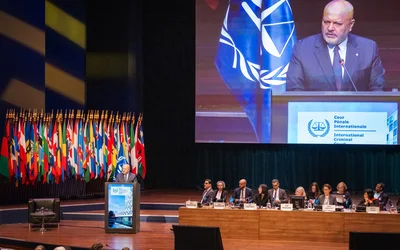
If the ASP found that Khan had committed serious misconduct, it would then hold a second vote on whether to remove him.
That vote would require an absolute majority of the 125-member ASP, or 63 votes, under Article 46 of the Rome Statute.
The bureau’s March procedures paper, seen by MEE, reflects these court rules and outlines the process that should follow the bureau’s decision.
However, the bureau has decided to merge the two votes into a single one, requiring an absolute majority to remove the prosecutor.
A confidential bureau decision dated 8 June and seen by MEE states that the bureau found "the evidence establishes beyond reasonable doubt" that Khan "engaged in a sexual relationship" with the complainant. It argued that "in the context of that power imbalance a sexual relationship could never be appropriate".
Khan denied that any sexual relationship had taken place, while the complainant’s account centred on allegations of non-consensual conduct.
The bureau’s decision appeared to reframe the nature of the misconduct, in an apparent departure from the sexual assault allegations that have been the centrepiece of the investigation as well as media leaks about the case.
"This is no mere formality. Folding the second question into the first - which, again, has not been proven - enables removal based on an unsubstantiated accusation, or on a different issue altogether (such as engaging in a consensual intimate relationship from a position of authority - something that no one ever alleged)," Borrell wrote.
'Brick by brick'
Borrell traced the case against Khan to April 2024, when a group of US senators "warned, in fact, threatened" the prosecutor that seeking an arrest warrant for Israeli Prime Minister Benjamin Netanyahu would make him "a target himself".
Khan pressed ahead, filing applications for arrest warrants against Netanyahu, former Israeli Defence Minister Yoav Gallant and three Hamas officials. He had previously sought and secured warrants against Russian President Vladimir Putin, former Philippine President Rodrigo Duterte and Taliban leaders, noted Borrell.
"Khan has shown the courage and fortitude to seek arrest warrants for suspects who would have been considered untouchable in the court's earlier years," he said. "At a time when international criminal justice and the rule of law face a full-scale frontal assault, not least from indicted war criminals, he deserves the world's recognition and support."
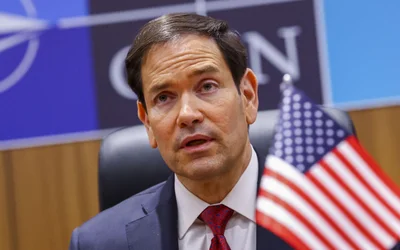
The former EU diplomat criticised a recent Wall Street Journal article by US Secretary of State Marco Rubio, in which he announced the administration's intention to dismantle the ICC “brick by brick”, noting that Washington had already sanctioned 11 senior ICC officials, including Khan, two deputy prosecutors and eight judges.
Citing reporting by The Financial Times, Borrell also said Trump had suggested during a May meeting with Chinese President Xi Jinping that China and Russia, neither of which is a party to the Rome Statute, join Washington’s campaign against the court.
Borrell said the proposal undermined Rubio's claims that the campaign was intended to defend national sovereignty.
"That America's chosen partners in this crusade are precisely the two countries with the greatest reason to fear the Court says more about the real purpose of the operation against Khan than any communique about sovereignty," he wrote.
Middle East Eye delivers independent and unrivalled coverage and analysis of the Middle East, North Africa and beyond. To learn more about republishing this content and the associated fees, please fill out this form. More about MEE can be found here.