The next UN secretary-general: Who would want ‘the most impossible job on earth’?

In April 1953, Norwegian UN secretary-general Trygve Lie was at New York’s Idlewild Airport to meet his successor. "Welcome, Dag Hammarskjold, to the most impossible job on this earth," he greeted the Swedish diplomat.
Seven decades later, the UN is about to choose the successor to incumbent secretary-general Antonio Guterres, for what many regard as one of the trickiest roles on the world stage. Each term lasts five years, usually renewable for a second term.
The next holder of the post is expected to come from Latin America, given how the post rotates between continents (the last was Peru’s Javier Perez de Cuellar, who left office in 1992). There is also a long-standing, informal push for the UN to appoint a woman for the first time in its 80-year history.
Whoever wins takes on an organisation under strain from multiple directions. Washington, the UN’s biggest contributor, has cut voluntary funding and withdrawn from the World Health Organisation (WHO). Elsewhere, worsening financial pressures, and unpaid member state contributions have deepened the ongoing liquidity crisis.
Under Guterres, the UN Security Council has been unable to halt or prevent genocides in Gaza and Sudan, or Russia’s war on Ukraine. Furthermore, the US has committed what many regard as breaches of the charter, including abducting and detaining Venezuelan President Nicolas Maduro, and its joint war with Israel on Iran.
New MEE newsletter: Jerusalem Dispatch
Sign up to get the latest insights and analysis on Israel-Palestine, alongside Turkey Unpacked and other MEE newsletters
The eight candidates each have their own agenda, but common issues have emerged, including the UN being more proactive to prevent potential crises emerging; the need to be a more streamlined organisation; reducing overlapping functions; allowing smaller nations more opportunity to shake off their debt burdens; and the impact of AI and other technologies on the world.
Discussions and lobbying will continue ahead of the UN General Assembly (UNGA), which begins later this month and the appointment of the next UN secretary general, who will take office on 1 January.
How does the UN election work?
The process began in late November 2025, when the UN General Assembly and Security Council presidents formally invited nominations and candidates began declaring their intentions.
Under the UN Charter, the 15-member Security Council formally recommends a candidate to the 193-member General Assembly for discussion and ratification - but usually it's just to rubber-stamp.
The focus of the contest is on the council, where a successful candidate first needs backing from nine of the 15 members, including, crucially, no opposition from the five veto-wielding permanent members – the US, UK, France, Russia and China.
The council starts by running anonymous, informal and non-binding "straw polls" to gauge what its members think. In these polls, ambassadors privately mark a ballot for each hopeful, ranging from "encourage" (positive) through "no opinion" (neutral) to "discourage" (negative).
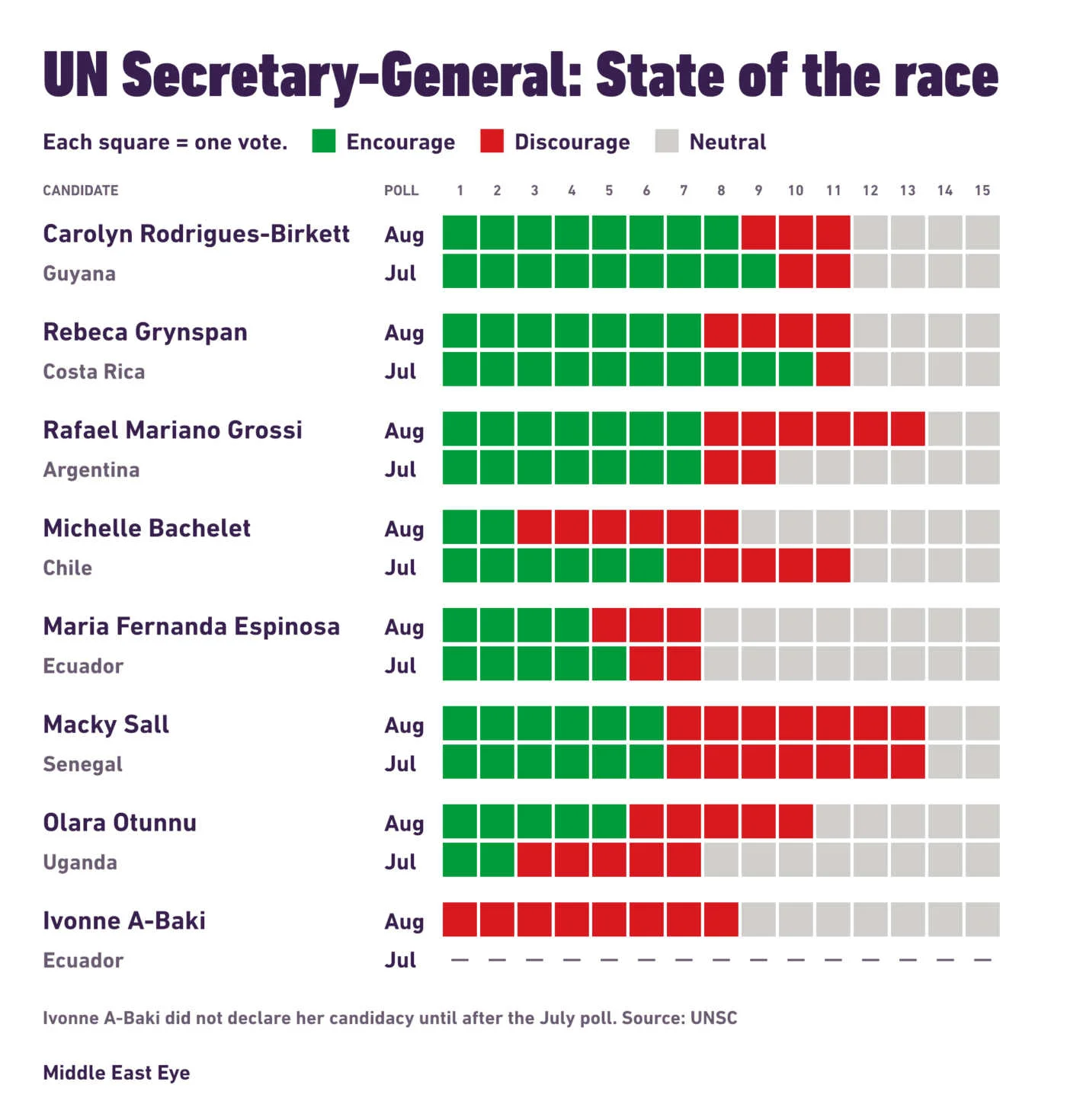
At first, all members use identical, unmarked ballot papers. If a clear frontrunner fails to emerge after a few polls, permanent members use different-coloured paper from the 10 elected members, allowing the council to see whether a veto holder objects to a specific candidate, without knowing which country. Such discouragement effectively ends a hopeful's chances.
During the current election, there have been two straw polls: colour-coded ballots are anticipated but haven't been used yet.
At the time of publication, Carolyn Rodrigues-Birkett from Guyana has edged ahead after the second straw poll, ahead of Costa Rica's Rebeca Grynspan and Rafael Mariano Grossi of Argentina.
Carolyn Rodrigues-Birkett (Guyana)
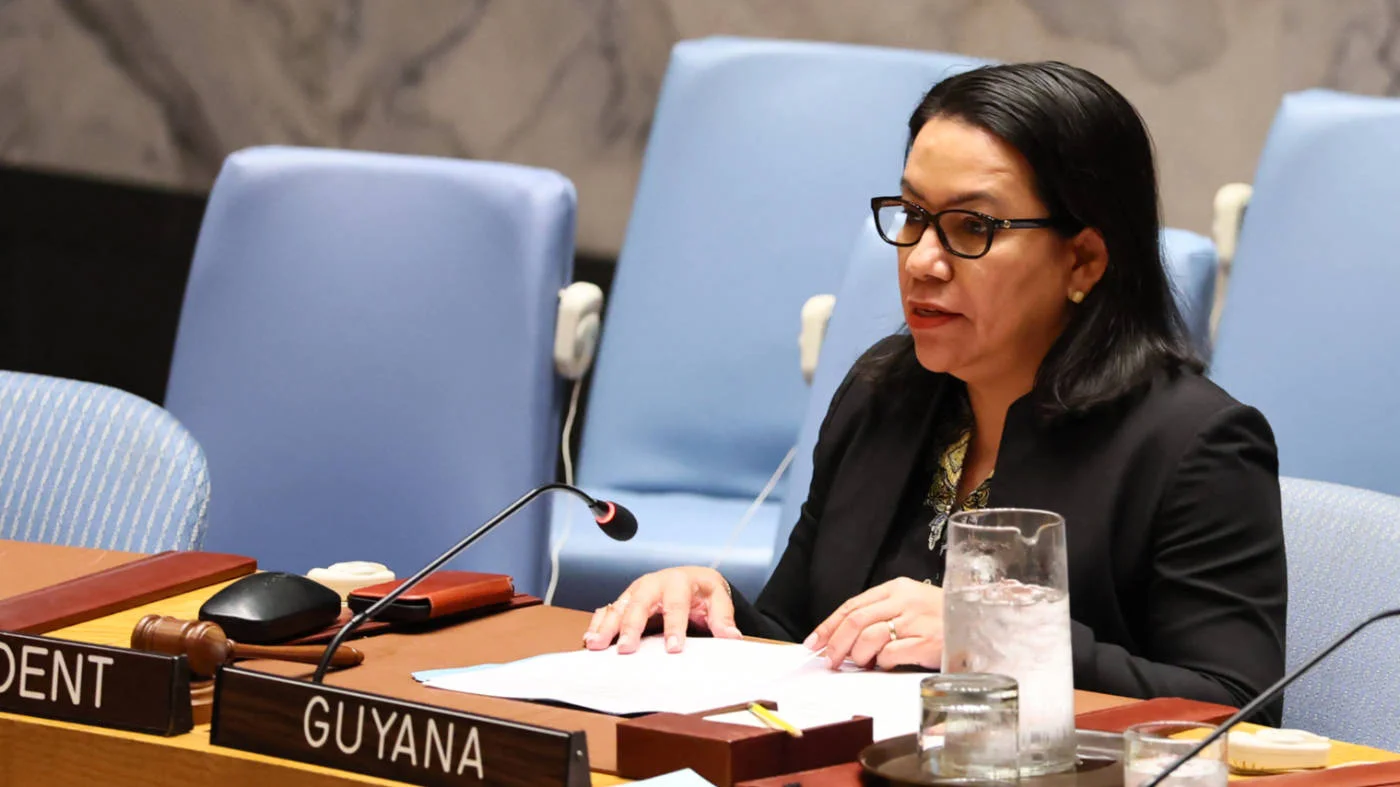

Who is she? Carolyn Rodrigues-Birkett, Guyana's ambassador to the UN and a former government minister for foreign affairs and indigenous affairs, represented her country on the UNSC in 2024–2025. Nominated by Guyana, the Caribbean Community (Caricom) formally endorsed her in July.
What's her platform? In Rodrigues-Birkett's official vision statement, she has presented herself as a "principled, pragmatic" candidate for small states, committed to treating the UN's peace and security, development, and human rights responsibilities with equal weight.
On peace and security, she has said she would be a secretary-general willing to use the "good offices" of her role more actively, invoking Article 99 of the UN Charter to bring threats to international peace and security before the Security Council.
Rodrigues-Birkett has also flagged that only 18 percent of UN Sustainable Development Goal targets are on track and has called for reform of international finance rules alongside deeper private sector partnerships. She has backed the secretariat's ongoing UN80 efficiency drive, but warned against cuts that might hollow out services on the ground for vulnerable populations.
What are her chances? Rodrigues-Birkett is the current favourite and leads the council's straw polling, topping the August round with eight "encourage" votes against three "discourage" and four "no opinion".
Rebeca Grynspan (Costa Rica)
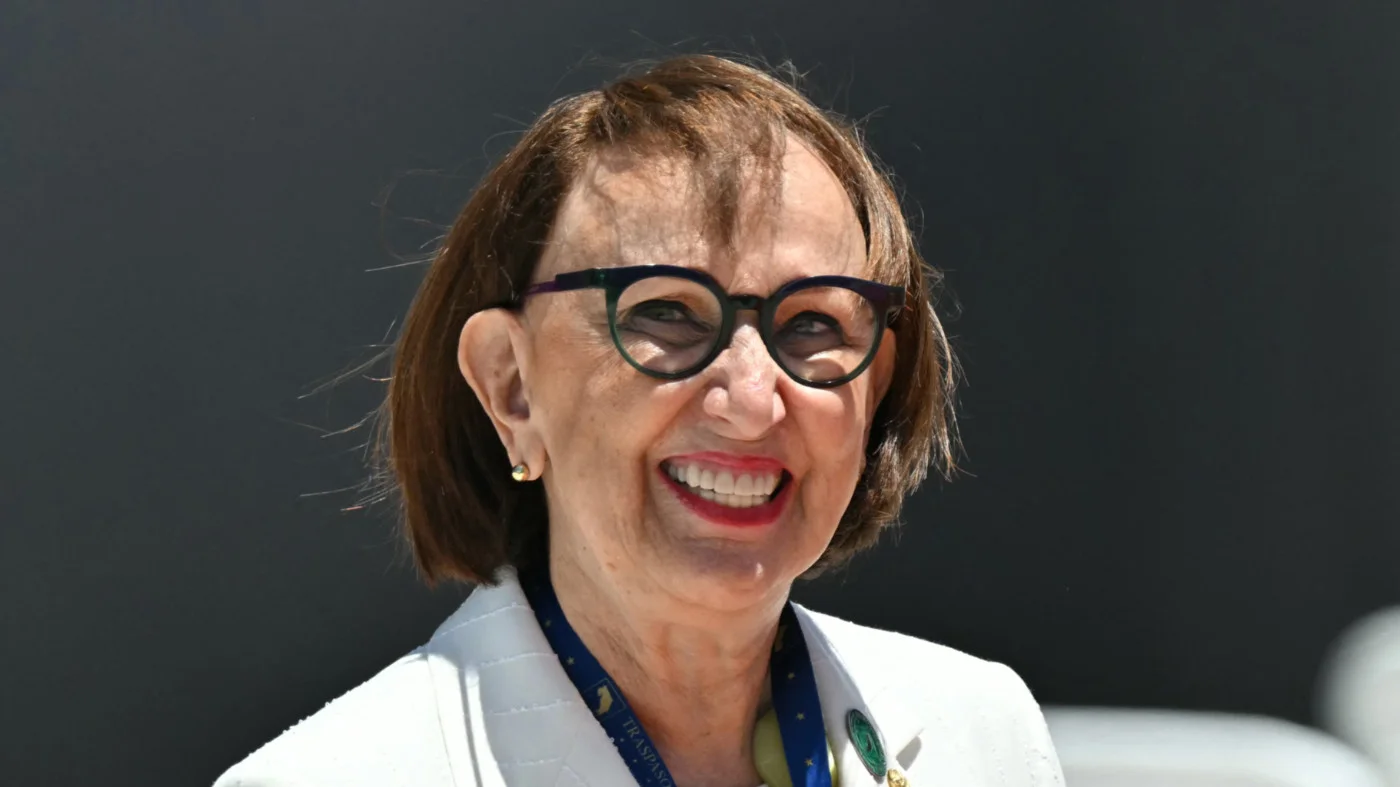
Who is she? said she would immediately reorganise the secretary-general’s office to underline its mediation remit, strengthening it as a trusted intermediary that makes better use of discreet diplomacy. She also wants UN peace operations to work more closely with regional groups on the ground.
The UN, Grynspan says, should additionally cut overlapping responsibilities and be more efficient; make better use of its budget; anticipate and respond to crises more quickly, including through technology and AI; and be more accountable, with appointments made on merit and zero tolerance for misconduct.
On development, Grynspan wants fairer borrowing terms for poorer countries, including an end to debt repayments that consume money needed for essential services.
What are her chances? Grynspan led the first poll in July with 10 "encourage" and one “discourage", but subsequently lost momentum and slipped in the next poll to seven "encourage" and four "discourage".
Rafael Mariano Grossi (Argentina)
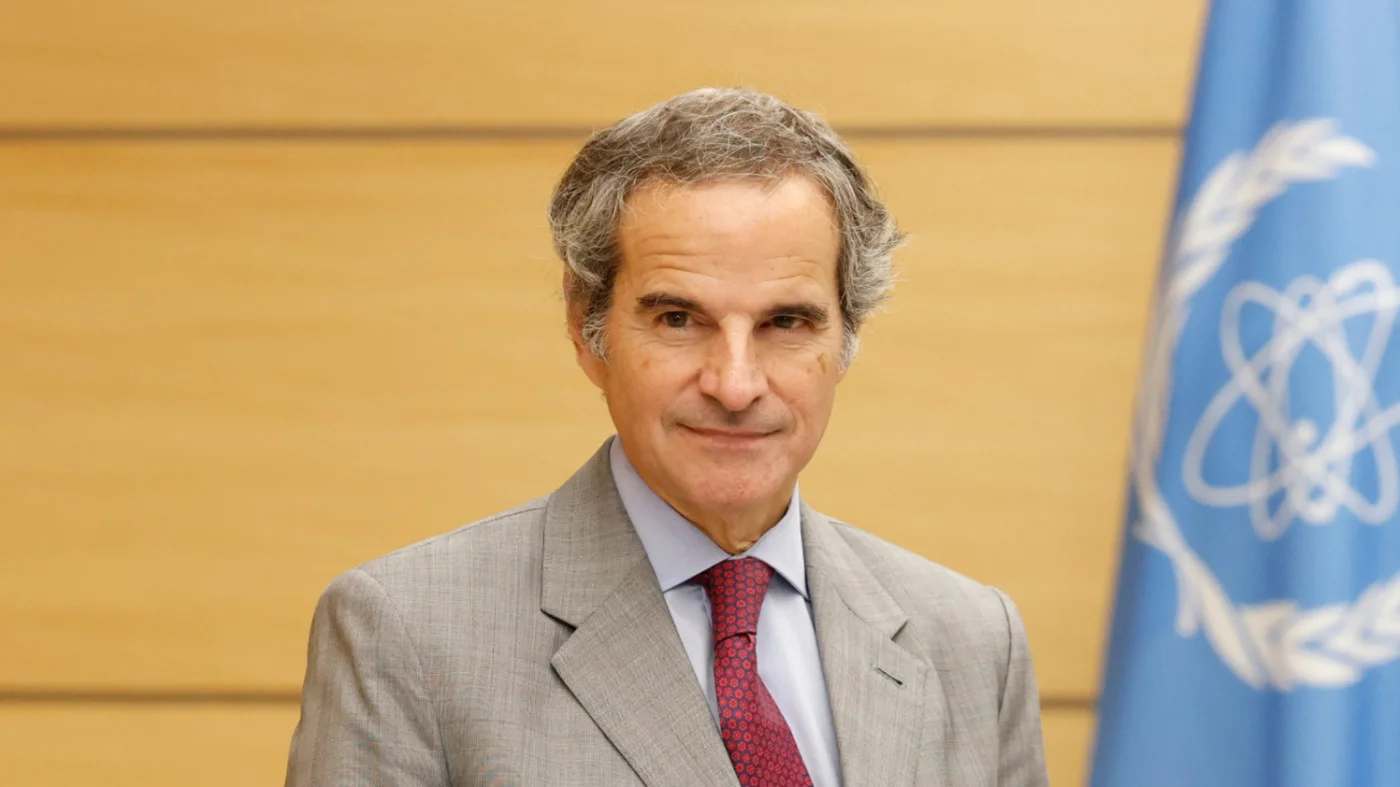
Who is he? Rafael Mariano Grossi has been director general of the global nuclear watchdog, the International Atomic Energy Agency (IAEA), for seven years. Argentina nominated him for UN secretary-general in late November.
What's his platform? Grossi, who has a four-decade record in diplomacy, has presented himself as an independent, personally financing his own campaign and selling himself as not reliant on the support of backers.
While several of his rivals have pledged to introduce sweeping institutional reforms, Grossi frames himself as a boots-on-the-ground mediator who would restore UN credibility through direct diplomacy and better delivery on existing commitments.
In his vision statement, Grossi argues the UN needs less rhetoric, more tangible results, and to protect its founding values. He sets out five priorities: peace and security; development delivered through partnerships; human rights presence on the ground; management and institutional renewal; and "pragmatic multilateralism" that engages all sides. "The world still needs the United Nations," he says. "But it must be a United Nations that works."
Like Rodrigues-Birkett, Grossi highlights that sustainable development goals are being missed and proposes deeper engagement with the private sector and scientific community.
He also wants overlapping UN mandates eliminated; UN operations further digitised; and department sizes and resourcing determined by funded and agreed priorities, rather than outlasting the mandates and budgets that initially justified them.
But Grossi makes little mention of climate policy, which he tends to fold into energy and nuclear-power discussions.
What are his chances? Grossi has performed strongly in UNSC straw polls, tying for second place in the August round with seven "encourage" votes, though he also drew six "discourage" votes, indicating he faces more opposition than his closest rivals.
His campaign has also become entangled in recent weeks in Argentina's escalating push to reopen sovereignty talks over the Falkland Islands. As one of the permanent members, London could theoretically veto his candidacy, although it has said that it is only focused on "the merit of the candidates".
Maria Fernanda Espinosa (Ecuador)
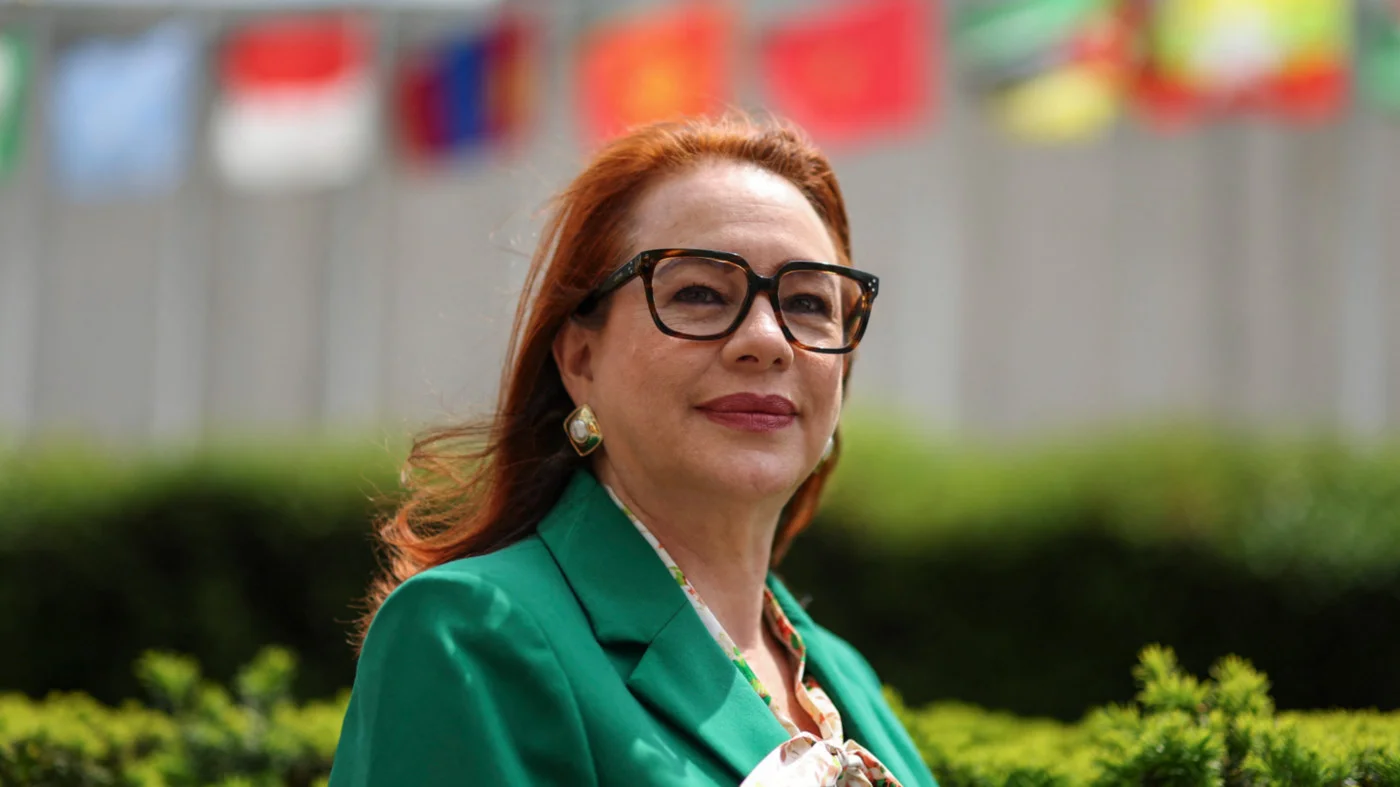
Who is she? Maria Fernanda Espinosa is an Ecuadorian diplomat who served as president of the UN General Assembly in 2018–2019, becoming only the fourth woman to do so, and the first from Latin America and the Caribbean. She also served twice as Ecuador’s foreign minister and as the country’s first female defence minister. She entered the race relatively late in May, after being nominated by Antigua and Barbuda.
What's her platform? In her vision statement, Espinosa says that "the gap between what the UN promises and what it is seen to deliver has grown far too wide". She organises her programme around five "pillars of transformation": peace and security; development; energy and digital transformation; improving the UN’s ability to deliver results; and securing the resources needed to carry out its work.
Her signature proposal is a "Prevention and Early Action Hub" reporting directly to the secretary-general, and combining the UN’s risk analysis and early-warning capabilities, which are currently spread across departments, so crises can be identified and addressed before they escalate. Espinosa says the hub would use existing resources rather than create another layer of bureaucracy.
On development, Espinosa argues that solutions "cannot be designed or delivered from New York" and should instead be locally led and nationally owned. She describes debt as "a structural constraint to development" and wants an international financial system that allows poorer countries to invest more in health, education and development after meeting debt obligations.
Espinosa also wants the UN to be an impartial forum where rival powers can negotiate rules when it comes to technology, and proposes a "Secretary-General’s Dialogue on Emerging Technologies" to develop shared safeguards across AI and other emerging technologies.
What are her chances? Support for Espinosa has been limited, with only four "encourage" votes in the August poll, leaving her well short of the threshold of nine.
But in her favour, she had a high number of "no opinion" votes (eight in August), indicating she faces less outright opposition than several candidates above her and giving her an outside chance.
Espinosa's challenge in the weeks ahead is to convert those who are undecided on her prospects to "encourage" if she is to stay in the race.
Michelle Bachelet (Chile)
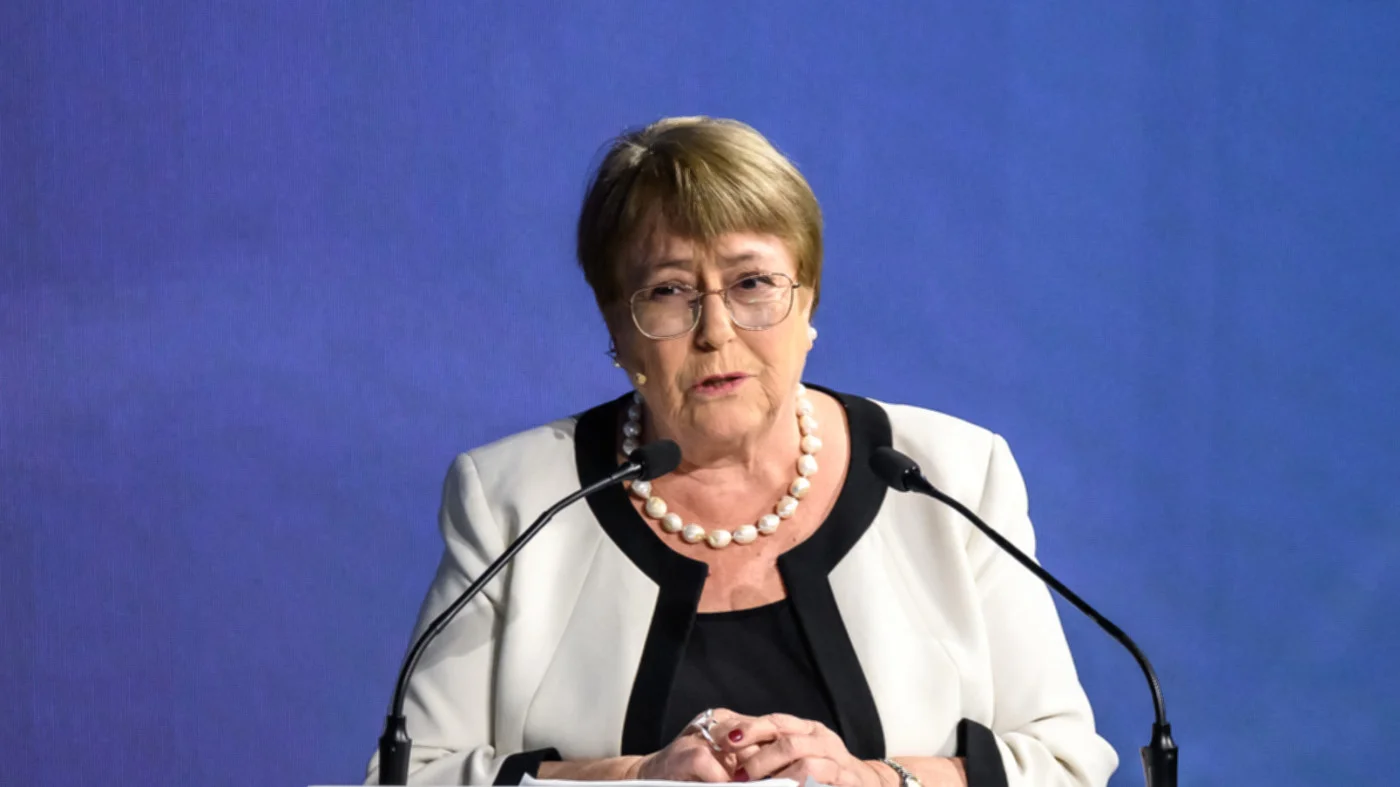
Who is she? Michelle Bachelet is a two-time former left-wing president of Chile (2006–2010, 2014–2018) who was detained, tortured and exiled under the dictatorship of Augusto Pinochet.
Serving as UN High Commissioner for Human Rights from 2018 to 2022, she was jointly nominated by Chile, Brazil and Mexico in February 2026. Her candidacy has survived despite Chile's newly elected hard-right government pulling its support in March, and continues to have the support of Latin American heavyweights Brasilia and Mexico City.
What's her platform? Bachelet has pitched herself as a proven administrator who can make the UN leaner and more effective "with existing resources" while strengthening its approach to early intervention.
Her official vision statement is built around four ideas: reforming the UN's internal bureaucracy; reconnecting the UN with ordinary people; reaffirming its founding principles; and designing forward-looking responses to fresh crises.
Bachelet wants the UN to take a more preventative approach, with more staff on the ground in crisis zones under a strengthened Department of Political and Peacebuilding Affairs and Mediation Support Unit, rather than issuing statements from New York.
On development, Bachelet has talked of tackling a "triple planetary crisis" of climate change, biodiversity loss and pollution through financial reform and debt relief targeted at small island states, landlocked developing countries and the least developed countries. She also wants women more involved systematically in peacebuilding and decision-making.
What are her chances? An early favourite, Bachelet slipped badly in the straw polls, drawing only two "encourage" votes and six "discourage" votes in the August round, despite her high profile.
Macky Sall (Senegal)
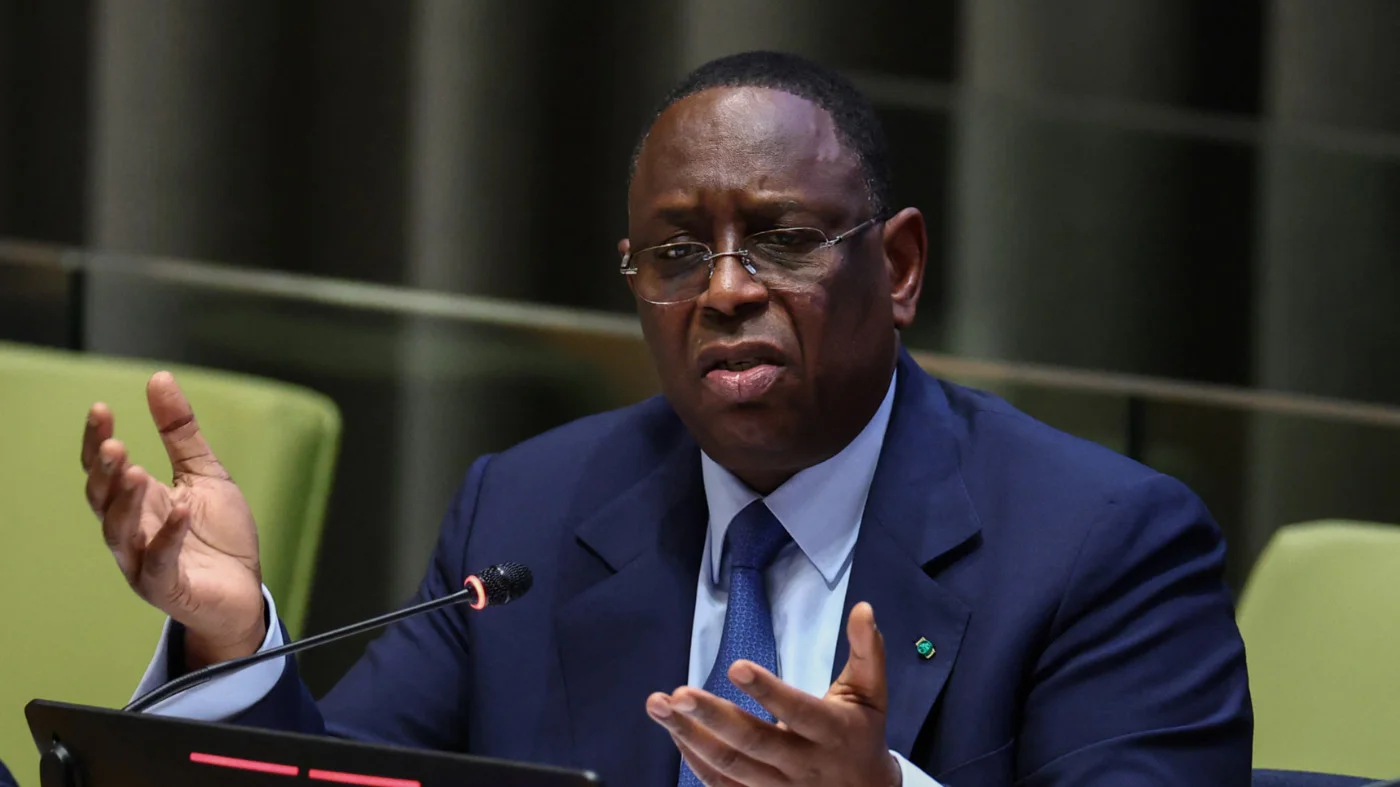
Who is he? Senegal’s president from 2012 to 2024, Macky Sall's formal nomination by Burundi in March, when it held the African Union’s rotating chairmanship, caused confusion. The organisation has subsequently declined to endorse Sall's bid.
What's his platform? Sall has made his record in Africa central to his pitch, campaigning under the banner "For a Renewed and Inclusive Multilateralism", with the slogan "Africa at heart, the world in sight".
He has identified three priorities for his first 100 days: strengthening the UN’s conflict-prevention work; reviewing its structures and mandates to improve effectiveness and financial governance; and making human rights and development central.
On development finance, Sall argues that poorer states face borrowing costs wildly disproportionate to the crises they did least to cause, and wants a restructure of how wealth and voting power are concentrated among the five permanent UNSC members.
He frames peace and development as inseparable, arguing that a country cannot be stabilised only through security measures if its underlying economic grievances go unaddressed.
What are his chances? Sall's vote numbers are static, polling the same in July and August. And while he has been boosted by the endorsement of Senegalese president and former rival Bassirou Diomaye Faye, the lack of a formal AU endorsement and emergence of Uganda's Olara Otunnu, another African candidate, have not helped.
Both candidates are also battling the same headwinds: the informal expectation that the next secretary-general will be from Latin America, and the consensus that the UN should finally have its first female secretary-general.
Olara Otunnu (Uganda)
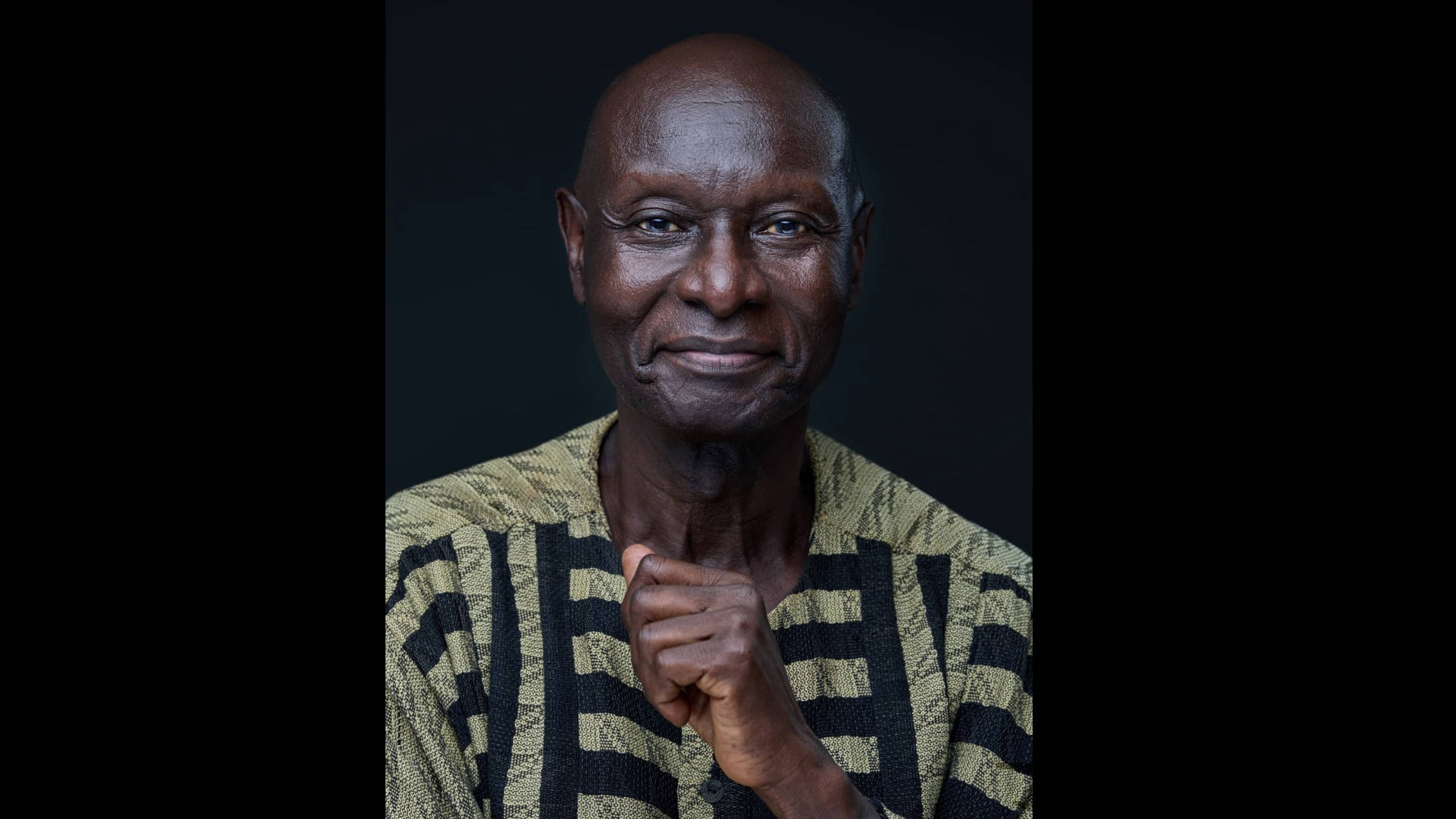
Who is he? Olara Otunnu is a veteran Ugandan diplomat with more than four decades of diplomatic experience. He has served as Uganda’s ambassador to the UN and foreign minister, held the rotating presidency of the UNSC, and was the UN under-secretary-general and special representative for children and armed conflict from 1997 to 2005.
What's his platform? Otunnu's vision statement presents his candidacy as ushering in an "age of hope and faith" for the UN, restoring its founding mission to "prevent the scourge of war" at a moment, he argues, when its mission has been neglected.
On day one, he promises, he would prioritise conflicts in Ukraine, Gaza, the Democratic Republic of Congo, Sudan and Iran, addressing each through a dedicated conference and regional framework.
Otunnu wants UN members themselves to drive the restructuring of the UN, rather than it being imposed by the secretariat, aiming for "coherence and accountability" to reduce duplication without undermining its legitimacy.
The UN should also have a dedicated agency overseeing AI governance, Otunnu argues, using digital technology to fight poverty. Action on climate should be pursued "without sacrificing economic prosperity" or energy security.
What are his chances? Uganda nominated Otunnu in July with the personal backing of former political rival President Yoweri Museveni, and posted the biggest gains of any candidate between the UNSC's two straw polls, doubling his "encourage" votes.
But while he has stronger chances at this stage than Macky Sall, he faces the same inherent challenges of not being a female candidate from Latin America.
Ivonne A-Baki (Ecuador)
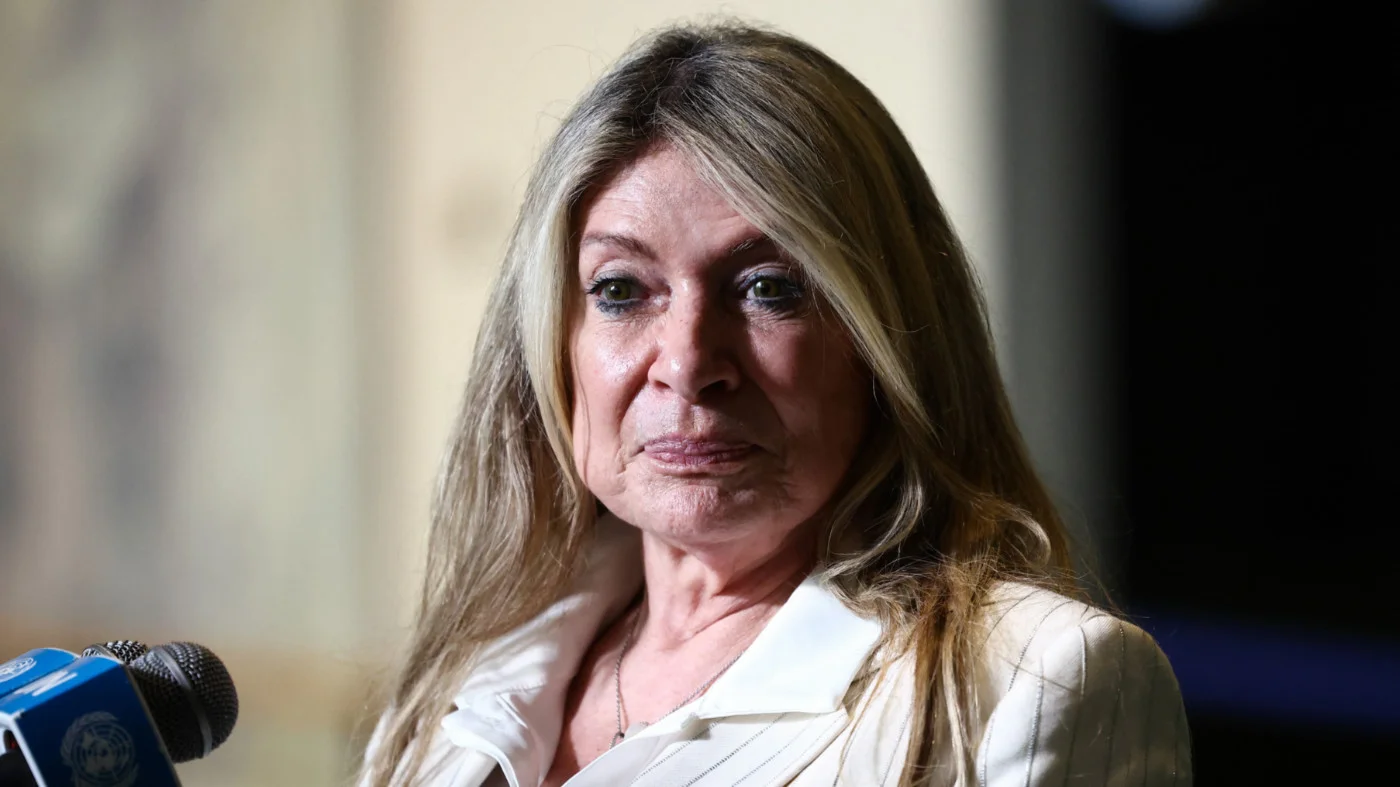
Who is she? Nominated by Tonga, Ivonne A-Baki is an Ecuadorian diplomat and former foreign trade minister of Lebanese descent who moved to Lebanon as a teen. Her personal narrative features prominently in her campaign: she says her lifelong commitment to conflict resolution was inspired by living in Beirut with her family while Ecuador’s honorary consul during the Israeli bombardment of the city in the 1980s. A-Baki advised Ecuador’s presidency during the talks that culminated in the 1998 peace deal with Peru.
What's her platform? In her vision statement, A-Baki frames conflict prevention as an economic imperative, citing an estimate that violence costs the global economy about $13.6tn.
She proposes applying the "guarantor method" of mediation, where a small group of mutually accepted states would accompany negotiations, helping guarantee any eventual settlement; and the implementation of Resolution 2719, allowing the UN contributions to fund African Union-led peace operations.
A-Baki also wants reform of the Security Council, including permanent representation for regions she says have historically been excluded, including Africa, Latin America and the Caribbean, describing the current veto-wielding nations as "the victors of a war that ended four generations ago".
She also criticises structural waste within the UN, pointing to the approximately 27,000 meetings held each year at a cost of around $360m. Instead, she wants mandates that would expire unless actively renewed.
What are her chances? A-Baki entered the contest only four days before the Security Council’s second straw poll and one day before presenting her candidacy to member states.
She received no "encourage" votes, eight "discourage" votes and seven "no opinion" votes in the August poll - the weakest result of any candidate - leaving her with likely insurmountable ground to make up.
Because the poll used identical ballots for permanent and elected council members, it is not known whether any of the five veto-wielding permanent members opposed her candidacy or why individual members voted against her.
Middle East Eye delivers independent and unrivalled coverage and analysis of the Middle East, North Africa and beyond. To learn more about republishing this content and the associated fees, please fill out this form. More about MEE can be found here.