
Court hears Palestine Action defendant suffered from emotional turmoil before Elbit raid

A British court has heard that a defendant in a Palestine Action trial accused of planning a raid on an Israeli-owned arms factory was suffering from emotional turmoil at the time the coordination of the action was alleged to take place.
Representing Julija Brigadirova, lawyer Tom Copeland told the court on Wednesday, that her circumstances around the time she was alleged to be planning the Filton action were marked by mental and emotional distress - including an attempt on her own life.
Copeland suggested that the reason Brigadirova appears to be absent from the evidence of the alleged coordination of the Elbit raid in the weeks preceding it, is because “in the context of her life at the time, she may not have been in a place to usefully contribute”.
"You may think she had more important things going on," he said.
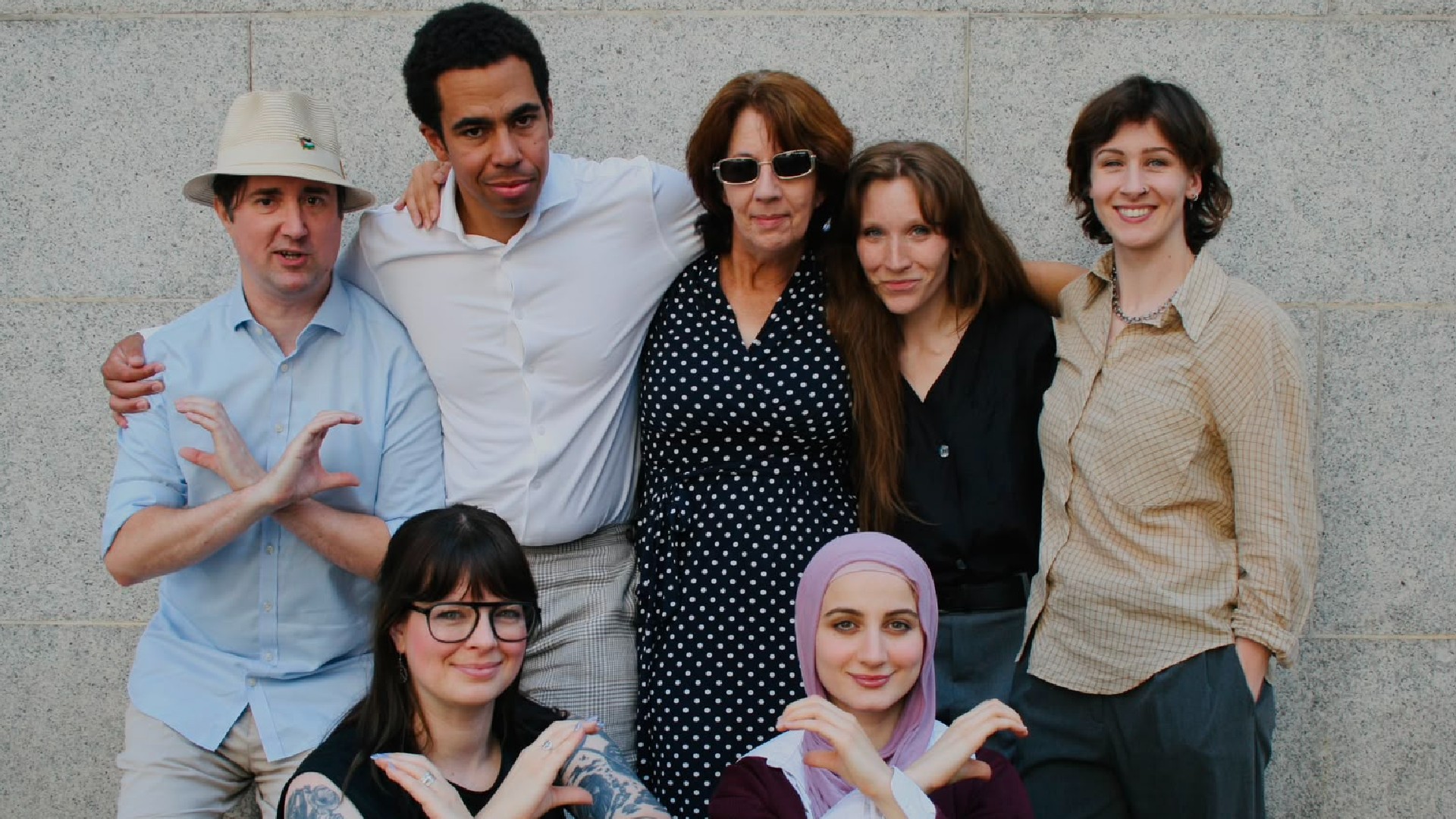
Brigadirova, 33, along with co-defendants Hannah Davidson, 53, Ian Sanders, 47; Aleksandra Herbich, 41; Teuta Hoxha, 30; Sean Middlebrough, 33; and Madeleine Norman, 31, face charges of violent disorder and criminal damage in connection with a break-in to an Elbit Systems plant in Filton, near Bristol, in August 2024.
New MEE newsletter: Jerusalem Dispatch
Sign up to get the latest insights and analysis on Israel-Palestine, alongside Turkey Unpacked and other MEE newsletters
William Plastow, 35, was acquitted of violent disorder. He continues to face criminal damage charges.
The eight defendants are accused of coordinating the break-in by carrying out reconnaissance and purchasing equipment, but are not alleged to have gone into the factory premises during the raid.
They all deny the charges.
Representing Brigadirova, barrister Tom Copeland told jurors in his closing remarks on Wednesday that the prosecution's case that she was a “key player” in the action is an “assumption” not “borne out by evidence”.
He highlighted that the prosecution had not presented any evidence of financial transactions made by Brigadirova linked to the Filton raid, nor were any messages sent from her signal handles related to planning or organising the action.
“If the prosecution is right, perhaps she should be called the invisible coordinator,” Copeland said.
“She’s not invisible - you can see her in the flesh in the dock. She is a real human being.”
“Or perhaps, the prosecution have got it wrong when it comes to Ms Brigadirova. That is a bigger mistake and one which is unforgivable," he said.

The prosecution pointed to messages between Brigadirova and a friend, Jasmine Cruickshank, in the days before the action.
They suggested that a message from Cruickshank to Brigadirova on 24 July asking, “Are you still up for the Bristol van trip next weekend?" evidences the defendants’ knowledge of the Filton site, and that this was Bridagirova's means of travel to the action.
Copeland dismissed this as “a nonsense”, pointing out that the prosecution had not called Cruickshank - who had provided a character statement for Brigadirova in which she described her as “part of my family” - as a witness.
“They could have asked her how the message came about,” Copeland said. “It didn’t happen. Her statement was read to you unchallenged as agreed evidence. At the same time, the prosecution seeks to use that message against her”.
“The idea that she has used her friend as some sort of charade is an assertion, not evidence,” he told jurors.
The jury heard that Brigadirova was driven down to Bristol on 4 August by Cruickshank, and later took a selfie upon arrival at Cruickshank's father's house. They also heard that Cruickshank later drove the van back to Manchester, without Brigadirova.
‘Low mood’
Copeland noted that the prosecution had “glossed over” the information about Brigadirova's mental health at the time, describing the defendant as suffering from “low mood”.
The court heard that Brigidirova was kept in hospital for four days after the attempt on her life.
“Low mood, seriously?” Copeland asked jurors. “This is not the first time it’s happened. It was a serious, genuine attempt to take her own life”.

He noted Brigadirova's presence at the Airbnb, where activists stayed from 4 August ahead of the action on the morning of the 6 August.
“Can you rule out the possibility that at that difficult time in her life, or her going along for the ride, with friends? As a support, but a support for herself more than anything,” Copeland said.
Copeland told jurors that the first mention of Brigadirova in the evidence following the raid is a message sent to a contact named Saeed (Feeld), saying “just stayed with friends down south, nothing special”.
He explained that ‘Feeld’ is the name of a dating app.
“What I cannot tell you is who in this courtroom knew it was a dating app,” adding that he would leave jurors “to speculate on that”.
‘Cooking a lot of pasta’
Representing co-defendant Aleksandra Herbich, barrister Emma Fenn told jurors that her role in the Filton raid was so limited that she handed over her phone to another defendant at the time of the action.
She noted that this runs contrary to instructions outlined in the Palestine Action document entitled the "Coordinator’s manual" which stipulates that coordinators “must be contactable at all times”.
Fenn said that the evidence shows that Herbich’s role in the raid was primarily limited to purchasing food and cooking.
She described Herbich captured on CCTV footage at Paddington Station on 4 August, with “blue hair distinctly on show”, carrying a box “the size and shape of a sushi box".
During her time at the Airbnb "safe house" in Bristol prior to the action, Herbich was described by co-defendant Madeline Norman as “cooking a lot of pasta. That’s all I saw her doing”.
Fenn emphasised that “cooking doesn’t even come close” to qualifying as an “intentional act” assisting or encouraging the offences of violent disorder and criminal damage.
“There is nothing to connect her with tools or weapons,” Fenn said, describing Herbich as “someone doing the cleaning at most and the cooking at least”.
‘Limited interaction’
Representing Plastow, Barrister Andrew Rose told jurors that his client had “limited interaction” with Palestine Action in the months prior to the raid, agreeing to do odd jobs and purchase tools.
The prosecution case against Plastow rests on his purchasing of a number of items used in the Filton raid - including rucksacks, protective gear and crowbars - and handing them over to co-defendant Charlotte Head.
They argue that this is tantamount to coordinating the action, and assisting with criminal damage to Elbit’s property.
When giving evidence on 16 July, Plastow told jurors that he had no knowledge of the Filton site prior to the action, and that the first he had heard of it was via a news item on the morning after the raid.
Citing the judge’s directions, Rose urged jurors that they must be sure Plastow supplied the equipment to Head with the intention that "Elbit’s property would be destroyed or damaged in accordance with the plan in which Charlotte Head and others were engaged”.
“If he thought the equipment might be used by others including those he handed it over to, in a different type of action involving Elbit that wouldn’t be the plan in which others were engaged,” he said.

Rose noted that the equipment list Plastow accessed for the purchase of the items included tools that were not used in the Filton action, including banners and rope.
He said that a more detailed, and seemingly more Filton-specific list was not shared with Plastow.
Citing Palestine Action guidelines, Rose read: “Everything is on a need-to-know basis, even among trusted people.”
“Mr Plastow was not ‘need to know,’ and didn’t want to know,” Rose said.
Rose reminded jurors that Plastow had been acquitted of violent disorder charges after Judge Field concluded that there was insufficient evidence that he knew violence would occur at the Filton site.
Rose argued that the remaining criminal damage charges against Plastow contain an “inherent, inescapable contradiction”.
He said that the prosecution’s case against all eight defendants is that, if they were involved in the Filton plan, they knew that the action would involve criminal damage (count 1) and, if necessary, violent disorder (count 2).
“It would be illogical, nonsense in my submission for Mr Plastow to be in the know, with knowledge of the Filton plan of criminal damage, but in complete and utter ignorance of violent disorder,” Rose told jurors.
“How could he really be a knowing participant and not be told this key part?” he asked.
“It’s ridiculous. The death of count 2 should also spell the death of count 1."
Rose, Fenn and Copeland’s closing remarks came as the judge sent jurors out to deliberate on Thursday.
The trial continues.
If you need support in the UK, then the Samaritans can be contacted at jo@samaritans.org or on 116 123. For the US, please try the National Suicide Prevention Lifeline on 1-800-273-8255. For other countries, please see befrienders.org.
Middle East Eye delivers independent and unrivalled coverage and analysis of the Middle East, North Africa and beyond. To learn more about republishing this content and the associated fees, please fill out this form. More about MEE can be found here.