From 'absolute monarchy' to dear friend: How Nigel Farage and Reform learned to love the UAE
Nigel Farage hasn’t always been fond of the United Arab Emirates.
Writing in The Telegraph on 15 December 2023 in opposition to a bid by the oil-rich Gulf state to take over the newspaper, he didn’t mince words.
“As the UAE is an absolute monarchy with an abysmal human rights record, it seems fanciful that it would take jokes or questions in the spirit that runs through the British press,” Farage argued forcefully.
“Would Sheikh Mansour, the vice-president of the UAE and a member of the ruling family of Abu Dhabi, allow one of his relatives to be caricatured in a Telegraph cartoon?” he questioned.
“What would he do if The Telegraph’s investigations unit began inquiring into a UAE-owned company? Or if a Spectator columnist criticised the UAE’s attitude towards homosexuality? Does anybody really want to find out the answers to these questions?”
New MEE newsletter: Jerusalem Dispatch
Sign up to get the latest insights and analysis on Israel-Palestine, alongside Turkey Unpacked and other MEE newsletters
The UAE bid ultimately failed.
Fast forward to 28 January 2026, with Farage as leader of the right-wing party Reform UK, which at the time was dominating the national polls.
That evening he was in Dubai at a lavish private party held on the rooftop of the high-end Ritz-Carlton hotel.
It was an exclusive affair, attended by around 80 people and hosted by GB News, the right-wing British television channel for which Farage is a presenter.
Among the guests, sources told Middle East Eye, were Laila Cunningham, Reform’s mayoral candidate for London, and Nadhim Zahawi, the former Conservative chancellor who had defected to Reform earlier that month.
They were joined by Sultan Ahmed al-Jaber, the UAE's minister of industry and advanced technology.
Reform’s leader gave the keynote speech.
'The UAE is an absolute monarchy with an abysmal human rights record'
- Nigel Farage in December 2023
He was effusive about the UAE. “Look around The Palm! I want Clacton to look like this,” he declared, referencing his constituency, a sleepy and deprived coastal town in the east of England, where one in five people don't have a job.
"We have a lot to learn from you, my dear sirs," Farage told the Emirati officials in attendance.
"We recognise you are our friends," he added. "A Brexit London, a Reform London, will remember you."
He praised the UAE for banning the Muslim Brotherhood and said a Reform government would do the same, according to sources.
This speech was a far cry from his previous ferocious criticism of the UAE. Something had changed.
An unexpected attraction
Reform UK is considered a contender to form a future British government, although Farage is now mired in scandal and subject to an investigation over an undisclosed gift.
Britain's leading populist figure resigned as MP for the seaside town of Clacton last month and immediately stood for re-election.
His aim is to be voted in again on Thursday night to prove that his constituents have confidence in him, although his chief opponent is a joke candidate dressed as a bin called Count Binface, an 11-to-one outsider according to bookmakers William Hill.
Despite this absurdity, Farage is taken seriously in the Gulf.
Despite his previous condemnation of Abu Dhabi, the Emiratis have courted his political party, and prominent Reform figures have developed close ties with and a deep interest in the Gulf country.

At a glance, this might seem absurdly paradoxical. Reform, on the one hand, is a British party which calls for net-zero migration and mass deportations.
The UAE, meanwhile, is a Middle Eastern dictatorship with no free speech and a population largely made up of migrants. Islam is its state religion.
On closer examination, however, there is a profound coherence to the warm relationship between the two.
A close look at their relationship sheds new light on the UAE’s agenda in the western world. But it also reveals a great deal about Reform itself.
Richard Tice and Dubai
While he was in Dubai for the GB News party, Farage also hosted a private lunch with the backing of Dubai-based Indian billionaire Sunny Varkey at Rockfish, an expensive beachside restaurant. The lunch was reportedly attended by wealthy UAE-based businessmen.
Farage had been spending significant time in the country. It was reported in April 2025 that Reform was looking to raise funds from wealthy foreign donors in low-tax countries including Monaco, Switzerland and the UAE.
Farage visited Abu Dhabi in December on a trip valued at approximately £10,000 ($13,500), paid for by the Emirati government.
He publicly spoke about watching the Formula 1 season finale in Abu Dhabi. But on the trip he also had private meetings with Emirati officials.
In his own party, Farage was a relative latecomer to the UAE. His deputy leader, Richard Tice, had long before shown deep interest in the country.
On one occasion, on 13 January 2025, Tice stood up in the House of Commons to ask a rather eccentric question.
The government of the United Arab Emirates had just announced it was proscribing eight British companies as terrorist organisations, he informed the House.
They were an eclectic range of small entities, including a Bolton-based education consultancy supporting international students applying to British universities called Future Graduates Ltd and Waslaforall, which teaches Arabic to children.
Tice asked: “What action will be taken following the news that eight UK companies and organisations have been deemed terror groups by the United Arab Emirates?”
Dan Jarvis, the security minister, gave the perfunctory reply that it “would not be appropriate for the government to comment” on the UAE’s “processes”.
Tice later posted on X, writing: "The UK Govt must act on these 8 organisations deemed terror groups by our international partners, the UAE."
Human Rights Watch (HRW) found that “all eight companies are solely registered in the United Kingdom and are owned or previously owned by exiled Emirati dissidents or their relatives”.
Joey Shea, a senior researcher at HRW, urged the British government to “defend British businesses against the spurious claims of Emirati authorities”.
This wasn’t the only time that Tice has spoken about issues important to Abu Dhabi in parliament.
On 2 December, he made an intervention on the civil war in Sudan, where the UAE is known to arm the Rapid Support Forces (RSF) militia, which has been widely accused of committing genocide.
The UAE has often claimed to be acting to counter the Muslim Brotherhood, its regional bete noire, in Sudan.
“This is an appalling civil war, with all its atrocities,” Tice said in the Commons. “How concerned is the foreign secretary that the growing influence of Iran and the Muslim Brotherhood is leading to the deliberate fomenting of extremism, and the rejection of ceasefire efforts by the Sudanese regime?”
Tice’s history with the UAE is deep-rooted. His grandfather, Bernard Sunley, built the country’s first major skyscraper, the Dubai World Trade Centre, in the 1970s.
In February this year, speaking to the Emirati-owned newspaper The National, Tice suggested that there could be joint listings between the London Stock Exchange and Dubai’s financial hub under a Reform government. He said Britain and the UAE could “do great things together”.
'Dubai is the ultimate multi-cultural success story'
- Isabel Oakeshott, British columnist
On another occasion he praised the practice of students in Dubai’s schools standing for the national anthem each morning.
Tice often travels to the UAE to be with his family. Isabel Oakeshott, Tice’s then-girlfriend (now his fiancee), explained in a Telegraph column in January 2025 why she moved to Dubai with their children.
It was the VAT on private school fees introduced by the Labour government which was the “last straw”, she said.
“Facing an annual post-tax bill of around £150,000 for three children, it was time to find another way.”
Oakeshott was effusive about the country, praising how it didn't have “striking train drivers, aggressive pro-Hamas marches and endless rain”.
Even better, she added, “in the United Arab Emirates - a Muslim country - there would be no toxic gender ideology claptrap or critical race theory in classrooms.
"Those who break the law or can’t look after themselves are simply imprisoned or deported – so they don’t. What that means is that young girls like my daughters are far safer here than they would be at home.”
She described the UAE as “the beating heart of the modern Middle East”.
Mapping the relationships
Other Reform figures have spent lots of time in the Emirates, including Nick Candy, the party’s treasurer, who said in April 2025 that he travelled to the UAE “every other week”.
According to the Financial Times, Candy arranged Farage’s meetings with Emirati officials in Abu Dhabi in December.
Nadhim Zahawi, who defected from the Conservatives to Reform in January, is the chairman of an advisory board at Omniyat, a major property developer in Dubai.
He attended the 2023 COP28 summit in the city as a guest of the Emirati government, while still an MP, and was part of the UAE’s failed bid to buy the Telegraph.
In February, Zahawi became the director of Evolution Investment Fund, which is backed by the UAE-based Shanshal family and investing £1bn ($1.35bn) in hotels in Mayfair.
According to sources with knowledge of the matter, Zahawi has helped Reform cultivate relations with the government in Abu Dhabi.
It is common for important figures on the British right to have business interests in the UAE because they tend to be from business backgrounds.
Legatum Ventures, the British private equity firm that co-owns GB News - the channel which Farage presents on, and which has been accused of having a heavily pro-Reform slant - is based in Dubai.
That was why GB News hosted a party in Dubai in January.
Christopher Chandler, who owns Legatum and lives in Dubai, attended the party.
Legatum also funds Prosperity Institute, a think tank understood to be heavily influential in Reform itself. Cambridge academic James Orr, Farage’s senior adviser, sits on Prosperity’s advisory board.
The material connections many figures on the British right have with the UAE help explain why they are so enamoured with it.
These are businessmen; they appear to sincerely admire the UAE as an attractive, wealthy country that is pro-business and has low taxes.
Tice, for example, believes the UK could learn from the UAE’s national pride and low crime rate.
Meanwhile, in the view of Reform treasurer Candy, himself a billionaire property developer, “today you are more likely to find the values we grew up with in Dubai and Abu Dhabi” than in Britain.
Then there is the billionaire hedge fund manager Sir Paul Marshall, one of the political right’s most influential figures.
Having been a donor to the Vote Leave campaign, Marshall is a major funder of GB News, as well as the owner of the Spectator magazine.
In December 2024, speaking at a finance conference in Abu Dhabi, Marshall sang the praises of the emirate and compared it favourably to Britain: “Income tax: Britain 45 percent, Abu Dhabi zero; capital gains tax: Abu Dhabi zero, Britain’s just gone to 24. So in terms of tax, Abu Dhabi is absolutely nailing it. It’s a very attractive place.”
Lessons on immigration
As Farage expressed at the party in Dubai, Reform has come to see the UAE as a model to learn from. This extends even to its immigration policies.
Last September, Reform promised to replace Indefinite Leave to Remain (ILR) with work visas that would force migrants to reapply every five years to stay in the country.
The party explicitly cited the UAE, with its strict residency rules, as an inspiration for the policy.
The journalist Simon Kuper has characterised the recent popularity of this sort of immigration policy in European countries as a move towards creating a “permanent immigrant serving caste”.
He described the rise of what he calls “Eurokafala” - a play on the kafala system for migrant workers in the Gulf - throughout Europe.
While politicians look towards the UAE, rights groups continue to report widespread violations against migrants there.
Joey Shea at HRW told MEE that “we’ve documented widespread labour abuses” in the country.
“We’ve consistently documented conditions that may amount to forced labour, serious health and safety concerns on workplace sites.
"The abuses which have been allowed to proliferate under kafala is because the system doesn’t grant labour or political rights to a large population.
“Trade unions are banned. I don’t think the kafala system is consistent with a liberal democracy,” Shea said, describing it as creating a population living under “two separate political systems”.
It is evident that figures in Reform admire many features of the UAE and its domestic policies. But what exactly is Abu Dhabi's interest in Reform?
Why the UAE is courting Reform
While relentlessly pursuing dissidents internally and abroad, the UAE has developed a thicker skin when it comes to western politicians, who have criticised it in the past.
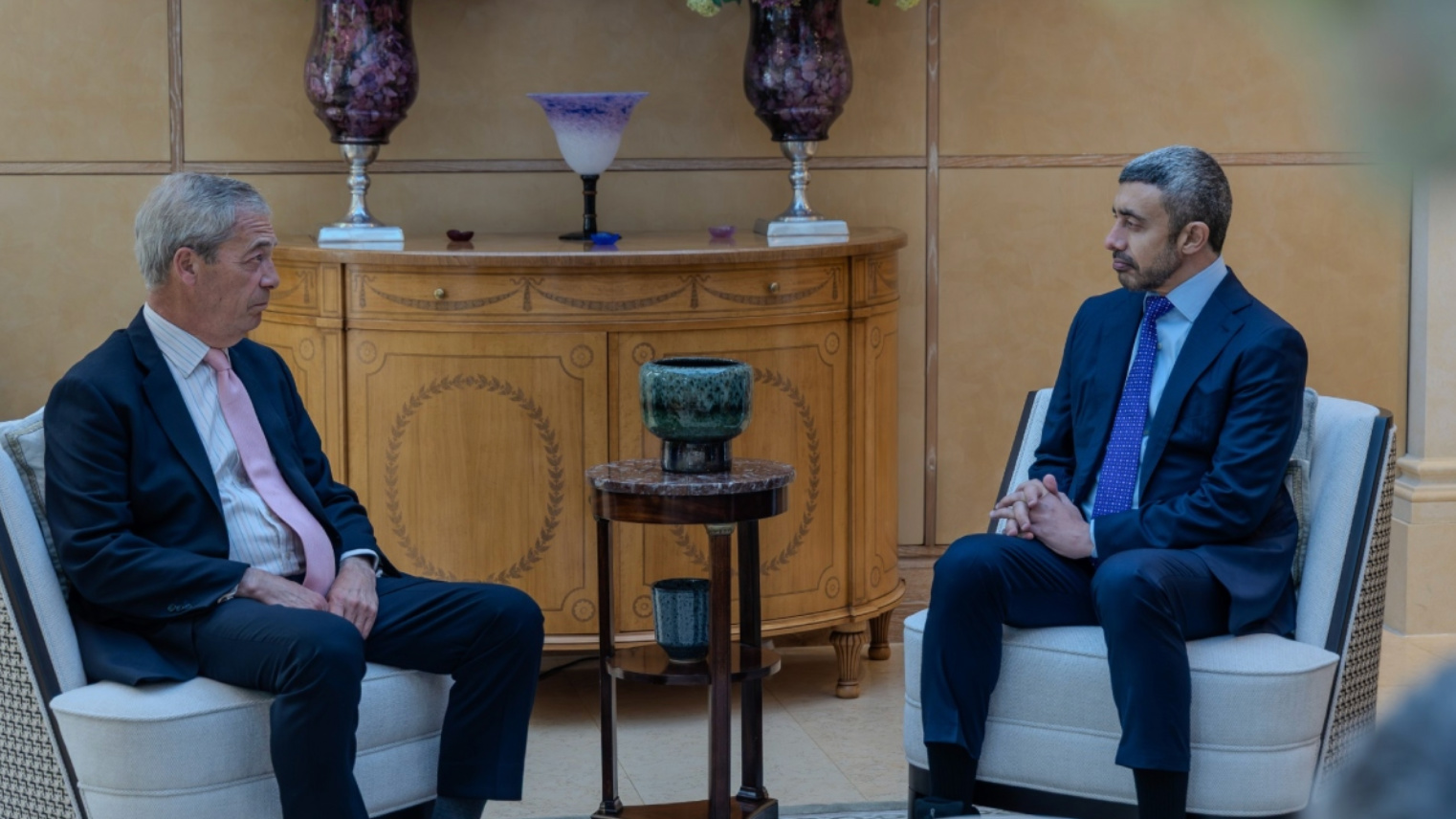
Abu Dhabi has calculated that Farage's Reform could be in government in the future. In May, the Emirati foreign minister, who is also the deputy prime minister, took the unusual decision to hold a meeting with Farage during a visit to London, after meeting the British foreign secretary.
The Emirati foreign affairs ministry said the pair discussed the "latest regional developments and the repercussions of the unprovoked Iranian terrorist attacks targeting the UAE", as well as strategic relations between the UAE and Britain.
'[Farage can] carry narratives into American and European networks that the Emirati government could never credibly penetrate itself'
- Andreas Krieg, King's College London
The UAE seemed to be treating the Reform leader as a prime minister-in-waiting.
Another factor is that Emirati relations with the Conservative Party and Labour have been somewhat strained in the past few years.
A former senior minister told MEE in 2024 that UK-UAE relations were privately challenged over British opposition to the UAE’s involvement in Sudan.
Compare this with Reform’s deputy leader, Richard Tice, telling Parliament that the Muslim Brotherhood was responsible for trouble in Sudan - a common Emirati narrative.
“Reform and Farage sit at the intersection of British populism, the European far right, the MAGA ecosystem, wealthy transnational donors and an influential right-wing media environment,” Andreas Krieg, an associate professor at the Defence Studies Department of King’s College London, told MEE.
“That makes Farage useful to Abu Dhabi whether or not Reform ever governs. He can move the political conversation, force the Conservatives and Labour to respond to issues he elevates, and carry narratives into American and European networks that the Emirati government could never credibly penetrate itself.
“This is classic Emirati network-centric statecraft.”
Hunting the phantom menace
Perhaps the biggest reason Abu Dhabi is drawn to Reform is over its opposition to political Islam, an agenda it has pursued across the Middle East since the Arab Spring - and increasingly in Europe and America as well.
Last September, Farage pledged to ban the Muslim Brotherhood, pointing to the fact that several Gulf states have done so.
The Muslim Brotherhood was founded in Cairo in 1928 and is one of the world's largest and best-known groups espousing political Islam. Where free elections are held in the Middle East, parties affiliated with the Brotherhood often win outright or form the largest opposition party.
It is chiefly the staunch opposition of democratic Islamists to autocracy and dictatorship, rather than direct fears over their religiosity, which has marked them out as an enemy to the UAE.
Abu Dhabi has previously tried unsuccessfully to have the Brotherhood banned in the UK.
'We recognise you are our friends...'
- Nigel Farage to Emirati officials in January 2026
In 2012, shortly after the Arab Spring, the UAE reportedly threatened to block arms deals with Britain and end intelligence cooperation if David Cameron’s Conservative government didn’t take action against the organisation.
This is believed to have motivated Cameron to commission a review of the Brotherhood in 2014, led by the former ambassador to Saudi Arabia, John Jenkins.
The review found that aspects of the Brotherhood’s behaviour were "contrary to British values, national interests and national security", but stopped short of deeming it a terrorist threat or recommending its proscription.
Then, in 2016, a review by the parliamentary Foreign Affairs Select Committee, which scrutinises government policy, concluded that democratic Islamists should not be lumped together with "intolerant, extremist" Islamists and strongly opposed a ban on the Brotherhood.
In 2023, it was revealed that the UAE paid a private intelligence firm based in Geneva, Alp Services, to smear Britain’s largest Muslim charity, Islamic Relief Worldwide, by seeking to link it with the Muslim Brotherhood.
The UAE's proscription in 2025 of eight British organisations - raised by Richard Tice in parliament - was also on the basis that they were allegedly linked to the Brotherhood.
Tice said in February that “we don’t want [the Brotherhood] in our country”. He added: “We don’t want them on our streets or setting up bank accounts here.”
'A catch-all term for extremism'
Human Rights Watch’s Joey Shea told MEE: “It’s part of the UAE’s playbook to use the Brotherhood as a catch-all term for extremism to justify their crackdown on peaceful dissent. This framework was moulded after the Arab Spring.”
For Mohammed bin Zayed, the ruler of the UAE, the Brotherhood “has become a threat category into which an increasingly broad range of independent Muslim organisations, political activists and critics of Emirati foreign policy can be placed”, Andreas Krieg said.
"MBZ’s [Mohammed bin Zayed's] fundamental fear is not really theology; it is autonomous mobilisation. His political system is built around the proposition that only the state should be able to organise society.
"Independent religious authority, civil society, political parties and social movements create alternative centres of power."
As a result, the UAE “promotes a model of Islam that is tolerant and moderate but also deliberately quietist, depoliticised and ultimately controlled by the state. Independent Muslim civil society is treated with suspicion precisely because it exists outside that command structure”.
"The UAE and Reform are in a kind of passionate love affair," said Imran Mulla, MEE's political reporter, during MEE Live on Tuesday.
— Middle East Eye (@MiddleEastEye) February 25, 2026
Watch the full episode on YouTube now pic.twitter.com/E168Yg8r0E
This includes Muslim civil society in western democracies. In January, the UAE restricted funding for its citizens to study at British universities over alleged Brotherhood influence within them.
The Brotherhood is understood not to operate as a unitary organisation, and no evidence has emerged from inquiries or reviews that it wields significant influence in the UK.
For Britain, a ban on the Brotherhood - an organisation not involved in violence in the country - would thus be unprecedented.
Yet it is precisely the phantasmic nature of the alleged Brotherhood threat that has allowed Reform to use it to make sweeping and unevidenced claims to raise the alarm on Islamism in the country.
Farage himself used unusually strong language to speak about Islamism this year.
In February, shortly after his trip to Dubai, he claimed in a speech that unnamed “senior intelligence sources” had told him the Muslim Brotherhood was “deeply embedded in several of the structures of our country”.
Farage said: “I'm talking about the education system. I'm talking about politics. I'm talking about the police force.”
He didn’t provide evidence for these dramatic claims, but added that Britain was in the grip of “rife and rampant sectarianism”. Islamists, he proclaimed, had been “allowed to dig themselves very, very deep into the British structure”.
Krieg said the UAE "gives Farage political cover".
"One of his vulnerabilities when talking about Islamism is the accusation that he is simply mobilising anti-Muslim sentiment.
"Being embraced by a wealthy, ostensibly 'moderate' Muslim state allows him to turn that accusation around: how can this be Islamophobia when the Emiratis themselves say Britain has an Islamist problem?"
The Brotherhood issue also allows Farage to “present himself not merely as an insurgent politician but as a statesman who already has relationships with Washington, Gulf capitals and major international investors”, Krieg said.
“Being received in Abu Dhabi, attending high-profile events and developing relationships with senior Emirati figures all help construct that image.”
Ultimately, then, Reform and the UAE are not exactly the star-crossed lovers they may, at first glance, appear to be.
As we have seen, their relationship has solid grounding and has become beneficial to both of them.
It is based on material interests, the Gulf state’s foreign policy, Reform’s electoral calculations and some genuine shared economic and political values.
The result of this mutual attraction has been an unusual spectacle: Britain’s leading right-wing politician, often described as a populist, singing the praises and repeating the talking points of a Middle Eastern dictatorship.
MEE has contacted Reform UK and the UAE's embassy in London for comment.
Middle East Eye delivers independent and unrivalled coverage and analysis of the Middle East, North Africa and beyond. To learn more about republishing this content and the associated fees, please fill out this form. More about MEE can be found here.