
Turkey's cross party Kurdish peace coalition makes history with PKK clemency law

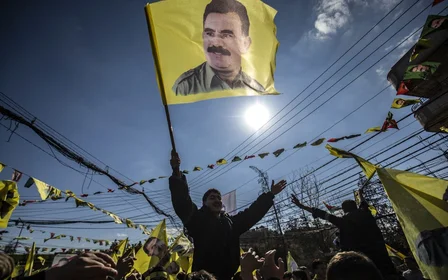
It would have been unimaginable three years ago to see lawmakers from Turkey's ruling coalition pose in parliament alongside pro-Kurdish MPs and other opposition politicians after voting to grant partial clemency to members of the Kurdistan Workers' Party (PKK).
But that's exactly what has happened after a historic vote.
For the first time in Turkey's modern history, the government introduced legislation establishing a framework for resolving its conflict with the PKK - and potentially ending nearly four decades of fighting.
The PKK has waged a guerrilla campaign against the Turkish state since the early 1980s, resulting in the deaths of thousands of civilians and members of the security forces.
The group initially sought independence and later greater autonomy for Turkey's Kurds.
New MEE newsletter: Jerusalem Dispatch
Sign up to get the latest insights and analysis on Israel-Palestine, alongside Turkey Unpacked and other MEE newsletters
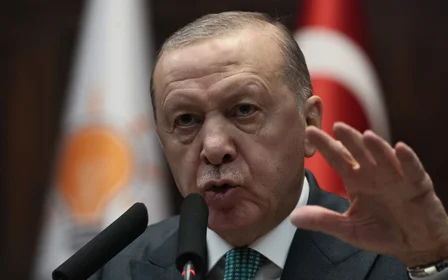
Following two years of negotiations with imprisoned PKK leader Abdullah Ocalan, the government of President Recep Tayyip Erdogan and its coalition partner, the Nationalist Movement Party (MHP), led by Devlet Bahceli, decided to pursue an end to the conflict.
The process was set in motion by Bahceli in a speech in October 2024, when he emerged as an unprecedented advocate for peace.
His address was startling not only because he said he would tolerate Ocalan appearing before parliament, after having repeatedly called for his execution, but also because Bahceli's MHP, a right-wing Turkish nationalist party, had long been among the strongest opponents of everything the PKK represented.
After months of work by a parliamentary committee addressing the Kurdish question, as well as hours of negotiations with Ocalan, PKK commanders in northern Iraq's Qandil Mountains and leaders in exile in Europe, the legislation was introduced in parliament last week.
It was quickly ratified on Monday.
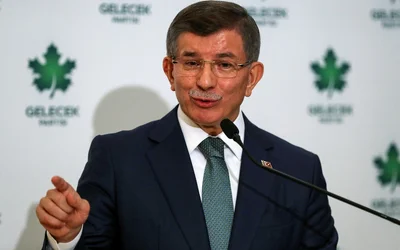
The law allows former PKK members who did not commit violent crimes, such as intentional homicide, to receive pardons. It also permits prisoners convicted of nonviolent offenses to be released.
The most surprising aspect of the episode was not that parliament approved the law, but the breadth of the alliance supporting it.
Alongside the ruling Justice and Development Party (AKP) and the MHP, the legislation was supported by the secularist Republican People's Party (CHP); smaller right-wing and Islamist parties such as the New Welfare Party, or Yeniden Refah; the Felicity Party, or Saadet; and the liberal Democracy and Progress Party, known as DEVA.
The Free Cause Party, or Huda Par - an Islamist Kurdish party and an opponent of the PKK - also voted in favour.
Socialists in the Workers' Party of Turkey (TIP) and several smaller left-wing parties also supported the measure.
Limited CHP opposition
Imprisoned Istanbul Mayor Ekrem Imamoglu backed the legislation in a statement, while New Party, or Yeni Parti Chairman Ozgur Ozel, who now represents the main opposition inside the country after breaking away from the CHP, publicly expressed his support.
The parties supporting the law have differing concerns and reservations. Ozel allowed New Party lawmakers to vote according to their own judgement, and many opposed the legislation.
Nevertheless, the broad coalition produced an unprecedented level of parliamentary support, with 468 of parliament's 592 members voting in favour.
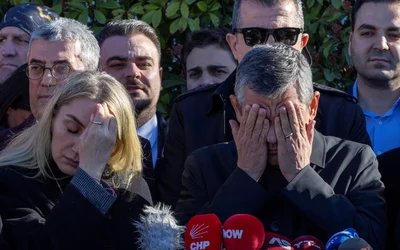
In his parliamentary address, Ozel said he would support the law despite the government's crackdown on opposition mayors across the country and its support for an effort to remove him from the CHP leadership.
"We have the greatest right to say no to this law. But we are also the ones who will not put this right before peace," he said in parliament on Monday. "We have not, and will not, put our anger before the future of the nation."
Ozel added that his party would not stand in the way of peace.
"We will pave the way for peace so that another mother does not have to embrace her son's coffin," he said.
Under the legislation, the PKK would first be required to lay down its weapons and demonstrate to Turkish authorities that it was upholding its side of the agreement. The PKK and its affiliated groups would also be expected to end illicit activities, including the smuggling of counterfeit goods and drugs.
The repatriation of PKK members who did not commit violent crimes could then begin in September, initiating a six-month implementation period. Former PKK members who failed to apply within the specified timeframe would no longer be eligible to benefit from the law.
Turkish intelligence would monitor the process and prepare a report confirming that the PKK had disarmed. The report would then be submitted to the National Security Council, formally initiating the next stage of the process.
The law would cover PKK members in all locations, including Europe. Potential sentences based solely on PKK membership would automatically be dropped on the grounds that their membership ended when the organisation dissolved, paving the way for former members to return to Turkey.
It remains unclear which components of the PKK - whether based in Europe, Iraq, Syria or the organisation's headquarters in the Qandil Mountains - would seek to take advantage of the law.
Some convicted PKK members who have already served 25 years in prison could also qualify for relief and become eligible for release.
The legislation would not grant Ocalan a formal role. However, once the law is enacted and implemented, officials expect him to receive greater freedom in his living arrangements on Imrali Island.
This could include more comfortable accommodations and increased access to journalists and opinion leaders, enabling him to communicate more effectively with the public.
During his speech, Ozel also warned that resolving the Kurdish question could pave the way for a new alliance between Erdogan and the pro-Kurdish Peoples' Equality and Democracy Party (DEM), potentially enabling Erdogan to seek another term.
Although Erdogan is serving his second term, a provision in the constitution would allow him to run again if parliament voted to hold early elections.
With the support of DEM and several smaller parties, Erdogan's AKP could potentially secure the parliamentary majority required to call an early election in 2028.
Middle East Eye delivers independent and unrivalled coverage and analysis of the Middle East, North Africa and beyond. To learn more about republishing this content and the associated fees, please fill out this form. More about MEE can be found here.