US strengthens military presence in breakaway Puntland amid battle for Red Sea

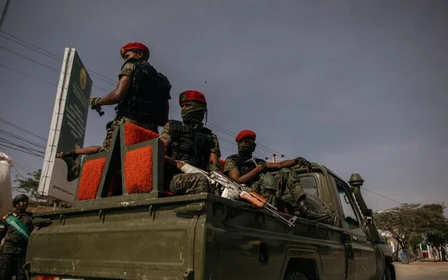
In early August, the commander of US Special Operations Command Africa, Major General Claude Tudor, signed a deal with the president of Somalia’s northeastern, semi-autonomous Puntland State, Saeed Abdullahi Deni.
The two agreed to expand the American military base in Bosaso, a port city on the Gulf of Aden. According to a brief statement circulated by the Puntland Government of Somalia, the expansion is essential to “improve operations against terrorism and to help protect maritime security”.
“The Puntland state remains committed to fighting terrorism and any threat that could harm the security, stability, and development of Puntland, Somalia, and the Horn of Africa,” the statement reads.
The US has previously utilised a United Arab Emirates-built air base in Bosaso primarily for Puntland’s Maritime Police Force (PMPF), a regional force backed by the UAE to combat piracy and trained, in part, by the notorious US private military contractor Xe, formerly known as Blackwater.
Its regional administration and lack of military licensure made the Bosaso Air Base and the PMPF a direct violation of UN Security Council Resolution 1425 and the UN arms embargo on Somalia, prior to the UN Security Council lifting the embargo in late 2023.
New MEE newsletter: Jerusalem Dispatch
Sign up to get the latest insights and analysis on Israel-Palestine, alongside Turkey Unpacked and other MEE newsletters
In October, Middle East Eye investigated the Bosaso Air Base, located next to the Bosaso International Airport. It identified military equipment from the UAE, namely “a radar facility, fortified ammunition depots, a dedicated cargo area for IL-76 heavy transport aircraft, a field hospital, a vehicle storage yard that houses dozens of pickup trucks, aircraft hangars and the original hangar of the Puntland Maritime Police Force (PMPF)”.
Much of the weapons and heavy logistical materials in transit from the UAE at Bosaso are destined for Sudan’s paramilitary Rapid Support Forces, which have been at war with the Sudanese Armed Forces since April 2023 and are accused of committing war crimes and acts of genocide.
The expanded US military presence appears closely tied to the widening terrain of the Iran war, as access to the Bab el-Mandeb Strait, the water body uniting the Red Sea and the Gulf of Aden, grows more perilous.
It may also suggest Washington’s desire to wage operations against Yemen’s Ansar Allah, commonly known as the Houthis.
The deal in Puntland occurred in the wake of the Houthis’ declaration of a maritime blockade on Saudi Arabia’s Red Sea ports, a retaliatory measure after Saudi strikes on Yemen’s Sanaa International Airport.
Djibouti holds the largest US permanent base in Africa, Camp Lemonnier, but its government is stringent and self-preservational, denying Washington permission to strike Yemen from its base because of concerns that it would endanger its people.
Peripheral moves
The Puntland deal is legally murky, as it bypasses the US-backed Federal Government of Somalia. Puntland has refused to recognise the federal system after Somali President Hassan Sheikh Mohamud introduced constitutional changes in 2024, concentrating power in Mogadishu.
Between June and July, there were at least seven armed clashes between forces of the Federal Government of Somalia and the Puntland administration.
US Africa Command (Africom) officials also met with leadership in Jubaland, a federal member state in southern Somalia that doesn’t acknowledge Mogadishu’s authority, in the days before the Puntland government announced the deal.
The US still affirms Somalia’s territorial integrity and sovereignty in response to Israel’s formal recognition of Somaliland and Somaliland’s subsequent establishment of a diplomatic mission in Jerusalem - though its negotiations could be seen as provoking divisions in Somalia.
New phase in Somali relations
At the onset of the War on Terror in 2002, the US began steadily expanding its military presence in Somalia, deploying special operations forces before introducing conventional troops, helicopters, surveillance aircraft, operating outposts, and drones.
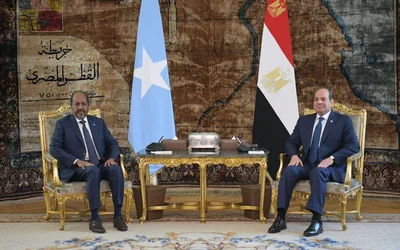
For more than two decades, Africom has conducted drone and air strikes against al-Shabaab leadership and Islamic State affiliates in coordination with the Federal Government of Somalia, while equipping and training the Danab Brigade, the Somali National Army's elite special forces unit that has led many of Mogadishu's ground offensives.
In his first term, US President Donald Trump carried out 219 air strikes on Somalia, ostensibly as “counter-terrorism” operations. Since his second inauguration, Trump has presided over an unprecedented escalation of the war in Somalia, striking the country 205 times so far.
The expansion of the Bosaso Air Base comes as the Pentagon has delegated operational authority to Africom.
During a visit to Africom headquarters in February 2025, US Secretary of War Pete Hegseth signed a covert directive removing the requirement for White House approval before drone strikes in Somalia.
The US ended its financial and logistical support for the UN Support Office in Somalia this July, foreclosing the African Union Support and Stabilisation Mission in Somalia.
The decision to negotiate in Puntland signals more than a continuation of America's counterterrorism campaign.
Considered alongside Washington’s resignation from multilateral “peacekeeping” missions and the loosening of constraints on Africom, the expanded Bosaso Air Base may be read as the US intensifying its foothold in Somalia while becoming more willing to act within the country’s political fragmentation rather than around or against it.
Middle East Eye delivers independent and unrivalled coverage and analysis of the Middle East, North Africa and beyond. To learn more about republishing this content and the associated fees, please fill out this form. More about MEE can be found here.