Why do US elections cost so much money?

In the United States, elections are big business.
No other country spends as much on them, and few political capitals are as heavily shaped by money and lobbyists as Washington, DC.
But the vast amounts of money poured into state and federal races aren't there to cover operational costs so Americans can access the ballot box.
They're designed to influence the narrative.
According to the OpenSecrets project which tracks campaign financing, nearly $5 billion was spent on the 2024 presidential and congressional election cycle by individuals, groups, and outside spenders combined.
New MEE newsletter: Jerusalem Dispatch
Sign up to get the latest insights and analysis on Israel-Palestine, alongside Turkey Unpacked and other MEE newsletters
Before 2010, that figure was below $1 billion.
Why are we examining this now?
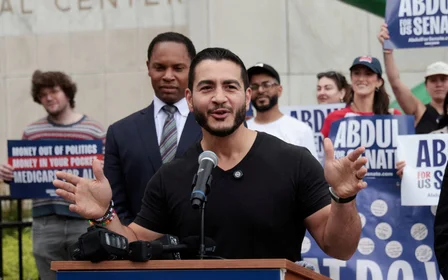
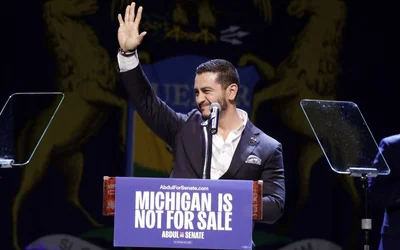
Abdul El-Sayed staged a stunning upset in Michigan earlier this month, when he beat Congresswoman Haley Stevens to clinch the Democratic party's nomination for the Senate.
Stevens, a centrist, was backed by the Democratic establishment as well as the state's governor. Sayed, a progressive who has never held political office, could now become the first ever Muslim senator if he wins in November.
But his win is being framed as an upset due to the record-setting influx of cash in the campaign to defeat him.
More than $50 million from corporate and single-issue organisations was thrown behind Stevens in the race. The pro-Israeli lobby alone spent $30m to ensure her win.
Sayed benefitted from a little over $5m in outside spending, mostly from a progressive values group.
This is separate from what each of their campaigns raised via donations - and all of it just for a primary, not even a general election.
That's because in the US, the sky's the limit for groups who want to support a candidate without having to route their money through the candidate's campaign.
And typically, the more money you can spend on things like television adverts to attack your opponent, or social media videos to boost your public image, the more likely it is you will emerge victorious.
"Money usually wins. So when it comes to campaigns, whoever spends more money usually wins by a 95 percent chance," Craig Holman, a government affairs lobbyist with Public Citizen, a consumer advocacy non-profit, told Middle East Eye.
But as we saw with Sayed's campaign, sometimes there are exceptions.
What is the legal basis for all this spending?
In the 2010 Citizens United case, the Supreme Court struck down limits on how much corporations and special interest groups could spend to influence elections. The justices ruled that such limits infringe on free speech - and that the spending itself is considered political expression, which should not be stifled.
"The Government may not suppress political speech based on the speaker's corporate identity," the ruling read. "No sufficient governmental interest justifies limits on the political speech of nonprofit or for-profit corporations."
That ruling set the stage for the rise of Super Pacs. More on that later.
For now, it's important to know that there is still a cap on direct individual donations to candidates, limited to $3,500 for federal races such as the presidency and the legislature, according to the Federal Election Commission (FEC). The cap can vary at state level.
Individuals may also donate to the national party overseer, such as the Democratic National Committee or the Republican National Committee, up to a limit of $44,300. These institutions vet candidates and develop their party's election strategy.
Earlier this year, the Supreme Court further de-regulated campaign financing by allowing candidates to gain control over the funds their party committee allocates for their race.
President Donald Trump hailed the decision as a victory.
What is a Pac?
Groups that have long-term interests and want to target specific candidates can get around the $3,500 limit by forming a Political Action Committee.
Pacs are rife within the US political system. All candidates across the political spectrum use them.
They must be registered with the FEC, have at least $1,000, and usually, they plan to outlast one or two election cycles given they are playing the long game in politics.
They can be single-issue dominated, or aligned with a party's general platform.
Anyone can start a Pac, campaign finance expert Anna Massoglia told MEE, but Pacs can only accept money from individuals and not organisations.
There is still a contribution limit when an individual gives money to a Pac on behalf of a cause or attached to a candidate. This is typically $5,000 at the federal level per election cycle, but those limits can again vary at the state level.
This means an American citizen is permitted to donate once as an individual, and a second time as a contribution to a Pac, but at no more than $7,000 in total.
The candidate, with whom the Pac works closely, can then use the funds however they choose.
Super Pacs, however, are another story.
What are Super Pacs?
These have unlimited spending power, and can collect as much money as they want from wealthy individuals and corporations.
"They are legally prohibited from coordinating with candidates in most ways, but they can spend in support of them," Massoglia said.
"They're what's called 'independence expenditures', and so basically they can take over $100m if they wanted to from a single individual, and spend all that money in support of a candidate," she added. "And as long as they disclose the spending, and whoever the donor is - at least the immediate donor - then that is perfectly legal."
The United Democracy Project (UDP) is an example of a Super Pac that is one of the highest spenders on US elections. It is a single-issue group, driven by pro-Israeli interests at the American Israel Public Affairs Committee (Aipac).
UDP spent more than $60m trying to shape the 2024 election cycle.
"What we all know is, if I'm spending a million dollars on behalf of a candidate, the candidate probably knows that I'm doing that, right? And so they'll have the same sort of sense of indebtedness to me as the spender," Michael S Kang, a law professor who teaches a course on regulating money in politics at Northwestern University, told MEE.
Super Pacs employ the kind of outside spending that is limitless, and can tip election results one way or another.
Aipac, as a Pac, is limited to the $5,000 cap per candidate, per election cycle.
And it's important to keep in mind that primaries and general elections are counted as separate cycles.
What is 'dark money'?
Not all donors who influence US election outcomes are known - even if they legally should be.
Since the Citizens United ruling in 2010, these so-called "dark money" actors have spent well over $4b on federal elections alone, Massoglia found.
"Oftentimes, they'll be spending on ads that mention a candidate in favourable or disfavourable ways, but [they] do not explicitly call for voting for or voting against that candidate," she explained. "They avoid those terms or any other related 'magic words' [so] they don't have to disclose their spending to the Federal Election Commission."
In essence, they make the argument that they are not really campaign finance actors at all, Kang said.
"They spend millions of dollars often on campaign spending that's indistinguishable from the campaign spending by political committees and by Super Pacs [and] over the last 15 years, 20 years, that type of entity has been able to get away with that," he said.
In some cases an anonymous donor would contribute funds to a non-profit group, and that non-profit group would make the contribution to the Super Pac, ultimately shielding the donor from financial disclosures, Massoglia said.
Others use shell companies to make political contributions, making tracing difficult.
Who are the biggest spenders?
In the 2024 election cycle, Republican interest groups far outspent those supporting Democrats, at 65 percent to to 29 percent, respectively.
The Make America Great Again Super Pac was the top fundraiser, with $410m collected to exclusively back Trump's third bid for the White House, and spread his agenda.
Nearly 91 percent of all outside spending was ideological or single-issue, broken down into categories such as gun rights, anti-abortion, defence policy, and oil and gas, among others.
But often ranked at the top, over multiple election cycles, are the US Chamber of Commerce, lobbying on behalf of businesses; the National Association of Realtors, influencing property laws; and the Pharmaceutical Research and Manufacturers of America, shaping health policy.
Tech giants like Meta and Amazon are also climbing fast.
As a Pac, Aipac was the third biggest spender in the 2024 election. Its Super Pac arm, UDP, ranks among the top 15 spenders across all industries.
No other group laser-focused on the interests of a foreign country has this much influence.
For the 2026 races, a report by Americans for Tax Fairness found that, as of 1 March, nearly 80 percent of all the billionaire contributions to Super Pacs were for Republican candidates and causes.
The funds mostly came from Tesla and SpaceX boss Elon Musk, Wall Street money manager Jeffrey Yass, and tech mogul Greg Brockman.
How does this system impact democracy?
The House of Representatives runs on two-year terms. The presidency runs on four. The Senate runs on six.
In a system where money creates the brand, candidates are continuously fundraising and worrying about the next election even in the early weeks and months of their term.
"It undermines the democratic process," Holman told MEE.
"It allows wealthy individuals, wealthy groups, corporations, and even foreign interests to invest heavily into who is elected to our government. If [candidates] want to remain in office, they know where the money is coming from."
Kang noted that the ability to raise large sums of money can be critical at the grassroots level, when, for example, a relative unknown is trying to run for local office for the very first time, and needs to be able to pay campaign staff.
"There are people who say that fundraising is kind of a proxy for popularity, but that's not really true, because we come from different communities and different communities have different amounts of wealth, and so the way that the role and the importance that money plays in politics has a way of favouring the wealthy [gives them] outsized influence," he said.
A 2016 paper by the conservative think tank The Manhattan Institute insisted that money did not buy election outcomes.
"Political scientists have had great difficulty determining the level of influence - if any - that contributions have in the legislative process," the paper read.
"Donations to campaigns are rarely given for the sake of changing politicians' minds. Rather, donors generally give money to people with whom they already agree - and who have a shot at winning."
Are there efforts to reform campaign financing?
Yes - and many begin at the state level.
Mop Up Michigan is one group gaining traction after Sayed's primary victory, building on his messaging on getting money out of politics.
It's calling for a ban on utility companies and corporations from donating to political campaigns, and urging transparency so the public can understand who is funding political ads for or against candidates.
"I know Arizona is one state that's really worked hard to tackle this to try to at least shine some light on 'dark money', requiring additional disclosure around the ultimate source of funds," Massoglia told MEE.
"I would say those efforts have been somewhat successful but limited, because oftentimes 'dark money' groups and the operatives running them will continue to come up with new methods and tactics in order to hide their spending."
In recent Congresses, both major parties have proposed campaign finance bills, but no major amendments have become law.
The Brennan Center for Justice at the New York University Law School has advocated for what is describes as "the most effective and promising solution" to the problem of big money in politics: small donor public financing, whereby public funds match or multiply each contribution.
This incentivises candidates to seek out many supporters, not just a few big donors, the think tank argued.
But that also requires more legwork, and greater outreach, when it can be easier to fall back on the millions of dollars in favourable ads that a Super Pac will run.
Current campaign finance regulation "is useless at this point", Holman told MEE.
"Even though the courts have not yet struck down contribution limits to actual candidates and political committees, they decided to open up a huge loophole of no limits and no source restrictions on contributions to nonprofit electioneering groups," he said.
"The biggest effort is to reform the court system, because it's the courts that have destroyed our campaign finance laws."
Middle East Eye delivers independent and unrivalled coverage and analysis of the Middle East, North Africa and beyond. To learn more about republishing this content and the associated fees, please fill out this form. More about MEE can be found here.