Iranian press review: Tehran says it will no longer wait to be attacked

Shift to offensive military doctrine in rhetoric
Iranian military commanders and politicians have recently underlined a shift in Iran's military doctrine, moving from a defensive to an offensive strategy against US forces in the Middle East.
The shift came with new Supreme Leader Mojtaba Khamenei appointing six military commanders to replace those killed by Israel and the US during the recent war.
While some figures had previously mentioned this change in military doctrine, the new appointments have made the topic prominent in local media.
On Wednesday, Brigadier General Alireza Sheikh, the deputy commander of the army, explained this new approach towards US forces to the media. He pointed to recent attacks on the bases of Kurdish opposition groups as an example of this strategy.
New MEE newsletter: Jerusalem Dispatch
Sign up to get the latest insights and analysis on Israel-Palestine, alongside Turkey Unpacked and other MEE newsletters
"Trump's political bluffs aim to distract public opinion and disrupt our analysis," Sheikh said.
"However, logical thinkers see that Iran can respond proportionally and even act pre-emptively. This shows our doctrine is shifting from purely defensive to deterrence and active action."
Previously, Mehdi Mohammadi, an adviser to the parliament speaker, outlined the new military approach, citing the Islamic Revolutionary Guard Corps' attack on US bases in Jordan on 29 July as an example. The attack came without any preceding US strikes against Iran.
"Iran no longer fights the enemy as it did in the past," Mohammadi said regarding the attack. "Launching surprise, fast attacks and targeting sensitive points are part of the country's new war strategy."
Mohammadi also dismissed the idea of an unwritten ceasefire between Iran and the US, which some believed was tied to ongoing talks in Oman regarding the management of the Strait of Hormuz.
"Over the past week, an impression had formed that due to the ongoing negotiations between Iran and Oman, Iran would not act against the US unless directly fired upon," Mohammadi added. "However, realities on the ground showed this calculation was completely wrong."
Pressure mounts to weaponise Strait of Hormuz
Ongoing talks between Iran and Oman to create a mechanism for controlling the Strait of Hormuz come amid rising pressure from conservative and ultraconservative groups inside Iran who want to maximise the use of the strait as a new weapon against the US and its allies.
On Tuesday, Alireza Zakani, the principlist mayor of Tehran and a former Revolutionary Guard member, emphasised the need to halt any talks with the US, saying that Tehran must use its control over the Strait of Hormuz to advance its policies against Washington and its Arab and European allies.
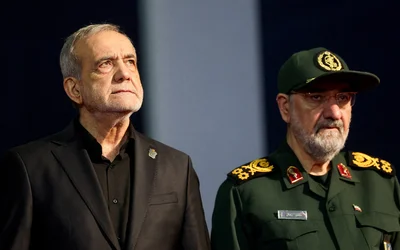
"If America wants to benefit from the Strait of Hormuz, it must pay us compensation. If Qatar wants to use this strait, it must release our frozen funds. Hardening access to this vital route will make Europe no longer dare to sanction Iran," Zakani said.
The pro-conservative Resalat daily also published a report, headlined “The drawn sword of Hormuz in Iran’s hand”, highlighting conservative demands that the Strait of Hormuz not be returned to the conditions that prevailed before the US and Israeli attacks.
According to the daily, closing the strait was a response "proportional to the repeated military aggression of America and the Zionist regime, and the naval blockade imposed on Iran following it".
Resalat concluded by stressing the importance of maintaining Iranian control over the Strait of Hormuz: "This drawn sword must always remain in Iran's hands so that peace and security are guaranteed not through begging, but through power."
'Echoes' of days before end of Iran-Iraq war
Majid Tafreshi, a political analyst and researcher of contemporary historical documents, compared Iran's current political situation to July 1988, when the country accepted UN Resolution 598 to end the war with Iraq.
In 1980, Iraq, led by Saddam Hussein and backed by western military and intelligence support, invaded Iran and occupied parts of its oil-rich provinces. Iran, under the leadership of its first Supreme Leader Ruhollah Khomeini, accepted the resolution in 1988.
Making this comparison, Tafreshi criticised political factions that want to continue the war with the US under current conditions. He noted that a similar approach existed during the Iran-Iraq war.
He also examined the record of Qassem Soleimani, commander of Iran’s Quds Force, who was assassinated in a US strike in Baghdad in 2020.
Tafreshi said that portraying Soleimani as someone who only engaged in military conflict contradicts his actual political history.
"Even Qassem Soleimani believed in dialogue and negotiation. He was a man of diplomacy and took up arms when necessary. However, some people turned him into a Rambo, Zorro, or Spider-Man figure who only solved problems through war," he added.
Economic hardships hit ordinary people
While various political factions inside the country debate how to confront the US and Israel and end the "neither war nor peace" situation, the Sazandegi daily has reported rising economic pressure on ordinary people due to the US naval blockade.
According to the report, activities at Shahid Rajaee port, one of the main marine import and export terminals, have dropped sharply in recent weeks and the port is "emptier than ever".
The daily predicted that the impact of the naval blockade would soon become visible as store shelves ran out of essential goods.
Sazandegi also noted that, despite Iran’s extensive access to land borders with neighbouring countries, overland transport is far more costly and time-consuming than shipping by sea. The difference, it said, would further harm the livelihoods of people.
The report concluded: "Store shelves are the last place where a supply crisis becomes visible. The first sign must be sought much further away. Somewhere by the sea among cranes, ships, and containers, where, if they do not arrive today, their absence may be seen on people's dinner tables a few months later."
Middle East Eye delivers independent and unrivalled coverage and analysis of the Middle East, North Africa and beyond. To learn more about republishing this content and the associated fees, please fill out this form. More about MEE can be found here.