Amid genocide in Gaza, why must Palestinian journalists uphold the illusion of neutrality?


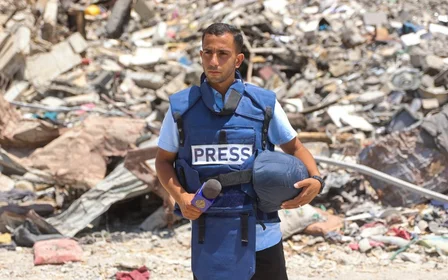
On 20 June 2026, the Israeli army killed Al Jazeera Mubasher cameraman Ahmed Wishah in a drone strike, less than two and a half months after the killing of his brother, Al Jazeera Mubasher correspondent Mohammed Wishah, who was targeted by the same army on 8 April.
After Mohammed's death, Ahmed appeared on Al Jazeera pleading: "Let Mohammed be the last journalist Israel kills. We don't want any more journalists targeted. My message to the world is to stop the occupation from killing journalists."
His global call went unanswered, and shortly afterwards, Ahmed was killed by the Israeli army.
In a study published on 1 April 2025, Brown University's Costs of War Project concluded that the war on Gaza had killed more journalists since October 2023 than the US Civil War, the First and Second World Wars, the Korean War, the Vietnam War - including the conflicts in Cambodia and Laos - the Yugoslav wars of the 1990s and 2000s, and the post-9/11 war in Afghanistan combined.
Moreover, in its annual round-up published in December 2025, Reporters Without Borders (RSF) found Israel responsible for nearly half of all journalist killings recorded worldwide that year, making occupied Palestine the most dangerous place in the world for journalists.
New MEE newsletter: Jerusalem Dispatch
Sign up to get the latest insights and analysis on Israel-Palestine, alongside Turkey Unpacked and other MEE newsletters
By the previous August, the organisation had already documented some 220 journalists killed by Israeli forces in the Gaza Strip in less than 23 months. That figure had risen to 259 by March 2026.
Why does Israel kill Palestinian journalists? Just as it kills children and other civilians, bombs hospitals and destroys infrastructure, it feels no obligation to offer convincing justifications, because it believes that it is immune from accountability.
The journalists' tent
In November 2023, I was discharged from Nasser Hospital in southern Gaza after receiving treatment for injuries sustained in an Israeli air strike that targeted my home and killed seven members of my family, including my son Abdullah.
I had to leave my hospital bed to make room for another wounded person, given the influx of thousands of casualties.
I had nowhere else to go. Our house was destroyed, my family was displaced, and I still needed time to recover.
A group of journalists welcomed me. They had set up a tent in the hospital courtyard for their work, and they offered to host me there.
They took me in, shared their food with me and gave me a place to sleep. I stayed with them for a month, until we were forced to evacuate when the Israeli military invaded Khan Younis and its tanks advanced towards the hospital.
Looking back, I can count at least four of the journalists I lived with in that tent who were later killed by the Israeli army
About eight journalists slept in that tent at night, and by day it became a busy newsroom frequented by about 20.
Looking back, I can count at least four of the journalists I lived with in that tent who were later killed by the Israeli army: Hassan Islayeh, Mohammed al-Bardawil, Mustafa Thuraya and Mohammed Abu Saada.
Another, Ismail Abu Omar, survived a direct Israeli drone strike but lost a leg.
I do not know what happened to the others. Communication was lost, and news from Gaza became increasingly difficult to follow amid the overwhelming scale of events.
Islayeh, one of Gaza's best-known local journalists, was first targeted by the Israeli military while he was in his tent. He was wounded, but survived.
He was then targeted a second time while lying injured in a bed at Nasser Hospital in Khan Younis, where he was killed on 13 May 2025.
In its statement on his killing, the Israeli military claimed without evidence that he was a Hamas member, and cited among its justifications his having documented the Hamas-led attacks on southern Israel on 7 October 2023.
But documenting those scenes is nothing more than professional work. Islayeh obtained those exclusive shots because he lived near the eastern fence in Khan Younis, which allowed him to arrive quickly and document with his camera.
Any journalist of any nationality near the location at that time would likely have done the same.
Killing the witness
On 10 August 2025, Israel killed six journalists who were sleeping in a tent near al-Shifa Hospital in Gaza City, among them Al Jazeera correspondent Anas al-Sharif.
Shortly after the strike, the Israeli military posted that Sharif "was the head of a Hamas terrorist cell and advanced rocket attacks on Israeli civilians and IDF troops".
An easy way to deflect criticism after targeting journalists is to claim they were killed by mistake, or that they were not civilians because they were affiliated with Hamas.
Yet the military offered no explanation for the killing of the five other journalists who died in the same attack, despite being fully aware that they were inside the tent with him.
Israel possesses advanced surveillance and intelligence capabilities that enable it to monitor potential targets before carrying out strikes.
As the cases of Sharif and Islayeh show, the Israeli military's most common allegation is that the journalists it targets are affiliated with Hamas.
However, Israel does not define what such affiliation means. The claim is difficult to verify objectively, and many journalists have been killed while clearly engaged in their reporting duties on the ground.
As Muhammad Shehada argued in an analysis for the Israeli independent magazine +972, Israel's record-breaking killing of Palestinian journalists serves a longer-term goal: the destruction of first-person testimony and evidence of its war crimes.
"Journalists in Gaza are often first at the sites of atrocities, mapping out attacks and reaching victims and witnesses," he wrote. "Silencing them eliminates vast troves of incriminating information."
On 11 May 2022, Israeli forces killed the Palestinian journalist Shireen Abu Akleh while she was reporting in the Jenin refugee camp in the occupied West Bank.
She was a Christian Palestinian who did not wear a headscarf, held American citizenship and lived in Jerusalem - a profile that makes any allegation of Hamas affiliation implausible even on Israel's own terms.
She was killed by the same army that has killed Islayeh, Sharif and more than 250 journalists in Gaza. The goal is always the same: to kill the witness who documents the crime.
Follow Middle East Eye's live coverage of Israel's genocide in Gaza
At a lecture, I was asked whether the absence of international journalists in Gaza was a valid explanation for the weakness of media coverage.
I replied that the party categorically preventing foreign journalists from entering Gaza is the Israeli army, and that prohibition is a direct indictment of it, a clear indication of the Israeli war criminals' intention to conceal the truth.
We should nonetheless be careful with the term "international journalists", so that it does not imply that those working inside the Gaza Strip are less competent.
No race or culture entitles a journalist to the title of "international" to the exclusion of others. International journalists come from diverse countries, and Palestinian journalists are international journalists, too.
They are already present in Gaza, direct witnesses to Israel's crimes, and they have documented those crimes in hundreds of thousands of videos, photographs and reports. They work with all the major international outlets and international organisations, and the United Nations rely on their work.
If Israel is going to accuse Gaza's journalists of lacking credibility, why has it not opened the doors for journalists from abroad to come and document the reality for themselves?
The illusion of neutrality
Any attempt to justify the killing of more than 200 journalists is flimsy. Israel has no convincing case against the majority of them, and no affiliation with any faction could justify their murders.
Even if it were established that some Palestinian journalists were affiliated with Palestinian political movements, why should that, in principle, justify their killing?
Any journalist anywhere in the world grows up within a national and cultural context that shapes their identity and life direction, and it is absurd to assume that a journalist can be separated from the context in which they were raised.
There is no such thing as neutrality, only the objective reporting of facts. Israel's horrific crimes in Gaza require nothing more than their documentation.
The Palestinian people have been struggling against colonialism for a century, and the demand for national rights has formed the consciousness of generations.
It is as unrealistic to strip Palestinian journalists of their natural national affiliation as it would have been to condemn a Dutch journalist for supporting the national resistance against the Nazi invasion in the 1940s.
During media interviews and speeches in the Netherlands, I was asked about neutrality in journalistic work. One journalist expressed surprise that I combine the roles of journalist and activist, and wondered whether the two can work together.
My answer is that neutrality is an illusion. When a journalist witnesses a soldier killing a child, how can they be neutral?
There is no such thing as neutrality, only the objective reporting of facts. Israel's horrific crimes in Gaza require nothing more than their documentation.
When people die of starvation in Gaza, it is impossible to avoid mentioning that Israel is preventing food trucks from reaching civilians. When hundreds of thousands of civilians flee their homes, it is impossible to avoid mentioning the forced displacement orders issued by the Israeli army.
These facts cannot be diluted under the guise of neutrality. Neutrality in this context is siding with the aggressor and participating in the crime.
Another question concerned whether a journalist who is close to events is more likely to be swayed by emotion, while a distant journalist is more objective.
I respond with a counter-question. Is emotional engagement with an event a source of strength or of weakness for a journalist? Is emotional detachment really a prerequisite for good journalism?
Emotional engagement breathes life into journalism, whereas reporting from a distance often presents statistics and figures with little sense of the human experience behind them. Audiences do not follow the news merely to absorb numbers; they look for a living story that speaks to them on a human level.
Consider the difference between a journalist working from an office outside Gaza who writes a report, supported by statistics, about the suffering of people living in tents in the scorching heat, and a journalist living in a tent who writes a story shaped by personal experience.
Which story is more likely to feel alive?
Compare, too, a distant journalist preparing a report on casualty figures with one who has lost a brother or a mother and writes about that loss while still adhering to the professional standards of the craft.
Journalism does not require journalists to be emotionally detached. It requires accuracy and objectivity, qualities that Gaza's journalists have demonstrated with professionalism and distinction.
After all, the best people to tell a story are often those who have lived through it.
The views expressed in this article belong to the author and do not necessarily reflect the editorial policy of Middle East Eye.
Middle East Eye delivers independent and unrivalled coverage and analysis of the Middle East, North Africa and beyond. To learn more about republishing this content and the associated fees, please fill out this form. More about MEE can be found here.