How the military-industrial complex is waging war on the planet


The scale of the arms industry’s contribution to climate change is often minimised, avoided or ignored.
But preparations for war, and war itself, are killing the planet faster than practically any other single factor. The military-industrial complex causes more environmental damage than either the civilian aviation industry or the global shipping industry; in fact, its carbon footprint is close to both combined, according to a recent report.
It does so through both standard peacetime operations and the actual waging of war itself.
The best-known attempt to estimate the global military carbon footprint came in a 2022 study by researchers at Scientists for Global Responsibility and the Conflict and Environment Observatory.
They estimated it at about 5.5 percent of global greenhouse-gas emissions, with a plausible range of 3.3-7 percent, larger than Russia’s national emissions - and that figure does not include the emissions generated by actual wars.
New MEE newsletter: Jerusalem Dispatch
Sign up to get the latest insights and analysis on Israel-Palestine, alongside Turkey Unpacked and other MEE newsletters
So why do the peacetime operations of the arms industry make such a huge contribution to climate change?
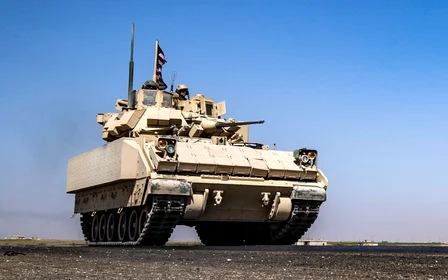
Firstly, modern armed forces depend heavily on oil. Fighter aircraft, bombers, helicopters, warships, tanks and military logistics fleets consume very large quantities of jet fuel and diesel. Military exercises and the worldwide movement of personnel and equipment add to this.
Nato itself now explicitly recognises military activities and installations as sources of greenhouse gases, and has even developed a methodology for measuring them.
Permanent footprint
Military infrastructure has a permanent footprint. Bases, airfields, naval facilities, radar installations, military housing and training grounds consume electricity and heating fuel, and require construction and maintenance.
Maintaining a worldwide network of military installations therefore generates emissions even when no war is taking place. Nato’s own accounting methodology explicitly includes military facilities and installations.
Secondly, weapons production - encompassing aircraft, ships, armoured vehicles, missiles, electronics, buildings and ammunition - has a large industrial footprint, requiring steel, aluminium, titanium, cement, chemicals and huge international supply chains.
Unless military production is radically de-escalated, it could burn the planet before it has a chance to bomb the planet
But that is just the start of it. Once soldiers begin using their weapons, the planet is among the first casualties. When fighting starts, aircraft fly far more missions, armoured vehicles operate continuously, ammunition has to be transported, ships deploy, and vast logistical systems move fuel, food, weapons and personnel. The carbon footprint of a military at war is thus substantially greater than its peacetime footprint.
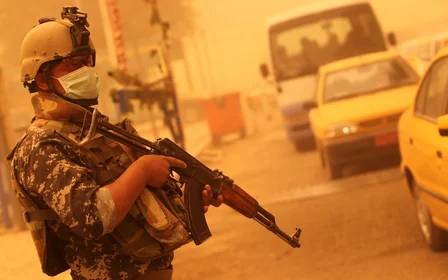
The destruction of war magnifies the impacts on the environment. Attacks on oil refineries, fuel depots, factories, power stations and industrial facilities can release greenhouse gases directly and generate enormous fires.
Urban warfare can also burn buildings and vehicles. The Conflict and Environment Observatory consequently treats emissions generated by warfare as an additional category beyond the estimated 5.5 percent military footprint.
And even after the fighting stops, the costs to the environment continue to mount. Reconstruction can be exceptionally carbon-intensive. Destroying a city creates emissions during the attack, but rebuilding it requires huge quantities of cement, concrete, steel, glass and asphalt.
Cement and steel production are themselves major sources of carbon dioxide. A war can therefore create a second wave of emissions lasting many years after the fighting stops. The 5.5 percent estimate excludes post-conflict reconstruction.
Disastrous effects
Even then, the damaging effects are not done. War can destroy natural carbon sinks. Forest fires, deforestation, destruction of wetlands, soil degradation and damage to ecosystems can release stored carbon, while simultaneously reducing the land’s future ability to absorb carbon dioxide.
Conflict can also weaken environmental regulations and make illegal logging or uncontrolled resource extraction easier.
All these factors are likely to be underestimated, not overestimated; military emissions have historically been poorly reported, and states differ considerably in what they count.
This is the situation as it currently exists. But we are in the foothills of a global rearmament binge, and that will have even more disastrous effects on the climate.
We have seen that the hypothetical “global military” is among the largest emitters on Earth - behind China, the United States and India. Nato accounts for an extraordinary proportion of the world’s military expenditures, which reached nearly $2.9 trillion in 2025; of that, Nato’s 32 members accounted for nearly half.
But Nato has set a much larger target for 2035, aiming to increase defence spending to 5 percent of GDP. The June 2025 Hague declaration commits allies to spending 3.5 percent of GDP on core military requirements, plus up to 1.5 percent on defence and security-related infrastructure and expenditures.
The Stockholm International Peace Research Institute has calculated the implications. The average military burden of Nato members in 2024 was 2.2 percent of GDP, with the alliance’s total expenditures reaching $1.5 trillion. If the 5-percent target is achieved, Nato security-related expenditures would reach roughly $4.2 trillion a year.
This would, among other things, massively increase the military’s damage to the environment.
Competing for resources
A major 2025 study in the Nature Communications journal examined the relationship between military spending and carbon emissions. It found a statistically significant relationship between growth in the global military-spending share of GDP and increases in carbon-emission intensity.
Looking at Nato’s proposed 3.5 percent core military target, researchers estimate that the increase could produce roughly an additional 540 million to 1.25 billion tonnes of greenhouse gases annually by 2035, approaching the emissions of one of the world’s major national emitters - and that’s on top of the military emissions already occurring.
Ironically, international shipping organisations are formally committed to reducing emissions. So we could be looking at a remarkable divergence: civilian transport decarbonises, while the military sector rapidly adds to its carbon footprint.

That makes military expenditures increasingly important as a uniquely damaging factor in climate change. Every additional $1 trillion devoted to this sector represents capital, industrial capacity, skilled labour, steel, electronics, research and government borrowing that cannot simultaneously be used elsewhere.
Military expansion thus competes for precisely the same resources required for renewable power generation: electricity grids, railways and public transport, building insulation, heat pumps, low-carbon steel, battery production and climate adaptation measures.
This is why the economic myopia of some labour leaders, like Unite’s Sharon Graham, ignores the hidden costs of military expenditures, at the direct expense of their members’ jobs and wages - as well as the future of the planet. And that may ultimately be as important as direct military emissions.
There is now a strong empirical basis for the argument that rearmament on the scale contemplated by Nato isn’t merely competing financially with the green transition; unless military production is radically de-escalated, it could burn the planet before it has a chance to bomb the planet.
The views expressed in this article belong to the author and do not necessarily reflect the editorial policy of Middle East Eye.
Middle East Eye delivers independent and unrivalled coverage and analysis of the Middle East, North Africa and beyond. To learn more about republishing this content and the associated fees, please fill out this form. More about MEE can be found here.