Israeli opinion article says Turkey's Nato protection does not apply to troops in Syria

An opinion article on Thursday in the right-wing Israeli paper Israel Hayom has suggested that any Turkish troops in Syria would be considered sitting ducks for Israel, because Nato's collective defence pact would not apply outside a member state's borders.
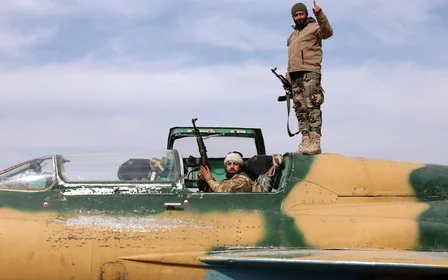
The piece comes two days after Israeli air strikes destroyed parts of a disused air force base in northern Syria, close to the Turkish border, where Israel believed Turkish troops were on the cusp of moving in.
"Before Turkish troops arrive, the target is infrastructure; once they arrive, striking it also risks Turkish casualties, retaliation, American intervention and confrontation with a NATO member. Those costs alter the calculation, not Israel's authority to decide," Shay Gal, head of government relations and strategy firm Line of State, wrote in the Israel Hayom opinion piece.
Israel, he said, "has studied not only how NATO's Article 5 operates, but where it applies. The treaty protects Turkish territory; Turkish troops do not carry that territory with them onto Syrian or occupied Cypriot soil."
Israel Hayom is published by Miriam Adelson, an Israeli American who is the top donor to Trump, and, by the president's own admission, has considerable sway over his policies towards Israel.
New MEE newsletter: Jerusalem Dispatch
Sign up to get the latest insights and analysis on Israel-Palestine, alongside Turkey Unpacked and other MEE newsletters
Israeli officials have made no secret of perceiving Turkish President Recep Tayyip Erdogan's government as an enemy that wants to weaken it. But under US President Donald Trump, Washington is growing closer to Ankara than ever.
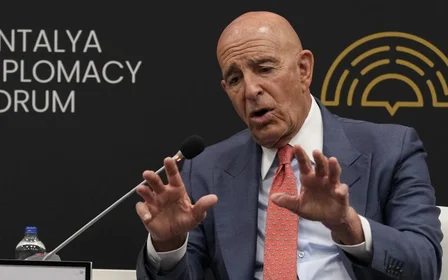
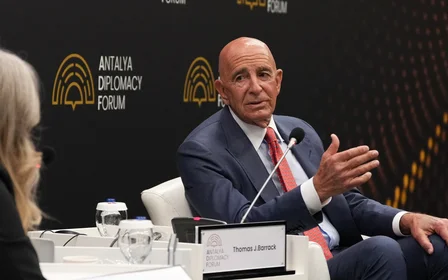
US ambassador to Turkey and envoy to Syria Tom Barrack said Turkey was not warned about the strikes, despite a deconfliction line with Israel in Syria established last year.
Barrack suggested in an interview with Reuters this week that communication had broken down.
"This underscores the need for a deconfliction mechanism involving Israel, Syria and Turkey. That is something we are actively working on to establish in order to prevent future miscommunication," he said.
The Israel Hayom article warned that Turkey's close security ties to Damascus are a threat to Israel.
"Turkey's Syrian project has moved beyond political influence," Gal wrote. "Ankara trains Syrian forces and rebuilds military institutions. In 2025 Turkish military teams examined T4, Palmyra, and Hama as sites for Turkish military depth. Israel subsequently struck those facilities."
Israel, the article says, "acted before Turkish military depth matured" to become an "occupation" such as that of northern Cyprus.
'Unnecessary escalation'
Barrack defended the Syrian government on Tuesday after Israeli air strikes targeted the Abu al-Duhur military air base, calling it an "unnecessary escalation".
"The Al-Sharaa government has neither adopted a predatory posture nor maintained proxy forces. It has, in fact, repeatedly indicated a preference for de-escalation with Israel," he wrote on X.
"We are deeply concerned," he added. "[This] does not advance regional stability."
The Syrian government condemned the attack and said eight strikes hit the runway of the defunct air base in the early Tuesday morning hours, local time.
The Syrian Observatory for Human Rights said the strikes followed a visit by a Turkish military delegation to the airfield in recent days "as part of efforts to reactivate it".
Since former Syrian President Bashar al-Assad fled to Russia in December 2024, Israel has consistently targeted sites along Syria's western border and its north, focusing on degrading the Syrian air force.
It has also sent ground troops into a United Nations-operated buffer zone between the two countries.
The Israeli prime minister’s office said in a statement late on Tuesday that Israel and Syria had agreed to maintain the security status quo, “which Syria was on the verge of breaching by permitting Turkish troops to deploy at an airbase near Aleppo”.
Syrian officials told Middle East Eye that a Turkish technical team had been tasked with repairing the runway and control tower and that there was no military presence at the base.
“The last team tasked with reconstructing the base was there two days beforehand,” one official said.
The officials added that Turkey had been helping the Syrian army build bases across the country, without any specific plans directed at Israel. Ankara, they said, wants to rebuild a robust Syrian military capable of defending the country.
“Turkey doesn’t take over every base,” one official added.
Ankara has, in fact, closed many smaller military outposts in northern Syria and already operates several established bases in the area.
Middle East Eye delivers independent and unrivalled coverage and analysis of the Middle East, North Africa and beyond. To learn more about republishing this content and the associated fees, please fill out this form. More about MEE can be found here.