Trump removes Syria from 'terrorism list'

The Trump administration on Monday formally removed Syria from the State Sponsor of Terrorism (SST) blacklist, in a landmark move that unlocks export restrictions and allows for the US to supply military aid to the country.
Secretary of State Marco Rubio said in a statement that he also delisted Hay'at Tahrir al-Sham's (HTS) designation as a Specially Designated Global Terrorist.
Syrian President Ahmed al-Sharaa, under his nom de guerre Abu Mohammed al-Jolani, was the leader of HTS, an al-Qaeda offshoot.
"These actions represent another historic step by President Trump to give the Syrian people a path to prosperity," Rubio said.
The move follows Israel bombing Syria's Abu al-Duhur airbase last week, which escalated tensions between Washington and Damascus, as well as Syria's main foreign backer, Turkey.
New MEE newsletter: Jerusalem Dispatch
Sign up to get the latest insights and analysis on Israel-Palestine, alongside Turkey Unpacked and other MEE newsletters
Tom Barrack, US ambassador to Turkey and envoy to Syria, called the strike "serious and worrying" in an interview last week, floating the idea that Israel may have been trying to "bait" Turkey into a war.
The US has previously signalled its intent to Syria's removal from the SST blacklist.
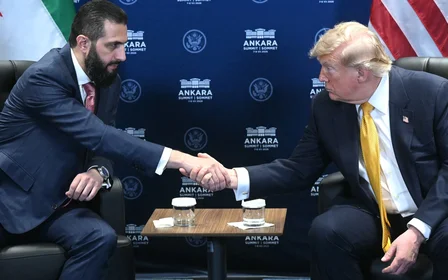
President Donald Trump formally kickstarted the process last month, in what was arguably the most significant result of his trip to the Nato summit in Ankara, Turkey, where he met with Sharaa on the sidelines of formal meetings.
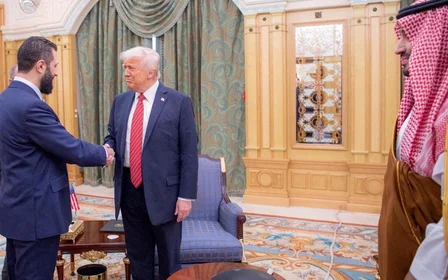
That meeting itself was a win for Sharaa, who was first introduced to Trump a little over a year ago in Riyadh, Saudi Arabia, before finding himself in the Oval Office exchanging gifts with the US president in November.
No Syrian leader - and certainly not one with Sharaa's past as a US-designated terrorist - had been in the White House in decades.
Syria was blacklisted in 1979, when the country was ruled by Hafez al-Assad, Bashar al-Assad's father. During the Cold War, Syria received financial and military aid from the Soviet Union. While the elder Assad was known for keeping channels open to both the US and its Cold War foes, he fell out with Washington over Lebanon and support for Palestinian resistance groups.
'Tough'
Trump's swift embrace of Sharaa has been one of the standout foreign policy moves of the past year, and one that perhaps no other US president from either party would have taken on.
The US president has called him "fantastic", "highly respected", and "tough".
Monday's delisting stems from Trump's executive order in June 2025, directing sanctions relief for Syria, noting his assessment of positive changes and counterterrorism actions taken by the Syrian government under Sharaa, and formal assurances provided by Damascus.
"In the past year, the Government of Syria has taken significant steps to counter terrorism, to include formally joining the Global Coalition to Defeat ISIS in November and conducting operations to disrupt the terror networks of ISIS, al-Qa'ida, Hizballah, and Iran-aligned groups," Rubio said.
"Rescinding Syria's designation as an SST and HTS' designation as an SDGT eliminates the final major barriers for private sector investment in Syria and promotes Syria's economic recovery and reintegration into the global economy."
Natasha Hall, associate fellow with the Middle East and North Africa programme at Chatham House, previously described to Middle East Eye the delisting's impact as "earth-shifting" for Syria.
"That was kind of one of the final barriers to Syria's economic recovery," she said.
The Syrian American Council, which actively pushed for the delisting, said it was "grateful" for the move.
"This is a clear win for US policy... from just the American national security perspective," the group's grassroots officer, Alberto Hernandez, told MEE. "This is the right way for engagement."
Middle East Eye delivers independent and unrivalled coverage and analysis of the Middle East, North Africa and beyond. To learn more about republishing this content and the associated fees, please fill out this form. More about MEE can be found here.