‘My land is forbidden to me’: Israel’s settlement push encircles Jenin

Ahmed Zeidat was tending his olive trees in the occupied West Bank when a group of Israeli settlers came charging towards him.
They punched him in the face and stomach. Zeidat fled on his tractor, with the settlers in pursuit.
Israeli soldiers eventually intervened, removing the settlers - and detaining Zeidat.
His offence, he was told, was being on his own land.
“When I asked the officer why I was being detained, he told me I was on private land that I wasn’t allowed to access,” the Palestinian farmer told Middle East Eye.
New MEE newsletter: Jerusalem Dispatch
Sign up to get the latest insights and analysis on Israel-Palestine, alongside Turkey Unpacked and other MEE newsletters
Bemused, Zeidat said: “This land is mine. How did it become private, and who does it belong to?”
The soldier, according to Zeidat, replied: “It belongs to us, and you’re not allowed to enter it.”
After a brief detention, Zeidat was released and ordered not to return.
“My land, the fruit of my labour and toil, is forbidden to me,” he said.
“It used to give me 600 kilos of pure olive oil. Now I look at it from afar. I can’t even look, because my heart aches.”

For Palestinians in Jenin and the surrounding villages, Zeidat’s experience is becoming increasingly familiar.
Since Israel’s unilateral disengagement in 2005, Palestinians in the northern West Bank had largely been spared direct contact with settlers. Israel dismantled four settlements in the area at the time - Ganim, Kadim, Homesh and Sa-Nur.
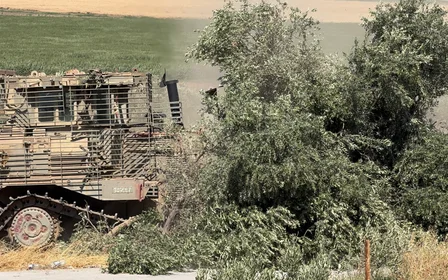
But since the current Israeli government took office in late 2022, settlement activity has accelerated across the West Bank. In and around Jenin, Israel has moved to re-establish the four evacuated settlements, approve new ones and build the military infrastructure needed to protect them.
Palestinians fear the result will be an expanding ring of settlements and military bases around Jenin, cutting the city off from neighbouring areas and tightening Israel’s control over land and movement.
Settlements and military bases
Israel has approved 11 new settlements in the Jenin area, in addition to the four it has revived, Tariq Ighbaria, director of the Wall and Settlement Resistance Commission (CWRC) in Jenin, told MEE. Settler families have already begun moving into some sites, while roads and other infrastructure are under construction.
In late July, the Israeli military seized nearly 200 dunams of Palestinian-owned land in Jenin through 15 military orders, according to the CWRC.
Haaretz reported that the land was seized to connect two new settlements south of Jenin, Noa and Emek Dotan.
The orders affect land designated as Area A under the 1995 Oslo Accords, which is supposed to remain under full Palestinian Authority control.
Israeli anti-settlement organisation Kerem Navot said it was the first time the army had used seizure orders in Area A to connect illegal settlements rather than for military purposes.
In June, Haaretz reported that the Israeli army was establishing a permanent military base in the heart of Jenin city - the first permanent military post it has built in Area A since the Oslo Accords. Sources told the newspaper the base was intended, among other purposes, to protect Israeli settlers returning to the area.
'What is happening represents a complete change to the geography of Jenin'
- Tariq Ighbaria, CWRC director in Jenin
The changes are already reshaping the landscape.
“The landscape of Jenin has changed significantly in recent months due to the return of settlers,” Ighbaria said.
Large swathes of Palestinian farmland and olive groves have been turned into construction sites, while bulldozers carve out roads and military installations.
“Bulldozing operations are also continuing in the mountains of Masliya and Qabatiya, while a military base is being constructed in the Jabriyat neighbourhood, classified as Area A and located in the heart of Jenin,” Ighbaria said.
He warned that the amount of land taken on the ground could be far greater than that specified in individual confiscation orders.
“If 200 dunams are confiscated to construct a road linking two settlements, the road and its security perimeter could effectively lead to the seizure of hundreds of additional dunams, perhaps reaching 600 or 700,” he said.
The expanding road network is also changing how Palestinians move around the area, Ighbaria said, separating villages from Jenin and disrupting links with Nablus, Tulkarm and Tubas.
Residents of Arraba, Marqa, Masliya, Qabatiya, Jaba, Fandaqumiya and Silat al-Harithiya are finding it increasingly difficult and dangerous to reach Jenin.
Settlers travelling in four-wheel-drive vehicles on roads and through farmland have added to the risks.
“What is happening represents a complete change to the geography of Jenin,” Ighbaria said, describing a network linking settlements and outposts, encircling Palestinian towns and bringing more land under Israeli control.
‘Cutting a piece of my soul’
The impact is already being felt by Palestinians whose livelihoods depend on the land.
Tariq al-Shaer, a vineyard owner in the Arraba Plain, south of Jenin, was forced to harvest his crop and sell it wholesale after receiving notice that his vineyard would be demolished and bulldozed.
The farm covers more than six dunams and contains about 750 grapevines. Shaer planted the first saplings 15 years ago, gradually turning the vineyard into a livelihood for his family and 15 others.

“Harvesting the grapes feels like cutting a piece of my soul,” he said.
“My family and I have worked so hard on this, and no one can help us keep it. The Israeli decision has been made, and that’s final.”
Mohammed Abu Mualla, who runs a poultry farm with his brothers between Marqa and Qabatiya, said they were also ordered to remove it under threat of demolition.
The farm is in Area A.
“They gave us only seven days to remove it, and we were forced to do so for fear of its demolition and the destruction of its contents,” Abu Mualla said.
“The notice came as a complete surprise to us.”
Demolitions and displacement
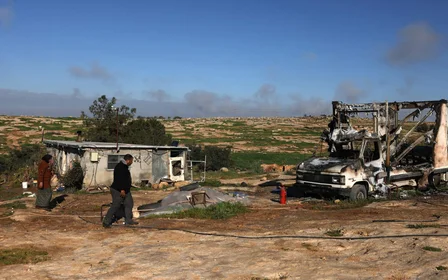
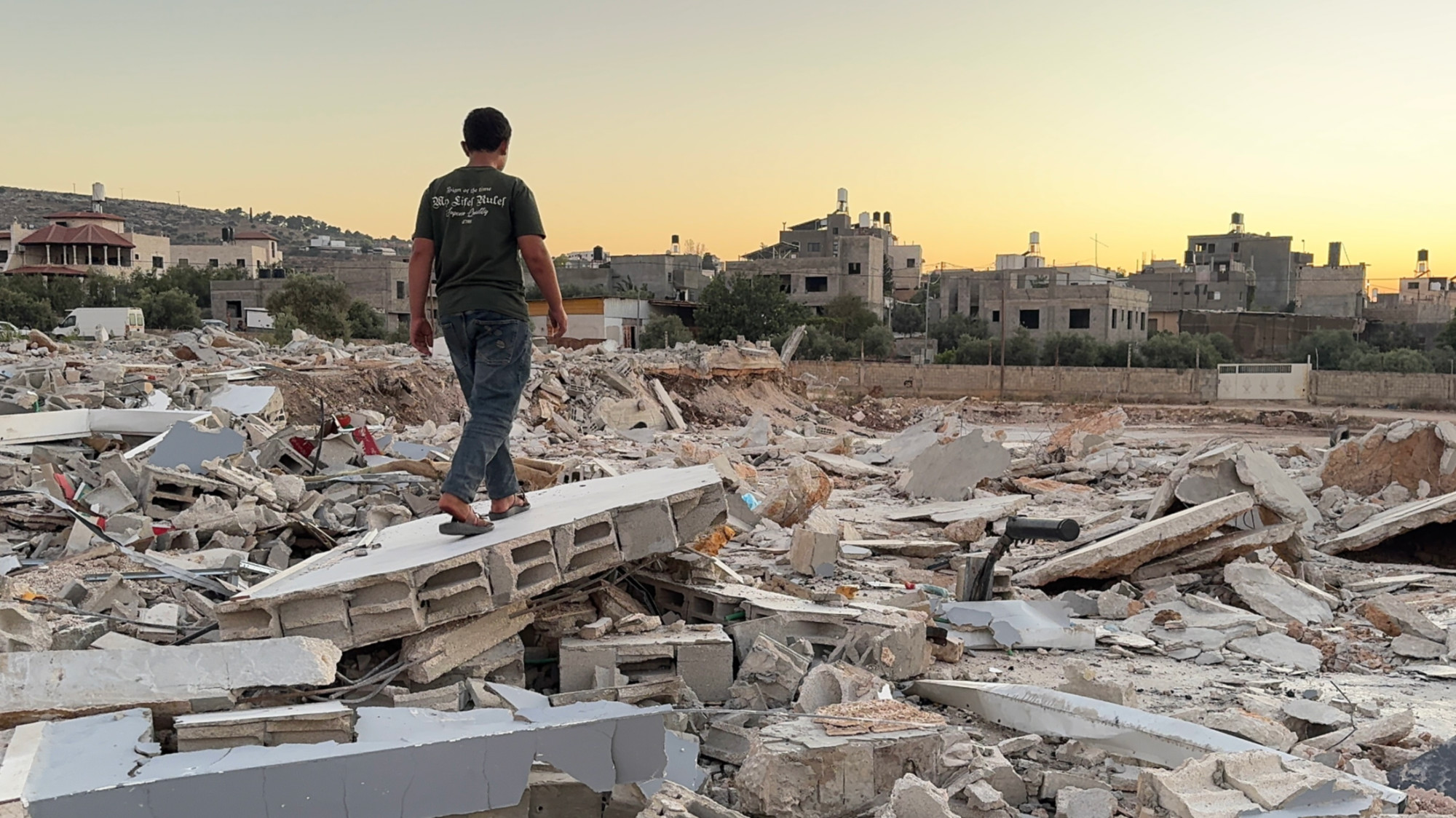
Land seizures have been accompanied by demolition orders targeting Palestinian businesses and other structures, clearing space for roads and settlement projects.
On 11 August, Israeli bulldozers demolished 12 Palestinian commercial warehouses in Anza, south of Jenin. The structures stood along a main road that Israel plans to reroute for settlers.
'Everything is gone'
- Mohammed Mahamid, Palestinian shop owner
Hisham Sadaqa, head of Anza’s village council, told MEE that the village is particularly vulnerable because of its location on the Jenin-Nablus road, which is expected to connect the revived settlements.
The following day, a further 27 shops were demolished in Deir Abu Daif, east of Jenin.
Among them was Mohammed Mahamid’s shop, which he had built just six months earlier in the hope of securing an income for his family.
“Building these shops cost me 180,000 shekels ($60,000), and my health condition doesn’t allow me to find other work,” he said.
“I hoped the shops would be my source of income so I could settle down, but everything is gone.”
Israeli Finance Minister Bezalel Smotrich said on social media that the demolitions were “a step towards resuming settlement activity” in Ganim and Kadim.
Cantons
Researcher and political analyst Sanaa Zakarna said the developments went far beyond laying the groundwork for new settlements.
With some orders targeting areas classified as Area A, she said, Israel was effectively dismantling the Oslo framework on the ground.
Zakarna argued that Israel was using the current political and regional circumstances to revive plans drawn up years ago, including proposals to fragment the West Bank into isolated Palestinian cantons.

In 2017, Smotrich, who now oversees civilian affairs in the West Bank, published what he called “Israel’s Decisive Plan”, a blueprint aimed at eradicating Palestinian national aspirations.
A central element was the cantonisation of the West Bank, fragmenting the Palestinian population into isolated territorial enclaves.
Last year, Smotrich unveiled a proposal to annex 82 percent of the West Bank, extending Israeli sovereignty over the vast majority of the territory while isolating six Palestinian population centres - Ramallah, Nablus, Jenin, Tulkarm, Jericho and Hebron - into separate cantons.
Zakarna said Jenin’s location made it particularly significant to Israel’s settlement strategy.
The city lies close to the Green Line and is surrounded by strategically important roads and military sites.
It is also at the centre of a thriving agricultural economy, with the Marj Ibn Amer plain, extensive farmland and stone quarries supporting local livelihoods.
“Controlling the land means weakening the population’s ability to produce and imposing further economic and security restrictions on them, gradually forcing them to leave,” she said.
Middle East Eye delivers independent and unrivalled coverage and analysis of the Middle East, North Africa and beyond. To learn more about republishing this content and the associated fees, please fill out this form. More about MEE can be found here.