Why Turkey is showing restraint over Israeli strikes on Syria

Turkey is likely to maintain its restraint in responding to Israeli attacks on Syria until after Israel’s general election in October, as Ankara does not want to throw a lifeline to Prime Minister Benjamin Netanyahu’s struggling election campaign.
Although Israeli strikes on the Abu al-Duhur military airbase in northern Syria, approximately 70km from the Turkish border, were seen as provocative, they did not surprise officials in Ankara.
Israel claimed that Turkey was preparing to deploy air defence systems at the base.
“Israel has hit other bases in Syria before. There is nothing particularly important about this one,” one Turkish official told Middle East Eye.
The official added that the Turkish government had clearly conveyed its position on Israel’s actions through multiple public statements. Ankara believes Netanyahu is under intense pressure at home and is seeking a way out by escalating tensions with Turkey.
New MEE newsletter: Jerusalem Dispatch
Sign up to get the latest insights and analysis on Israel-Palestine, alongside Turkey Unpacked and other MEE newsletters
“And he is a madman, definitely, for trying that,” the official added.
Many Ankara insiders expect the Israeli election to result in a change of government and bring more reasonable politicians to power. Turkish officials point to opposition from some Israeli politicians to the escalation triggered by Netanyahu, including Yair Golan, a former general and chairman of the left-wing Democrats party.
Israel’s decision not to use the hotline between the two governments during the strikes on the Syrian airbase is seen as particularly dangerous.
Another provocative factor is Israel’s apparent violation of understandings reached with Ankara during talks in Baku last year.
Violation of previous understanding
A regional official familiar with consultations between Turkish and Israeli officials told MEE that both sides had agreed that the area north of the T4 airbase, near Palmyra, would form a dividing line in Syria between Israeli and Turkish security zones.
T4 had been a particular point of contention for the Israeli government, because Ankara wanted to turn it into a drone base for operations against the Islamic State, which has a strong presence around Palmyra.
Israel bombed the base before the Turkish military could move in, prompting the two sides to begin talks on a deconfliction mechanism.
The agreement on a dividing line stemmed from Israel’s request to maintain an air corridor through Syria for potential strikes on Iran in the event of a war.
The regional official added that Israel continued to oppose the deployment of Turkish radars and air defence systems in Syria but had been relatively satisfied with the progress made in talks.
However, last week’s strikes indicate that Israel now wants to forcibly impose its opposition to any Turkish-supported or Turkish-armed airbase in northern Syria, including in areas very close to the Turkish border.
Ankara says it has made no attempt to deploy forces to the Abu al-Duhur airbase – a position supported by statements from Syrian and US officials. Turkey therefore views the Israeli strikes as a violation of the previous understanding.
Several Turkish officials told MEE that Ankara no longer considers the current Israeli government a rational actor.
The officials said Ankara had demonstrated to the world that Turkish President Recep Tayyip Erdogan, rather than Netanyahu, was acting rationally and with restraint in addressing regional issues.
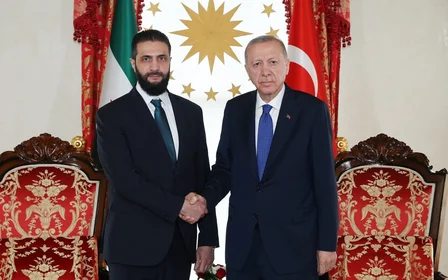
Despite the strikes and repeated insulting statements from Netanyahu, Erdogan did not cut short his holiday to make an announcement. Instead, he was filmed last Friday joking with local politicians near Marmaris, where he often spends his summer holidays.
When Erdogan emerged on Tuesday, he again avoided directly mentioning Israel or Netanyahu. He said he would not dignify “murderous networks” seeking political gains for their failing election campaigns by addressing them directly.
However, he forcefully reiterated that Ankara had a plan for the region and would not abandon its friends. He also said Turkey had no secret objectives and sought only to promote peace.
Turkey playing 'long game in Syria'
One reason Turkey has responded calmly and cautiously in Syria is that Netanyahu’s relationship with US President Donald Trump has deteriorated significantly over the past year.
Netanyahu’s maximalist demands regarding Iran, Lebanon and Gaza have often put Trump at odds with regional realities and key Arab allies.
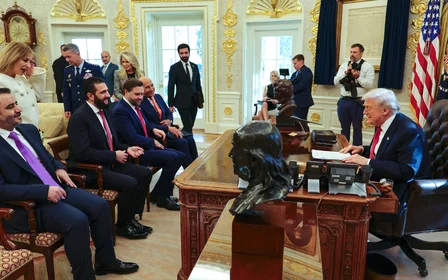
Rather than confronting Netanyahu directly, Turkey has followed Washington’s lead. In this case, the Turkish leadership’s decision to establish close ties with US special envoy Thomas Barrack played an important role in strengthening Ankara’s position.
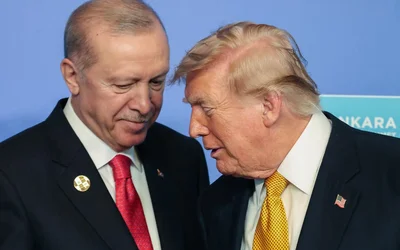
Thanks to the strong rapport between Trump and Erdogan, Ankara this week overcame a series of Israeli objections concerning Syria.
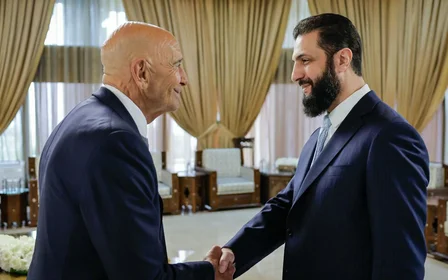
First, the US State Department has removed Syria from its list of state sponsors of terrorism, after 47 years. The move came as Israeli officials continued to describe Syria’s interim president, Ahmed al-Sharaa, as an extremist and a “militia leader”.
The department also revoked the designation of Sharaa’s former group, the al-Nusra Front – also known as Hay’at Tahrir al-Sham (HTS) – as a Specially Designated Global Terrorist organisation.
Second, despite Israeli efforts to preserve a Syria with a weak central government or divided into separate entities, Mazloum Abdi, the commander-in-chief of the Kurdish-led Syrian Democratic Forces, announced the full integration of his forces into the Damascus government and the abolition of the self-declared autonomous zone. This represented another victory for Turkey.
“Turkey is playing a long game in Syria,” a second Turkish official said. “Unlike the Israelis, we prioritise a stable, sovereign and prosperous country that would strengthen security and peace across the region.”
Middle East Eye delivers independent and unrivalled coverage and analysis of the Middle East, North Africa and beyond. To learn more about republishing this content and the associated fees, please fill out this form. More about MEE can be found here.