
Moroccan minister questions Spanish sovereignty over enclave of Ceuta

A Moroccan minister has questioned Spain's sovereignty over the enclave of Ceuta during an official ceremony marking the birth of the Prophet Muhammad.
Ahmed Toufiq, Minister of Habous and Islamic Affairs, made the comments at the Royal Palace of Rabat at an event presided over by King Mohammed VI.
Speaking about scholars who had informed the understanding of the Prophet Muhammad throughout the centuries, Toufiq referenced a number of works by intellectuals from Ceuta.
“The emotional manifestation is reflected in their bringing to prominence the commemoration of the Prophetic virtues and stations, beginning with Al-Shifa by Qadi Iyad, followed by Al-Durr al-Manzum by Al-Azafi, both scholars being from the city of Ceuta, and culminating in Dala’il al-Khayrat by Imam Al-Jazuli,” Toufiq said.
He said that Dala’il al-Khayrat, a collection of prayers for the Islamic prophet, “became a symbol for Moroccans in their mobilisation to liberate the occupied cities along the Atlantic coast at the beginning of the modern era”.
New MEE newsletter: Jerusalem Dispatch
Sign up to get the latest insights and analysis on Israel-Palestine, alongside Turkey Unpacked and other MEE newsletters
Toufiq was referring to the historical Moroccan resistance against Portuguese and Spanish expansions along the Atlantic and Mediterranean coasts during the 15th and 16th centuries.
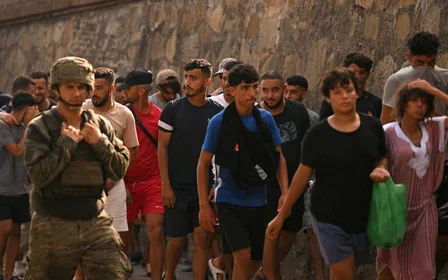
His comments provoked anger in Spain, which has recently had to deal with an influx of Moroccans and other migrants attempting to enter Ceuta.
The 30 July incident, which saw at least 141 people killed, had already raised tensions between the two countries, with some in Spain accusing the Moroccan authorities of deliberately facilitating the movement of migrants as a way of pressuring Madrid.
On Tuesday, Spanish Migration Minister Elma Saiz pushed back against Toufiq's comments.
“Ceuta and Melilla are Spanish,” she said at a press conference. “They are our southern borders, as well as the borders of Europe. There is nothing more to add.”
Toufiq was the second member of the Moroccan government to publicly assert a claim to the Spanish autonomous cities since 30 July. Last week, Morocco's minister of justice, Abdellatif Ouahbi, invoked Morocco's "historical and geographical right" to Ceuta and Melilla, and proposed the creation of a bilateral commission to address their "return to the homeland".
Madrid "categorically" rejected any questioning of Spanish sovereignty over the two cities.
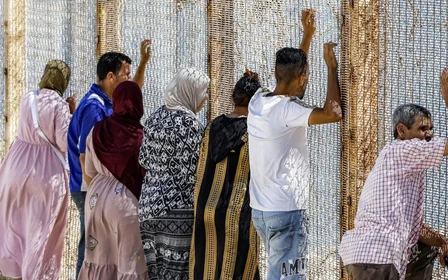
Ceuta and Melilla, two Spanish autonomous cities enclaved along the northern coast of Morocco, share the only land borders between the European Union and Africa.
Rabat has never recognised Spanish sovereignty over the two territories.
At least 72,000 people crossed into Ceuta from Morocco during the July crisis, including around 7,000 children, according to the Spanish government.
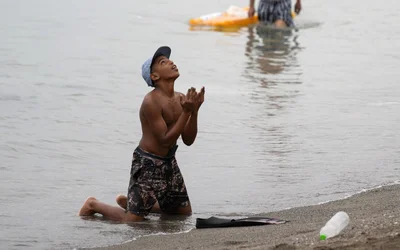
Footage posted online showed people swimming into the enclave around the border barrier, with some wearing swimsuits and using flotation rings to make the dangerous journey.
While most migrants went back to Morocco within hours, several thousand stayed in Ceuta, many of them unaccompanied minors. Due to overcrowding in local shelters, Madrid announced an emergency plan to transfer 500 of the most vulnerable children to the Spanish mainland.
Middle East Eye delivers independent and unrivalled coverage and analysis of the Middle East, North Africa and beyond. To learn more about republishing this content and the associated fees, please fill out this form. More about MEE can be found here.