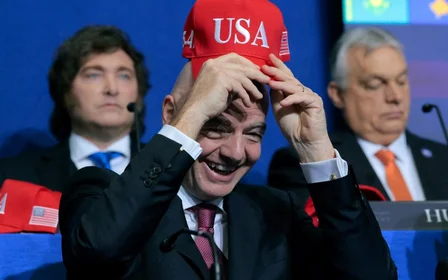
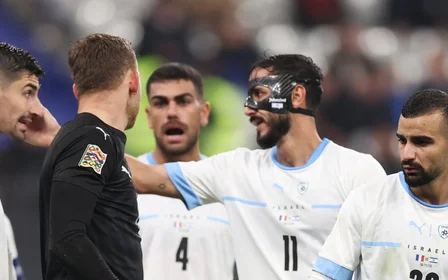
How football's governing bodies support illegal Israeli settlement clubs

Football in the occupied West Bank has been brought to a near standstill since Israel launched its genocidal war on Gaza.
Palestinian players struggle to reach training grounds, matches are routinely cancelled because of checkpoints and military closures, and hundreds of sports facilities have either been damaged or destroyed.
But in illegal Israeli settlements, Israeli football teams are thriving, with players continuing to train and compete while clubs expand their facilities.
An investigation by Arab Reporters for Investigative Journalism (ARIJ) and Bridges Investigations for Middle East Eye has found that illegal settlement-based clubs are participating in Israeli domestic competitions with the backing of the Israel Football Association (IFA), while Fifa and Uefa continue to recognise and financially support the IFA.
According to the investigation, Fifa, which formally says it is committed to respecting internationally recognised human rights through its statutes and strategic goals, has not only declined to take action against settlement clubs; its Fifa+ platform also broadcasts their matches.
New MEE newsletter: Jerusalem Dispatch
Sign up to get the latest insights and analysis on Israel-Palestine, alongside Turkey Unpacked and other MEE newsletters
For Palestinian players, the consequences have been felt every time they try to train or travel to a match.
Mahdi al-Assi, a goalkeeper for the Palestinian youth team, knows this well.
Getting to the pitch can mean hours spent at checkpoints, while training itself can be disrupted by raids and teargas, he says.
"More than once, I've set off three or four hours before training, only for them [Israeli soldiers] to turn us back at the checkpoint for no reason at all," he told MEE.
Meanwhile, just a few kilometres from where al-Assi plays, the floodlights are on at a football pitch inside the Israeli settlement of Givat Ze'ev.
Here, the Beitar Givat Ze'ev team trains on land that international law classifies as occupied Palestinian territory.
A journey of checkpoints and closures
Al-Assi said that routine travel between Palestinian cities has become a gruelling ordeal because of Israeli military checkpoints.
Restrictions have grown since Israel's last elections in 2022, and since October 2023, when Israel launched its genocidal war on Gaza.
According to al-Assi, Israeli forces also disrupt sporting activities by storming pitches.
Since Israel launched its war on Gaza, 292 sports facilities have been completely or partially destroyed in the besieged enclave and the occupied West Bank, according to data obtained from the Palestinian Football Association.
The association's league has also been suspended.
'We can't schedule the league, the gates could be shut at the time of a match'
– Susan Shalabi, Palestinian Football Association
"It became too dangerous to keep the league going," said Susan Shalabi, vice-president of the Palestinian Football Association.
"There are more and more checkpoints, and towns are sealed off by electronic gates, trapping people inside."
According to Shalabi, it has become virtually impossible to arrange matches: "We can't schedule the league; the gates could be shut at the time of a match, so it gets cancelled."
According to al-Assi, after the league was cancelled he was no longer able to train regularly, so he turned to a private coach.
"Because of the war, there are no games being played now. But playing matches is a basic element in a footballer’s development, so I’m training with a private coach."
This poses an additional financial burden, but he remains determined to continue playing, in the hope of representing his country in international competitions.
Football and settlement expansion
The situation is markedly different for clubs operating in the hundreds of illegal Israeli settlements in the occupied West Bank.
The settlement of Ariel was established in 1978 on land Israel seized from Palestinians in the area of Salfit. Last year, the mayor of Ariel, Yair Shatbon, launched a long-term plan to allocate a large budget to the development of the sports sector. This included a new stadium on Efrata Street and more football pitches and sports facilities throughout the settlement.
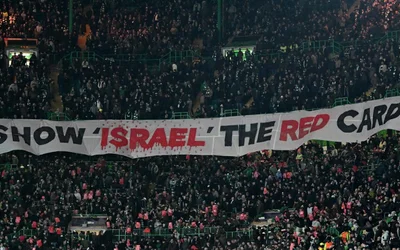
Shatbon also announced a project to modernise the main pitch of FC Ironi Ariel, including replacing the turf with artificial grass that meets Fifa standards.
According to Shalabi, the issue of settlement clubs dates back to 2013, when their details appeared on the official website of the IFA, before later being removed as international attention grew.
"Fifa didn't take any position on clubs, so their numbers went from five to around nine today," she said. "Fifa just tells you to go back to the UN, and what does the UN say? It says these are occupied territories," she said.
Ironi Ariel is one of nine football clubs associated with Israeli settlements in the occupied West Bank. Some play directly within settlements, while others are based there or use their facilities.
A 2016 report by Human Rights Watch criticised Fifa for funding matches held within settlements, describing them as "illegal under international humanitarian law".
Article 49, paragraph 6 of the Fourth Geneva Convention of 1949 relative to the Protection of Civilian Persons in Time of War states: "The Occupying Power shall not deport or transfer parts of its own civilian population into the territory it occupies.”
Broadcasting matches
The relationship between Fifa and settlement football extends beyond the IFA's participation in domestic competitions.
According to research published in Scottish Sport for Palestine's report 'Beyond the 'Green Line 'Israeli Settlement Clubs in Occupied Palestine', FIFA+ had broadcast and archived matches from the Har Homa settlement and shared links to these matches on the DAZN platform.
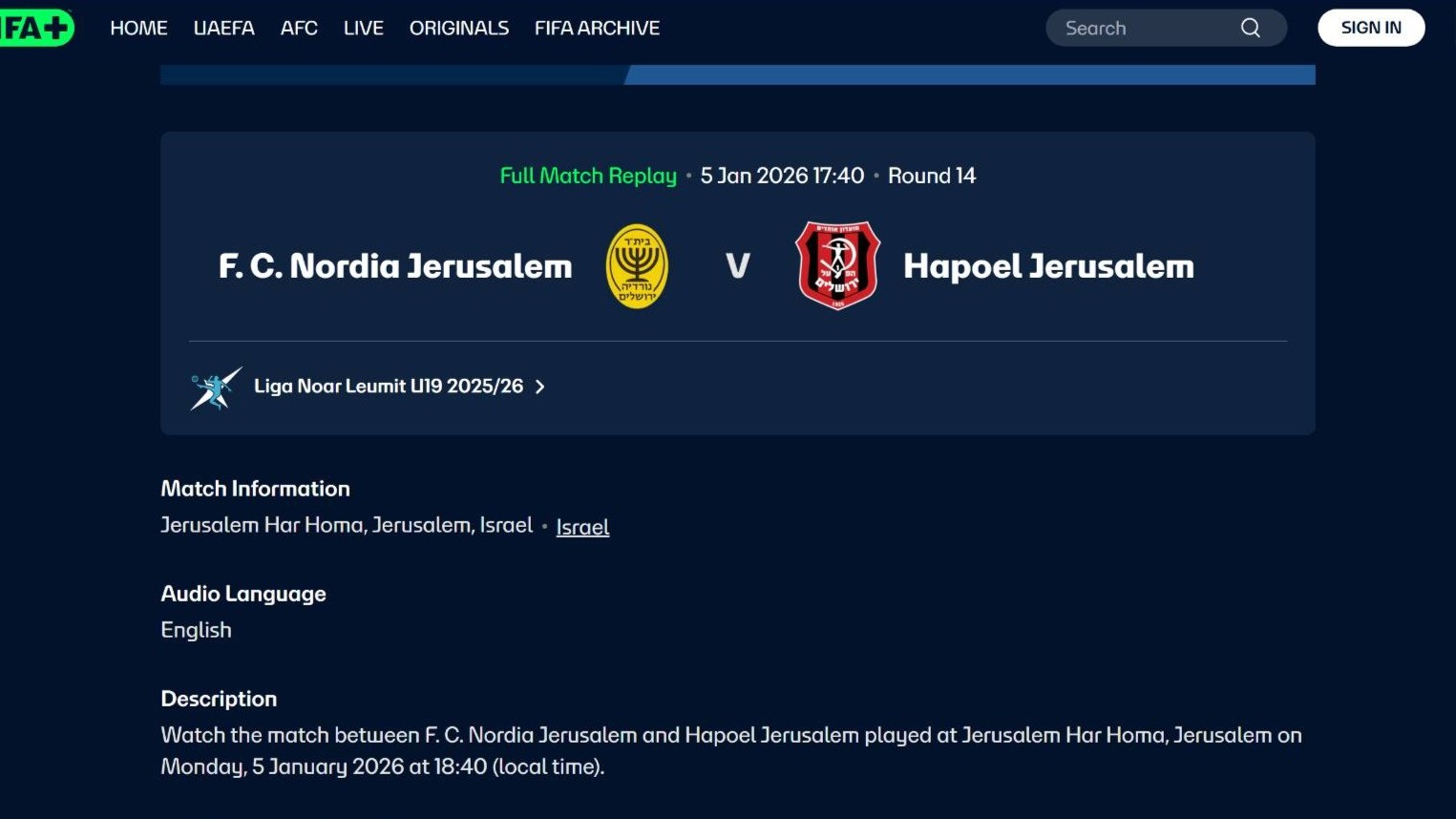

The broadcasts took place while the participation of settlement clubs in Israeli competitions was being challenged at the Court of Arbitration for Sport.
The Israel Youth League page on Fifa+ includes replays of Nordia Jerusalem matches played at the Har Homa ground. The IFA's page on the platform also features live matches and replays from its competitions, including matches played at the same ground.
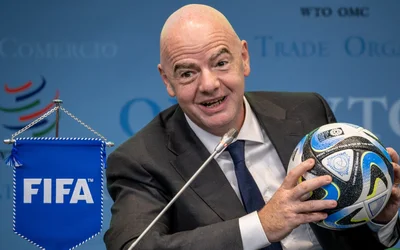
DAZN says it provides Fifa+ content on demand and describes itself as "the new home of Fifa+".
According to the 'Beyond the 'Green Line' report, Fifa+ generates revenue through advertising and sponsorship, as well as commercial expansion and an increasing audience base.
Matches involving clubs linked to settlements may therefore bring revenue to Fifa while providing a platform for showcasing the clubs and their players.
Fifa's budgets consolidate financial data in a way that makes it difficult to track revenue generated by its digital platforms. Revenue from digital broadcasting is consolidated within the federation's overall budget, which stands at nearly $13bn for the current financial cycle, 2023-2026.
The budget shows that television broadcasting revenue alone amounted to $3.092bn from matches in 2026.
MEE reached out to Fifa for comment but did not receive a response by time of publication.
Fifa declines to act
In March 2026, Fifa's Disciplinary Committee responded to a complaint by the Palestinian Football Association over the participation of settlement clubs in the Israeli league.
The complaint had been submitted during the 74th Fifa Congress in May 2024.
The committee said it would not take any action against the clubs because of what it described as “the unresolved legal status of the West Bank under public international law".
It did, however, fine the IFA 150,000 Swiss francs ($190,000) for "committing grave and systematic abuses relating to discrimination and racism; tolerance of politicised and militaristic messages; and exclusion of Palestinians from sports infrastructure in the West Bank".
Steve Cockburn, the head of Economic and Social Justice at Amnesty International, described Fifa's decision as "a failure to enforce Fifa's own rules".
'Fifa had a clear opportunity to both defend the rights of Palestinians and uphold international law. But… it has shamefully chosen to abandon both'
– Steve Cockburn, Amnesty International
"The decision is also a flagrant violation of international law. Fifa had a clear opportunity to both defend the rights of Palestinians and uphold international law. But by taking this decision, it has shamefully chosen to abandon both," he said.
"The International Court of Justice has stated quite clearly that Israel's occupation of Palestinian territory is unlawful, and that settlements in the occupied Palestinian territory are illegal," he added.
Amnesty wrote to both Fifa and Uefa on 1 October 2025, more than a week before the so-called ceasefire took hold in Gaza, and called on them to suspend the IFA from their competitions until clubs based in illegal settlements on occupied Palestinian land are barred from the Israeli football leagues.
Omar Shaker, who handled the Occupied Territories and Israel at Human Rights Watch before resigning in February, said: "Some of the land on which these stadiums are built is owned by families of players who can't get into them or play there."
Shaker pointed out that Fifa's regulations are clear: "You cannot play matches on the territory of any member state without obtaining its explicit permission."
Sajed Karakra, the coach of the Palestinian Under-20 national team, echoed this view and said he saw the participation of settlement clubs in the Israeli league as part of a wider policy.
"The participation of these sports teams is aimed at strengthening and supporting settlements," he said.
Karakra also condemned the paralysis of the sports system in the West Bank.
He said the contrast between the state of the game before and after 7 October 2023 points to an undeclared strategy to undermine local football and deprive Palestinian players of the physical and technical preparation they need.
Before the war, Karakra said, between 70 and 80 percent of regular sporting activity went ahead despite restrictions, and the Palestinian Football Association successfully ran a regular league under the auspices of the Asian and international federations.
Sports infrastructure in illegal settlements
ARIJ's investigation also found that sports infrastructure in settlements has expanded through projects supported by Mifal HaPais, the Israeli National Lottery.
An active member of both European Lotteries (EL) and the World Lottery Association (WLA), Mifal HaPais' board includes mayors, Likud Party leadership figures and members of settlement councils.
'The building of Israeli settlements in the occupied territories constitutes a war crime'
– Michael Lynk, former UN special rapporteur on Palestine
The current chairman is Itzik Larry, a former chief executive of Toto, the body which handles sports betting in Israel. Other figures involved in its management include Haim Bibas, the mayor of Modiin-Maccabim-Re'ut, and Benjamin Biton, the mayor of Dimona.
Mifal HaPais declares that it is owned by local authorities. Its governance page states that local government figures hold positions within its management structure, and that the mayor of Ma'ale Adumim, Benny Kashriel, was a member of its board.
Data published by the foundation shows that about 46 percent of lottery profits go directly to local authorities, without distinguishing between those in Israel and those in settlements. Mifal HaPais also invests 51 percent of its profits in building and developing sports facilities.
One major project funded by Mifal HaPais was the Sababa Sports Centre in the settlement of Efrat, which includes a near-Olympic-size swimming pool.
According to Mifal HaPais, the centre opened on 14 January 2026, as part of a partnership with the Efrat Settlement Council.
Official data shows that the project received 15.7 million shekels ($5.234m) in direct investment from Mifal HaPais for sports infrastructure. An additional three million shekels ($1m) came in a grant earmarked to cover the deficit and support operations, according to the minutes of the Efrat council for February 2026.
MEE reached out to Mifal HaPais, the EL and the WLA for comment but did not receive a response by time of publication.
European football funding
Settlement clubs continue to participate in the Israeli league, even though their official addresses place them in occupied Palestinian territory.
The IFA, meanwhile, continues to receive funding from both Fifa and Uefa as a member of the two governing bodies.
Human Rights Watch reported in 2016 that, based on financial records, Fifa and Uefa had transferred millions of shekels annually to the IFA. The report argued that by allowing the IFA to stage matches in Israeli settlements, Fifa was engaging in commercial activity that supported those settlements, despite its stated human rights commitments.
That financial relationship has continued. According to an Amnesty International report published in March 2026, both Fifa and Uefa continued to provide funding to the IFA after Israel launched its war on Gaza in 2023.
One of the main funding mechanisms is Uefa's HatTrick programme, which redistributes more than half of the net revenues from the European football championships among its member national associations.
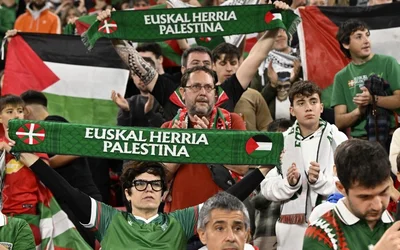
Funding is divided into three streams: investment funding, given as a one-off grant of up to €5m to each association for strategic projects; annual solidarity payments of around €1m to cover operating costs; and annual incentives of up to €2m to encourage implementation of Uefa programmes.
These include women's football programmes and training, referee development, youth programmes and governance.
Funds are paid to national associations, such as the IFA, rather than directly to individual clubs or local projects.
Uefa's allocations and funding to the IFA under the HatTrick programme between 2024 and 2028 totalled €17m ($17.3m), a 21 percent increase on the previous funding cycle.
Each national association that is a member of Uefa receives the same amount.
The UEFA Foundation for Children, chaired by Uefa President Aleksander Ceferin, also financed the Neighbourhood League project, implemented by Hapoel Katamon Jerusalem or its supporters' association, Katamon Madunim Ohadim. According to the foundation's website, it gave around €320,000 (approximately $370,000) to the project between 2020 and 2023.
At the same time, Hapoel matches were being held in Israeli settlements until 2025, and the association that received the funding is registered at an address in the Har Adar settlement.
MEE reached out to Uefa and the European Union for comment but did not receive a response by time of publication.
From Ma'ale Adumim to Madrid
The relationship between European football and settlement clubs extends beyond funding.
In March 2023, Spanish football organisations and the Spanish Football Federation hosted a delegation from Beitar Ma’ale Adumim, a club based in the Ma'ale Adumim settlement in the occupied West Bank.
The delegation visited La Liga's headquarters and Atletico Madrid's facilities, as well as Spanish clubs and sporting organisations including Getafe and Rayo Vallecano.
The director of Beitar Ma'ale Adumim, Osnat Kaduri, said Atletico Madrid had hosted the delegation and officials from La Liga had accompanied them throughout the visit.
According to Scottish Sport for Palestine's report 'Beyond the 'Green Line', this visit shows a club that operates within an Israeli settlement being integrated into European football activities and institutions, even though it is based in territory considered occupied under international law.
The visit came months after Fifa and Uefa suspended Russian clubs from competitions following Russia's invasion of Ukraine in 2022.
Michael Lynk, a former UN Special Rapporteur on the situation of human rights in the Palestinian territories, describes the difference as "double standards".
"There is no fundamental difference between Russia's illegal invasion and Israel’s ongoing 58-year-long effort to occupy and annex the Palestinian territories," he said.
The European Commission says Israeli settlements are illegal under international law and constitute a major obstacle to peace and the two-state solution.
EU member states are committed to not recognising changes to the 1967 borders, including in Jerusalem, and to ensuring their bilateral agreements with Israel do not apply to the settlements.
Lynk maintains that "the building of Israeli settlements in the occupied territories constitutes a war crime".
This conclusion, he said, is based on the 1998 Rome Statute and repeated resolutions issued by the UN Security Council, General Assembly and Human Rights Council.
Consequently, Lynk says football clubs in these settlements "are an extension of this practice, which is illegal under international law and even under Fifa’s own regulations".
Political pressure grows
Political pressure is also growing against international sporting bodies.
At an Irish parliamentary session on 9 June, MPs called for Israel to be suspended from international sporting organisations, citing its continued violations and the presence of at least 10 Israeli clubs in the occupied Palestinian territories.
'I try to train and I push myself, despite the circumstances'
– Mahdi al-Assi, goalkeeper for the Palestinian youth team
Sporting bodies have often argued that "sport must remain separate from politics". But Lynk rejects that position.
"Sport is big business," he said. "To say that sport is separate from politics flies in the face of what’s happened in sport over the last 45 years."
James Dorsey, a researcher in international football policy, similarly describes sport and politics as "inseparable twins".
Mark Doidge, an academic and researcher in the sociology of sport, also rejects the principle of neutrality invoked by Fifa and Uefa when faced with political disputes. "Neutrality is never neutral. It always goes along with the powerful," he said.
While the debate over the role of international sporting bodies continues, settlement sports infrastructure is expanding.
Between December 2025 and February 2026, the Israeli government approved construction of a corridor linking the Ma’ale Adumim settlement to East Jerusalem. The area is home to three settlement clubs affiliated with the IFA: Beitar Ma’ale Adumim, Beitar Givat Ze’ev and Ironi Yehuda.
The plan reflects a position expressed by Prime Minister Benjamin Netanyahu, who has said that the expansion of Ma’ale Adumim reinforces his conviction that “there will never be a Palestinian state”.
For Al-Assi, however, the focus remains on continuing to train and play despite the restrictions.
"I try to train and I push myself, despite the circumstances," he said. "They can't easily stand in our way."
This investigation was produced in partnership between ARIJ and Bridges Investigations.
Editor's Note: This article is based on original field reporting, interviews, and primary data verification by Middle East Eye, ARIJ, and Bridges Investigations. Select background details also incorporate prior research published in the report Beyond the 'Green Line': Israeli Settlement Clubs in Occupied Palestine by Scottish Sport for Palestine.
Middle East Eye delivers independent and unrivalled coverage and analysis of the Middle East, North Africa and beyond. To learn more about republishing this content and the associated fees, please fill out this form. More about MEE can be found here.