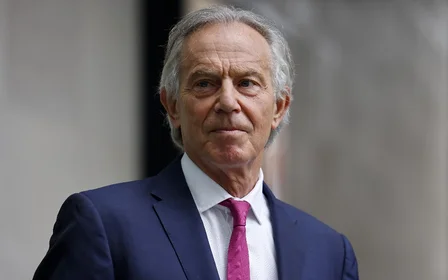
Palestine will outlast Blair and his grotesque 'Board of Peace'


Former UK Prime Minister Tony Blair’s latest reported intervention in the Middle East would be astonishing coming from any supposed mediator.
Coming from Blair, it feels almost grimly on brand.
Jeremy Greenstock, Britain’s former ambassador to the United Nations, says he learned from a ministerial-level source that Blair asked the Palestinian Authority (PA) to remove references to “Palestine” from its school curriculum.
More extraordinary still, according to Greenstock’s comments to Middle East Eye, the request was not simply to erase the word, but rather to replace references to “Palestine” with “Samaria” - the biblical Hebrew designation used by Israel for part of the occupied West Bank, and a term deeply embedded in the ideological vocabulary of the Israeli settler movement.
Blair has vehemently denied the report, with his eponymous institute noting on Thursday: “This claim is entirely false and without foundation.”
New MEE newsletter: Jerusalem Dispatch
Sign up to get the latest insights and analysis on Israel-Palestine, alongside Turkey Unpacked and other MEE newsletters
Such a move would mean that Palestinians were not merely being asked to surrender their own name for their homeland, but also to adopt the name preferred by those dispossessing them: to participate in the linguistic rewriting of their own history and geography, and to teach that rewriting to their children.
There is something monstrous about demanding that a people describe their own land in the language of those dispossessing them.
Symbolic erasure
Just consider the grotesque inversion of priorities.
Across the occupied West Bank, Palestinians are being violently dispossessed of their land and homes. Settlers attack villages, torch homes and cars, destroy olive groves, terrorise families and drive people from land they have inhabited for generations, frequently amid the presence or protection of Israeli forces. Settlements and outposts continue to swallow Palestinian land, while entire communities face forced displacement.
At precisely this moment, the man supposedly helping to make peace is instead, according to Greenstock, asking Palestinians to erase the very word “Palestine” from their children’s books.
Apparently, erasing Palestine on the ground is not enough. It must disappear symbolically too: from the map, from the textbook, from the vocabulary of Palestinian children. And who better to deliver the message than Blair, our celebrated “peace mediator”?

While Blair - the man who infamously took Britain into a catastrophic war on claims that proved disastrously false - calls Greenstock’s account a “complete fabrication”, the latter is hardly some passing political agitator.
Greenstock was Britain’s ambassador to the UN from 1998 to 2003, during Blair’s premiership; worked closely with his government through the Iraq crisis; and subsequently became Britain’s special representative for Iraq.
Blair’s record, meanwhile, speaks for itself. The Chilcot inquiry found that the threat posed by Saddam Hussein was presented with a certainty the intelligence did not justify, that continued production of chemical and biological weapons had not been established, and that Britain went to war before peaceful options had been exhausted.
Having helped to unleash one of the deadliest and most destructive wars in modern Middle Eastern history, Blair subsequently underwent one of the more remarkable career transformations in modern politics: he became a Middle East peace envoy.
His record there was hardly more distinguished. Palestinian officials complained that he privileged Israeli security demands over Palestinian rights. Palestinian negotiator Nabil Shaath attributed Blair’s meagre achievements to his efforts to please the Israelis.
Former British diplomats eventually called for him to be removed amid mounting criticism of both his effectiveness and the collision between his diplomatic and commercial lives.
Conspicuous overlap
Then there was Blair’s other great post-Downing Street vocation: making money. A great deal of it.
Blair built an extraordinarily lucrative international consultancy operation after leaving office, working with banks, corporations, governments and wealthy clients across the Gulf and beyond.
The overlap between Blair’s diplomacy and his lucrative commercial interests became so conspicuous that political writer Francis Beckett posed the obvious question: when he walked into a meeting in the Middle East, which Tony Blair had arrived - the Quartet envoy, the foundation patron or the international consultant?
The Board of Peace is Blairism in institutional form: grandiose moral rhetoric masking power, money and breathtaking contempt for Palestinian agency
The confusion was understandable; there were so many Tony Blairs available, and remarkably few of them working for free.
Nor did his enthusiasm for Middle Eastern autocrats strengthen his credentials as a champion of justice.
After Egypt’s military overthrew the country’s elected leader in 2013, and security forces carried out the Rabaa massacre - one of the deadliest mass killings of demonstrators in recent history - Blair emerged as one of President Abdel Fattah el-Sisi’s most enthusiastic western advocates.
He urged the international community to get behind Egypt’s new leadership, and later became involved in advising on economic reforms through a UAE-funded programme.
And now, this same man has been entrusted with helping to determine the future of Gaza.
But perhaps Blair is not an embarrassing anomaly on US President Donald Trump’s “Board of Peace”. Perhaps he is its perfect representative.
The Board of Peace is Blairism in institutional form: grandiose moral rhetoric masking power, money and breathtaking contempt for Palestinian agency.
Endless rhetoric
Gaza’s future is being shaped not by Palestinians, but by Trump, Blair, Jared Kushner, Steve Witkoff and billionaire financiers, while Palestinians themselves are relegated to a subordinate administration that Israel has not even allowed into Gaza.
As Palestinians in Gaza mourn their dead and survive in tent camps, these self-appointed custodians of their future have been discussing investment, real estate, tourism, Gaza’s coastline and its “productive assets”.
Billions were trumpeted for reconstruction. Only a tiny fraction initially materialised. Meaningful rebuilding stalled. The grand reconstruction plan eventually shrank to a small pilot scheme around Rafah.
Yet there has been no comparable shortage of imagination when it comes to a profitable “New Gaza”. And even the prospect of allowing the deeply compromised PA a place in this arrangement apparently requires another concession: erase “Palestine” from Palestinian schoolbooks.
This highlights the fraud behind the endless rhetoric of “PA reform”. Reform towards what, exactly?
The goalposts simply keep moving. For years, Palestinians have been told to reform their institutions, police their own population, satisfy Israeli security demands, renounce armed resistance, and rewrite their curriculum. And after all that, even the word “Palestine” itself has apparently become objectionable.
This is not reform. It is an ever-expanding test of submission - and Blair comprises a perfect messenger.
Annexationist vision
The timing makes the story more scandalous still.
The British government Blair once led is moving in precisely the opposite direction. Foreign Secretary Ed Miliband has condemned “appalling settler terrorism”, reiterated Britain’s support for a two-state solution and promised a “comprehensive” package of measures against Israel’s illegal settlement project.
Blair, meanwhile, is accused of pressuring Palestinians to remove the name of the state that his own former party is trying to prevent Israel from erasing.
On the same day Greenstock’s account emerged, a video circulated of Israeli settlers singing before Prime Minister Benjamin Netanyahu about Palestinian names disappearing. The coincidence was grimly apt: the settlers sing the wish, while Blair stands accused of carrying its bureaucratic translation to the Palestinians.
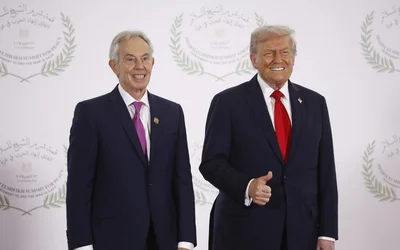
His position is indeed closer to the ideological programme of Israel’s annexationist far right than to that of the Labour government in London. And if anyone still doubts where that programme is heading, Israel’s defence minister was unusually helpful this week.
Israel Katz said on Wednesday that there is “no real solution for Gaza” without Palestinian migration. Israel, he said, is organised and prepared to move Gazans out “by sea, by air” and by other means. The obstacle, he explained, is not Israeli willingness, but the absence of American approval and countries willing to receive them.
The plan, Katz made clear, has not disappeared. It is merely waiting.
Suddenly, the argument over a word in a Palestinian textbook looks rather less trivial. Greenstock’s account comes amid an Israeli political project in which senior ministers openly discuss removing Palestinians from Gaza, while annexation advances across the occupied West Bank.
Veteran Haaretz journalist Amira Hass put the danger starkly this week: the question is no longer merely whether there will be a Palestinian state, but whether Palestinians will be permitted to remain as a people at all between the Jordan River and the Mediterranean Sea.
Global cause
That is the context in which Greenstock’s account must be understood. While Israel’s annexationist right works to erase Palestine physically on the ground, Blair stands accused of assisting with the process of symbolic erasure: remove Palestinians from the land, remove Palestine from the book and call the process peace.
No wonder Palestinians might be sceptical of a process in which the demands invariably travel in one direction. Disarm. Concede. Reform.
Wait for withdrawal. Wait for reconstruction. Wait for statehood. And while you wait, edit Palestine out of the curriculum.
Erase the name from the textbook if you can. Rename the hills. Bulldoze the homes. Rewrite the maps. Palestine will remain
The Board of Peace increasingly resembles less an impartial mediator than a mechanism for translating Israeli demands into conditions Palestinians are expected to fulfil. Blair is therefore not an awkward presence on it; he embodies its logic.
But there is one thing Blair, the Board of Peace and their friends among Israel’s far right have badly miscalculated: Palestine is not theirs to erase.
They may have the armies, the bulldozers, the money and the diplomatic machinery. But Palestinians have something they have failed for more than a century to extinguish: an unbreakable attachment to their land, and a refusal to disappear.
And Palestine is no longer theirs alone. It has become the cause of millions of people around the world.
Erase the name from the textbook if you can. Rename the hills. Bulldoze the homes. Rewrite the maps.
Palestine will remain, long after Blair and his grotesque “Board of Peace” are historical footnotes.
The views expressed in this article belong to the author and do not necessarily reflect the editorial policy of Middle East Eye.
Middle East Eye delivers independent and unrivalled coverage and analysis of the Middle East, North Africa and beyond. To learn more about republishing this content and the associated fees, please fill out this form. More about MEE can be found here.