
Germany asks ICJ to dismiss Gaza genocide case brought by Nicaragua

Germany asked the International Court of Justice (ICJ) on Monday to dismiss a case accusing it of facilitating genocide in Gaza through its military support for Israel.
Berlin told the UN's supreme judicial body that Nicaragua had failed to establish the existence of a legal dispute before bringing proceedings in March 2024 and that parts of the case fell outside the court’s jurisdiction.
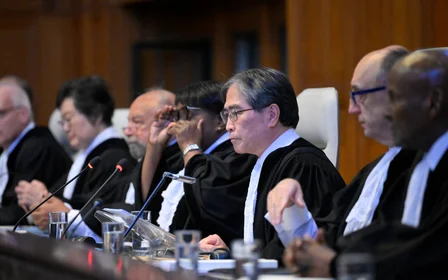
"Nicaragua’s conduct indicates that it was not interested in hearing Germany’s view on its allegations, but simply in bringing Germany before this court," Julia Monar, legal adviser at the German foreign ministry, told judges.
Germany has been Israel’s second-largest arms supplier after the United States.
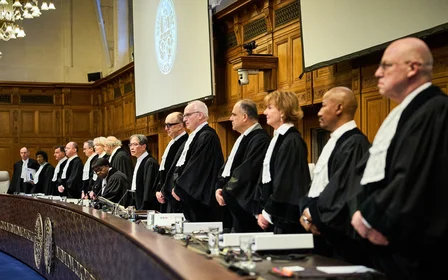
Opening four days of hearings in The Hague, Berlin also said that Nicaragua had not properly notified it of the allegations or allowed sufficient time for a response before filing the case.
New MEE newsletter: Jerusalem Dispatch
Sign up to get the latest insights and analysis on Israel-Palestine, alongside Turkey Unpacked and other MEE newsletters
The hearings concern Germany’s preliminary objections to the court’s jurisdiction and the admissibility of Nicaragua’s claims, and not whether Berlin has breached international law, which will be addressed during the merits phase.
Nicaragua accuses Germany of violating the 1948 Genocide Convention and international humanitarian law by supplying weapons and other military assistance to Israel despite being aware of the risk that they could be used to commit serious violations in Gaza.
The Central American state also accused Berlin of failing to prevent genocide and of contributing to the humanitarian crisis by suspending funding to Unrwa, the UN agency for Palestinian refugees.
"This has the potential to be an important case because it provides an opportunity for the ICJ to clarify the law with respect to the duty to prevent genocide and the obligation to ensure compliance with international humanitarian law," ICJ expert Mike Becker told Middle East Eye.
"The ICJ could decide that none, or only some, of Nicaragua’s claims can proceed to the merits," Becker, who is a professor of law at Trinity College Dublin, told MEE.
"If some of Nicaragua’s claims survive Germany’s challenge, those claims will not be decided until a later phase in the case."
Germany's defence
Germany is expected to argue that Israel is an indispensable third party to the proceedings.
Berlin maintains that the court could not find Germany responsible for aiding genocide or violations of international humanitarian law without first determining the legality of Israel’s conduct.
'It provides an opportunity for the ICJ to clarify the law with respect to the duty to prevent genocide'
– Mike Becker, Trinity College Dublin
Israel is not a party to the case and has not consented to the court determining its responsibility.
Under the ICJ’s Monetary Gold principle, the court cannot rule on a case when the legal responsibility of an absent state would constitute its "very subject matter".
Nicaragua is expected to counter that the proceedings concern Germany’s own conduct and obligations, rather than Israel’s responsibility as a state.
"Germany’s argument is that the ICJ will not be able to establish Germany’s alleged wrongdoing (based on provision of military equipment and weaponry to Israel) without first establishing that Israel is in breach of the 1948 Genocide Convention or international humanitarian law," Becker said.
"Because Israel is not a party to the case, Germany’s position is that Nicaragua’s action cannot proceed."
Surge in weapons approvals
The latest German government figures show a sharp rise in approvals for military exports to Israel in 2026.
Berlin authorised exports worth €63.6m in the first quarter and a further €735.8m between April and June, bringing the provisional total for the first half of the year to €799.4m – almost four times the €201m approved during the whole of 2025.
According to the German government’s response to questions by MPs, 67 percent of the second-quarter value related to a major maritime defence project and 21 percent to cooperation between German and Israeli companies serving the German military.
Separate data released by the Stockholm International Peace Research Institute in March found that Germany supplied 31 percent of Israel’s imports of major conventional weapons during 2021-25, solidifying its rank as the country’s second-largest supplier after the US, which accounted for 68 percent.
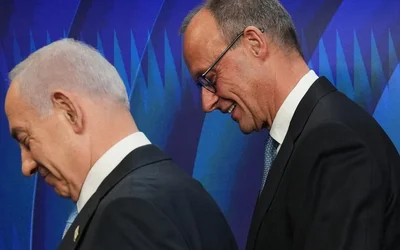
Chancellor Friedrich Merz imposed partial restrictions in August 2025, suspending approval of equipment that could be used in Gaza.
The government lifted those restrictions in November following the ceasefire, saying future applications would be assessed individually.
In its case, Nicaragua first sought binding provisional measures by the ICJ in 2024 requiring Germany to suspend military supplies to Israel and restore its support for Unrwa.
The ICJ declined to impose the measures in April 2024, noting that German arms exports had declined considerably and that Berlin operated a legal framework for assessing export licences.
However, the court rejected Germany’s request to remove the case from its list, finding there was no manifest lack of jurisdiction.
Germany filed its preliminary objections after Nicaragua submitted its full written case in July 2025, suspending proceedings on the merits.
Nicaragua will respond on Tuesday, before both countries present a second round of arguments on Wednesday and Thursday. The court will deliver its ruling at a later date.
If allowed to proceed, it could take years for the case to reach a final judgment.
The ICJ is currently hearing a separate case brought by South Africa against Israel, accusing it of breaching the Genocide Convention in its war on Gaza since October 2023.
A panel of eminent UN experts, as well as the world's largest association of genocide scholars, have already concluded that Israel's campaign in Gaza amounted to the crime of genocide.
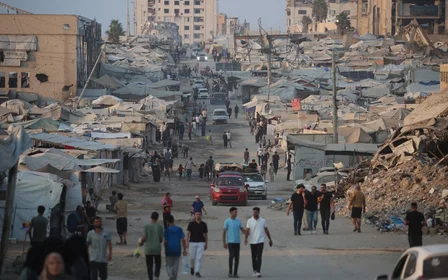
A fragile, US-brokered ceasefire has been in effect since October last year. But since then, Israel has killed at least 1,300 Palestinians in Gaza, bringing the genocide's death toll there to over 73,651.
Middle East Eye delivers independent and unrivalled coverage and analysis of the Middle East, North Africa and beyond. To learn more about republishing this content and the associated fees, please fill out this form. More about MEE can be found here.