9/11 at 25: Trump finds new targets for America's endless war on terror


On 11 September 2001, I was driving to work on the freeway in Austin, Texas when I heard the news on the radio that planes had crashed into the World Trade Center and the Pentagon.
As I went about nearly crashing my own car while trying to phone my best friend in New York City, I remember thinking that we were going to be hearing a lot about this particular date for a long time to come.
Sure enough, a quarter of a century has now passed since 9/11, and the events of that day continue to shape daily existence in the US - as trite as it sounds to say it.
Those of us who are old enough may remember the pre-9/11 panorama, when it was still possible to go through airport security with your water bottle and shampoo and Muslims could go to mosque without being pursued by FBI informants.
And while the US was never exactly all it was cracked up to be in terms of democracy and respect for basic rights, 9/11 definitively obliterated the right to privacy and other civil liberties upon which the country was supposedly founded.
New MEE newsletter: Jerusalem Dispatch
Sign up to get the latest insights and analysis on Israel-Palestine, alongside Turkey Unpacked and other MEE newsletters
Obviously, the fallout of 9/11 was quite a bit more physically and psychologically catastrophic for many people beyond US borders - like the millions of humans from Afghanistan to Iraq and beyond who were killed, mutilated, irradiated and otherwise targeted by the so-called "global war on terror".
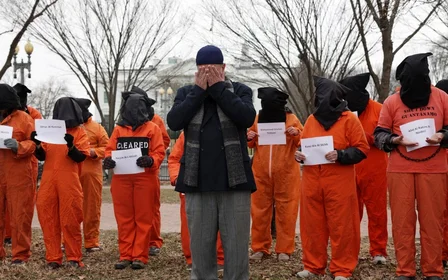
Recall, too, the CIA's ritual torture at assorted international "black sites" and a certain infamous illegal US penal colony on occupied Cuban territory.
Terrorism, defined
It has become almost tiresome to have to repeat, time and again, that this alleged war on terror has itself constituted terrorism plain and simple - at least if we go by, say, the Cambridge Dictionary definition of the word: "violent action or threats designed to cause fear among ordinary people, in order to achieve political aims".
It has become almost tiresome to have to repeat, time and again, that this alleged war on terror has itself constituted terrorism plain and simple
Indeed, it goes without saying that the US military's habit of indiscriminate slaughter has done much to instil fear among ordinary people. Drone strikes on wedding parties are but one example of, um, "violent action".
As per the official narrative, of course, the US is always and forever a victim of terrorism rather than its preeminent perpetrator - a line that is perennially propagated by a disgraceful corporate media establishment that declines under any circumstances to speak truth to power.
To be sure, the US has gotten a run for its money on the whole terror-victimhood front from Israel, which refuses to cede its self-appointed position as number one victim of terrorism in the history of the world - and never mind its lengthy history of terrorising Palestinians.
Predictably, Israel wasted no time in jumping on the post-9/11 "war on terror" bandwagon, paving the way for eventual all-out genocide in the Gaza Strip, which now proceeds apace with US backing and in spite of an ostensible ceasefire.
Scared silly
It bears mentioning that, in addition to sowing terror across the globe, the US government has done a bang-up job in causing fear among its own citizens to further political goals.
In the immediate aftermath of the 9/11 attacks, ordinary people in the US were liable to believe that, if we didn't start blowing up other countries willy-nilly, we'd all be annihilated by anthrax-dispersing crop dusters or worse.
Granted, George W Bush - on whose presidential watch 9/11 took place and who was thus in charge of leading the country to war - was not the most fear-inspiring warrior, perhaps due in part to his pathological inability to formulate proper sentences.
Fortunately for the war effort, however, other more frightening characters had the president's back.
These included the late Dick Cheney, Bush's vice president, who appeared on Foreign Policy magazine's 2012 list of the "Top 100 Global Thinkers" accompanied by the charming accolade: "If scaring us silly were a religion, Dick Cheney would be its high priest."
And while it is debatable whether scaring everyone silly should count as "great thinking", the post-9/11 bellicose thought process certainly worked well to justify all manner of government misdeeds at home and abroad and to generally solidify a global order predicated on the principle that the US can do whatever the hell it wants.
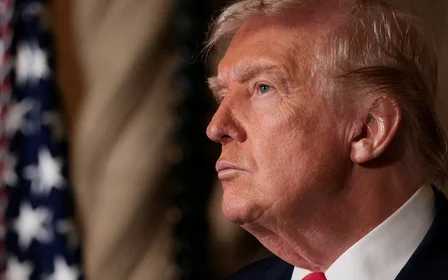
Fast forward a quarter of a century, and current US warrior-in-chief Donald Trump has taken the tradition of doing whatever the hell one wants to another level with a manic foreign policy that is entirely unrestrained by international legal obligations or ethical concerns.
From endeavouring to unleash the apocalypse on Iran to extrajudicially murdering fishermen and other folks in the Caribbean to kidnapping foreign heads of state and spontaneously renaming bodies of water, Trump has breathed new life into imperial impunity.
The president has also expanded the purview of the "war on terror", such that the old "counterterror" mechanisms developed in the wake of 9/11 are now being wielded against undocumented immigrants and anyone else Trump doesn't like.
And that, to put it mildly, should be more than enough to scare us all silly.
The views expressed in this article belong to the author and do not necessarily reflect the editorial policy of Middle East Eye.
Middle East Eye delivers independent and unrivalled coverage and analysis of the Middle East, North Africa and beyond. To learn more about republishing this content and the associated fees, please fill out this form. More about MEE can be found here.