Gaza's children with Down syndrome struggle to rebuild skills lost to genocide

After a long walk through displacement camps and dusty roads, 13-year-old Heba Alataar arrives exhausted at her class at the Right to Live Society (RLS) centre in al-Zawaida, central Gaza.
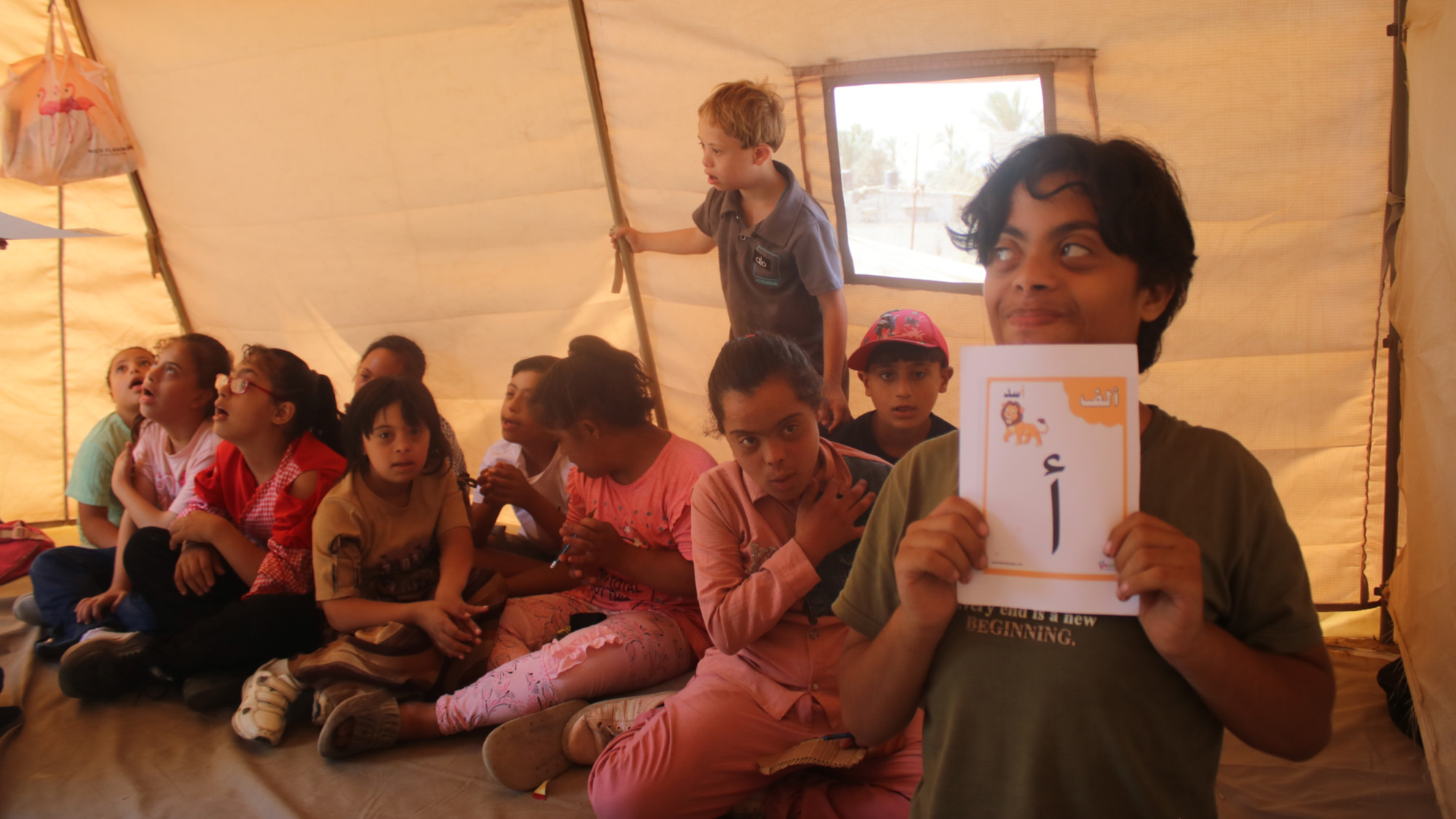
Inside a small makeshift tent divided into two classrooms, the Palestinin girl sits on the ground alongside her classmates, all children with Down syndrome, as they try to learn new skills.
Alataar is one of more than 1,000 children with Down syndrome in Gaza.
Like all children in Gaza, they have paid a heavy toll during Israel's genocide.
But the conflict has been especially destructive for these children.
New MEE newsletter: Jerusalem Dispatch
Sign up to get the latest insights and analysis on Israel-Palestine, alongside Turkey Unpacked and other MEE newsletters
Israeli attacks have destroyed the institutions that provided their education and care, erasing skills they spent years developing.
Children and their families are now struggling to rebuild their skills and lives amid displacement, trauma and a severe lack of resources.
Life before the genocide
Before the war, many children with Down syndrome in Gaza had access to specialised care from birth through adulthood, mainly through the Right to Live Society.
Founded in 1993, RLS operated three facilities across Gaza and employed 200 staff members.
Raoufa Salama, director of rehabilitation programmes, told Middle East Eye that its services included early intervention, education and rehabilitation programmes, as well as psychological counselling for parents.
For Heba's father, Alaa Alattar, that support was life-changing.
“When I found out my daughter had Down syndrome, I cried for days. I didn't know about her condition or how to raise her. I was worried about her future,” Alattar told MEE.
“All my fears and worries vanished when we visited RLS and saw the care the children receive and the level of skills they achieved.”

By the age of 10, Heba had mastered basic skills including comprehension, speech and personal hygiene. She was also beginning to learn to read and write.
“I was delighted and proud of my daughter's progress,” Alattar said. “I was starting to picture a bright future for her.”
But her progress was interrupted when Israeli attacks began in October 2023.
Major setbacks
Israeli attacks destroyed all RLS facilities and killed many children with Down syndrome, while others remain missing.
Those who survived the bombing faced constant terror and harsh conditions in displacement.
Nabila Abed Rabbo recalled how each wave of bombardment left her 13-year-old daughter, Saja Abed Rabbo, gripped by fear.
"Every time my daughter heard an explosion, she became terrified. She tried to cover her ears and came to me screaming and insisting on staying by my side,” Abed Rabbo told MEE.
“Because of the constant fear and the catastrophic living conditions in displacement, Saja has lost all her basic skills. She couldn't even use the toilet. We had to rely on diapers, which were extremely difficult to provide because of the blockade.”
For Alattar, watching his daughter lose her skills was devastating.
'There are no words to describe the heartbreak I felt... to see my little girl depressed and sitting alone in displacement'
- Alaa Alattar, Palestinian father
“The war took everything from Heba. She lost all her skills, interests and routine. She returned to square one, as if she never received any education or care,” the Palestinian father said, his voice breaking with emotion.
“There are no words to describe the heartbreak I felt as a father to see years of my daughter's hard work and the dedicated efforts of her teachers and family vanish in the blink of an eye, to see my little girl depressed and sitting alone in displacement.”
For other families, the disruption was just as profound. Bahjat Sultan said his 14-year-old daughter, Fatima, suffered as a result of the bombing, displacement and separation from her educational environment.
“The war affected Fatima deeply. She lost the ability to express her feelings and began showing aggressive behaviour," Bahjat told MEE.
"Even at night, she struggled to sleep and often woke up terrified and crying from nightmares.”
Salama said the trauma of war has taken a heavy psychological toll on children with Down syndrome in Gaza, causing major setbacks in skills such as communication and personal hygiene.
She also said there had been a rapid increase in births of children with Down syndrome in Gaza. The RLS centre in Al-Zawaida now receives four to five new cases a week, compared with one to two before the war.
Salama attributed the increase to exposure to high levels of pollution from Israeli explosives and psychological stress.
Rebuilding amid destruction
Despite their suffering, children have held on to memories of RLS.
Throughout her family's repeated displacement across Gaza, Fatima Sultan made sure to carry her RLS uniform in her bag.
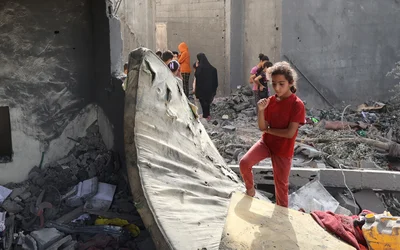
“Fatima would often wear her uniform and ask me to take her to the centre. I kept promising to take her later, hoping that education would resume one day,” her father said.
In July 2024, the RLS team began efforts to resume some of its services. Salama said the aim was to provide psychological support to parents and children, help them regain lost skills and, most importantly, raise awareness about the dangers associated with war and displacement.
The activities began with recreational events and home visits, and later expanded to include early intervention, educational and rehabilitation programmes.
News of RLS's return brought joy to families and children.
“I tried to enrol Saja in several schools, but she was rejected because of her condition,” said Abed Rabbo.
“When we received the invitation from RLS, she was so happy that she could finally go to her own school, learn and make friends.”
Today, RLS provides services to more than 1,000 children with Down syndrome and autism in makeshift tents at three locations across the Gaza Strip.
Because of the destruction and blockade, Salama said there is a severe shortage of essential resources, including suitable educational environments and equipment.
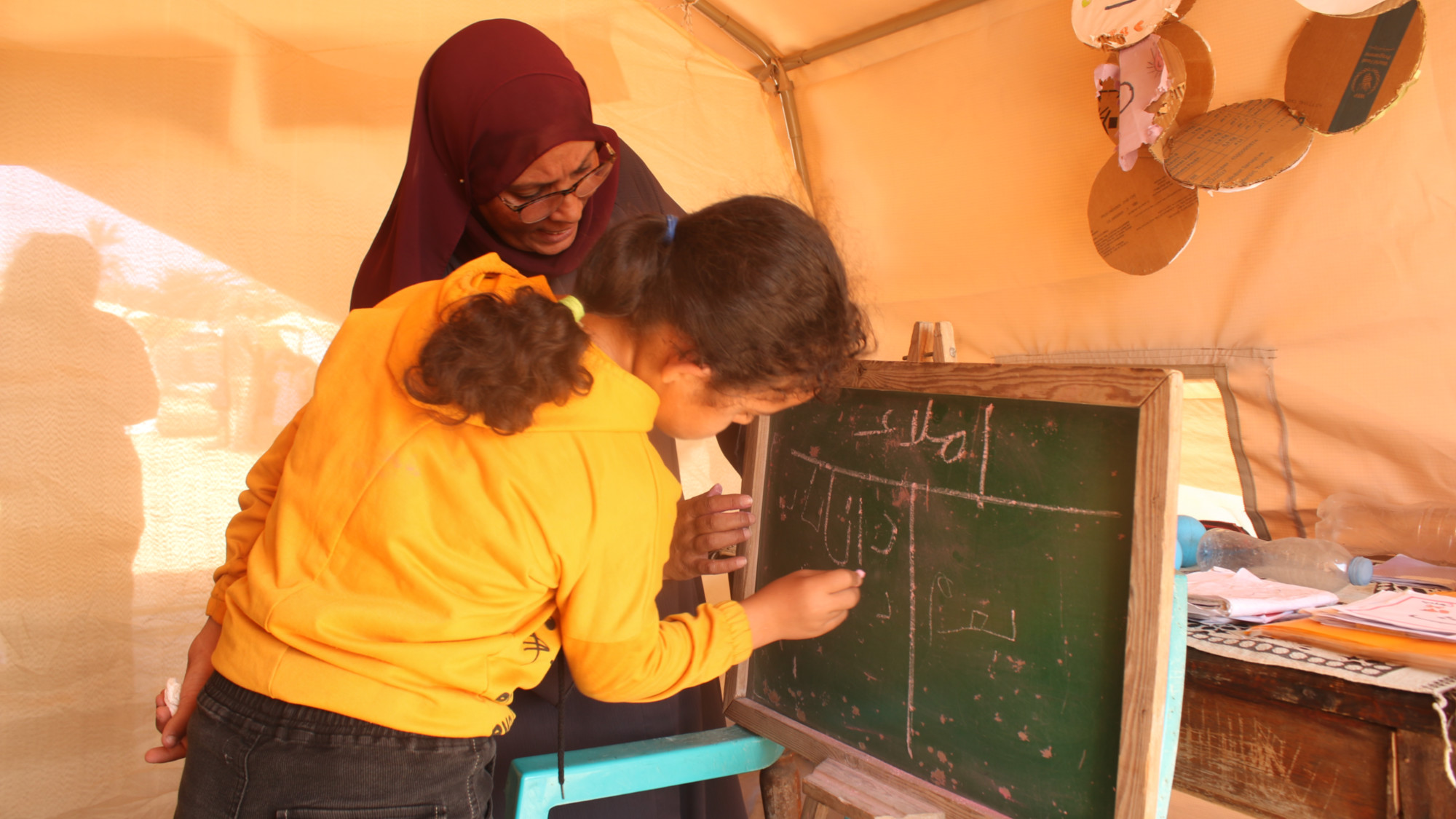
To cope with the shortage, teachers make educational materials using cardboard from aid packages and coloured paper.
According to Salama, ongoing Israeli attacks remain the biggest challenge to the rehabilitation process. Children risk losing newly regained skills as a result of trauma from air strikes and displacement.
Despite a ceasefire announced in October last year, Israel has continued to carry out near-daily attacks across Gaza and maintained severe restrictions on the entry of aid.
Israeli forces have killed at least 1,386 Palestinians since the ceasefire was announced, including at least 300 children.
Hundreds more have been wounded, including RLS student Ahmed Al-Mabhouh, 14, who was shot five times by an Israeli soldier while playing near his home east of Al-Bureij refugee camp. The shooting left him severely wounded and unable to attend his classes.
Hope through education
Despite the immense challenges, the children are gradually making progress.
Salama said children and their families remain committed to the rehabilitation process. They are regaining vital skills such as communication and personal hygiene, while beginning to learn to read and write and to recognise and avoid danger.
Since reuniting with RLS, Heba's life has changed, according to her father. Learning has become part of her daily routine.
“Learning became a new lifestyle for Heba. It occupies most of her time. She is always excited to go to the centre and loves to tell us about her friends and what she learned,” he said.
“She became happier and more focused. We are grateful for the devoted efforts of the RLS team.”
For Alattar, seeing his daughter make progress again has renewed his hopes.
“I hope that the war truly ends and our children no longer fear air strikes or sudden displacement,” he said.
“I hope for my daughter to have a safe educational environment that helps her recover, thrive and grow up to achieve our dream of becoming a teacher for children with Down syndrome.”
Middle East Eye delivers independent and unrivalled coverage and analysis of the Middle East, North Africa and beyond. To learn more about republishing this content and the associated fees, please fill out this form. More about MEE can be found here.