‘Britain can stop this’: The East Jerusalem yeshiva taking UK charity money and planning expansion
A young man in a New York apartment is watching a news programme about antisemitism, illustrated with images of pro-Palestine protests and Israeli flags in flames.
He shakes his head and closes his laptop as the music starts. A country-infused guitar line with a singer to match. The music video's hero, Jake, opens a letter: a business has agreed to invest in his startup.
He’s delighted, but perhaps there’s something missing in his life. The chorus kicks in: “He’d probably do better in Ohr / where the light shines bright like never before / in the heart of the Torah he’ll find his way.”
Jake goes to meet his potential investor, but just as the deal looks done, the investor sees Jake’s Star of David chain and changes his mind.
Back at his apartment, Jake takes out a letter from Ohr Somayach - the “Ohr” Jake would “probably do better” in.
New MEE newsletter: Jerusalem Dispatch
Sign up to get the latest insights and analysis on Israel-Palestine, alongside Turkey Unpacked and other MEE newsletters
The song’s lyrics ring out: “It’s time to return, it’s time go home.” And so Jake heads to Ohr Somayach, where he is welcomed by friendly rabbis and other happy young men, who study and pray together.
At the end of the music video there is a message: “Thousands of Jewish students are seeing the light. Will you?”
But where are they going home to? The music video is a promotional piece for Ohr Somayach, an ultra-Orthodox network of yeshivas for men - often from the US or other western countries - from less observant Jewish backgrounds.
It has a prominent campus in Maalot Dafna, an Israeli settlement in East Jerusalem, on land previously overseen by the UN and regarded under international law as occupied territory seized by Israel in 1967.
The traditional, male-only religious education institution’s plans stretch beyond this Jewish area of East Jerusalem, where in January Israel seized and demolished Unrwa's Jerusalem headquarters.
In 2013, Ohr Somayach began the process of obtaining planning approval for a massive new site in Sheikh Jarrah, the Palestinian neighbourhood that has for decades been a target for Israeli state-backed settlers.
On 20 April 2026, after over 12 years of delays and disputes, as the locals of Sheikh Jarrah and their allies fought the project, the Jerusalem District Planning Committee approved a plan from Ohr Somayach to construct an 11-storey - eight above ground and three below ground - building on land currently used as a carpark.
This building, located on a plot of land opposite a mosque that was originally designated for local public services, would contain both classrooms and dormitories for hundreds of the yeshiva’s students and teachers, and would include an underground basketball court.
Middle East Eye can now exclusively reveal that since Ohr Somayach submitted plans for its expansion, it has received funding from two charities registered in the UK, and that a third British charity facilitates donations to it.
Since 2013, according to tax records from the Israeli Corporations Authority, the London-based Achisomoch Aid Company has donated 2.13m Israeli shekels ($704,000) to Ohr Somayach, while another British-registered charity, British Friends of Yehuda Yaale has donated 1.8m Israeli shekels ($597,000).
Achisomoch says it was “established to advance religion in accordance with the Orthodox Jewish Faith and for such purposes as are recognised by English Law as charitable and in furtherance of the aforementioned objects”.
It can claim gift aid - whereby the British government adds 25 percent on top of the money given - on donations and advises potential donors how to do this, according to emails seen by MEE.
Together, the donations from Achisomoch and British Friends of Yehuda Yaale to Ohr Somayach amount to $1.3m over the past 12 years, according to the Israeli Corporations Authority records.
A third charity, UK Toremet, facilitates donations to Ohr Somayach, which donors can also claim gift aid on. The British charity took part in an international fundraiser that has raised over $2m for the yeshiva, promising that “all donations will receive a tax receipt according to the currency of the payment”.
The UK’s Charity Commission is already actively assessing concerns raised in the media about UK Toremet, which has reportedly been used to fund Israeli settlements in the occupied West Bank and to bankroll Regavim, an organisation sanctioned by the EU and Canada for encouraging human rights abuses, among many other charges.
In Al Jazeera’s recent documentary, Complicit, Regavim’s international director, Naomi Linder Kahn, is secretly filmed saying: “We work through UK Toremet.”
The UK Charity Commission has issued UK Toremet’s trustees with statutory guidance and an action plan, which warned them the charity must comply with the Geneva Conventions Act 1957.
Achisomoch did not respond to Middle East Eye’s request for comment. UK Toremet did not respond to MEE’s request for comment. Ohr Somayach did not respond to questions.
UK action on Israeli settlements
Responding to questions about British Friends of Yehuda Yaale’s donations to Ohr Somayach, Stephen Goodwin, a representative for the charity, said they were not aware of “any new building projects”, referring to the planned expansion into Sheikh Jarrah.
“Any donations were made to assist with day-to-day expenses involved in educating Jewish youth in the various religious programmes offered by the yeshiva, based on the yeshiva in its location and its running expenses when the donation was made,” Goodwin told MEE.
“In light of your revelations, I am contacting the yeshiva,” he said. Regarding the location of the current yeshiva in East Jerusalem, Goodwin said he was unsure “if it can properly be called occupied territory”, since it existed - before 1967 - between Israeli and Jordanian positions.
Ohr Somayach was founded by educators from the US in 1972. It has three branches there and in South Africa, as well as locations in the UK, Canada and Australia. Its East Jerusalem campus was built in 1977.
'In light of your revelations, I am contacting the yeshiva'
- Stephen Goodwin, British Friends of Yehuda Yaale
Earlier this month, UK Foreign Secretary Ed Miliband announced that his government had concluded that the ongoing Israeli occupation of Palestinian land was unlawful and that it was going to ban imports from illegal settlements.
“As the Foreign Secretary set out, we are taking clear action on settlements in the West Bank [and East Jerusalem and the Golan Heights],” a spokesperson for the Foreign, Commonwealth and Development office said.
“This includes banning the import of goods from illegal Israeli settlements into the UK and creating new designation powers to go after individuals and companies that support, facilitate or profit from illegal settlement activity.
“We are also banning the advertisement or promotion of land in the illegal settlements.”
Also responding to MEE, a Charity Commission spokesperson said: "Any concerns we receive about registered charities allegedly supporting or facilitating illegal Israeli settlements will be assessed in line with our published guidance.
“We continue to actively engage with government and other relevant agencies on this matter and are considering any implications of the government's announcement."
In July 2024, the International Court of Justice (ICJ) issued an advisory opinion that found Israel's decades-long occupation of the Palestinian territories to be "unlawful", and that its "near-complete separation" of people in the occupied West Bank breached international laws concerning "racial segregation" and "apartheid".
'Given the clear position under international law, it is hard to see how these charities’ activities meet the public benefit test'
- Stephanie Biden, charity lawyer
“This is the kind of situation where the Charity Commission appears to be starting to shift its regulatory approach, in response to changes in government policy, to take onboard the implications of the ICJ advisory opinion,” Stephanie Biden, a specialist charity lawyer, told MEE regarding donations to Ohr Somayach.
“Given the clear position under international law, it is hard to see how these charities’ activities meet the public benefit test - an important requirement under charity law is that a charity’s purposes must be furthered for the public benefit… and must not be furthered in a way which involves illegality,” Biden said.
She told MEE that it “would be helpful” for the Charity Commission to issue “urgent proactive regulatory guidance to charities that are known to work in Israel and/or the occupied Palestinian territories, to make clear that charitable funds should not be used in ways which sustain the illegal occupation of Palestinian territory…”
Battle for Sheikh Jarrah
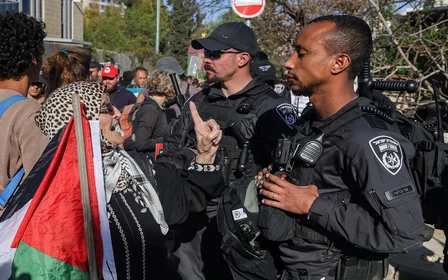
Saleh Diab, a Palestinian resident of Sheikh Jarrah, has campaigned for years against the attempted Israeli takeover of his neighbourhood. Israel has tried to forcibly evict him and his family in a case that has garnered the attention of human rights groups worldwide.
The Palestinian could see, as Israeli activists have also said, that the takeover of Sheikh Jarrah - including the expansion of the yeshiva - was part of longstanding settler attempts to gain control of a ring of Palestinian neighbourhoods around the old city of Jerusalem.
Diab told MEE about a separate plan which, if approved, would see Israeli authorities transfer 55 Palestinian families out of Sheikh Jarrah to make way for 328 homes for settlers.
He understands the planned yeshiva as part of a pattern of Israeli incursions into occupied Palestinian territory - a pattern that sees the process creep ever onward, until an area or neighbourhood belongs not to its original residents, but to Israeli settlers backed by the state.
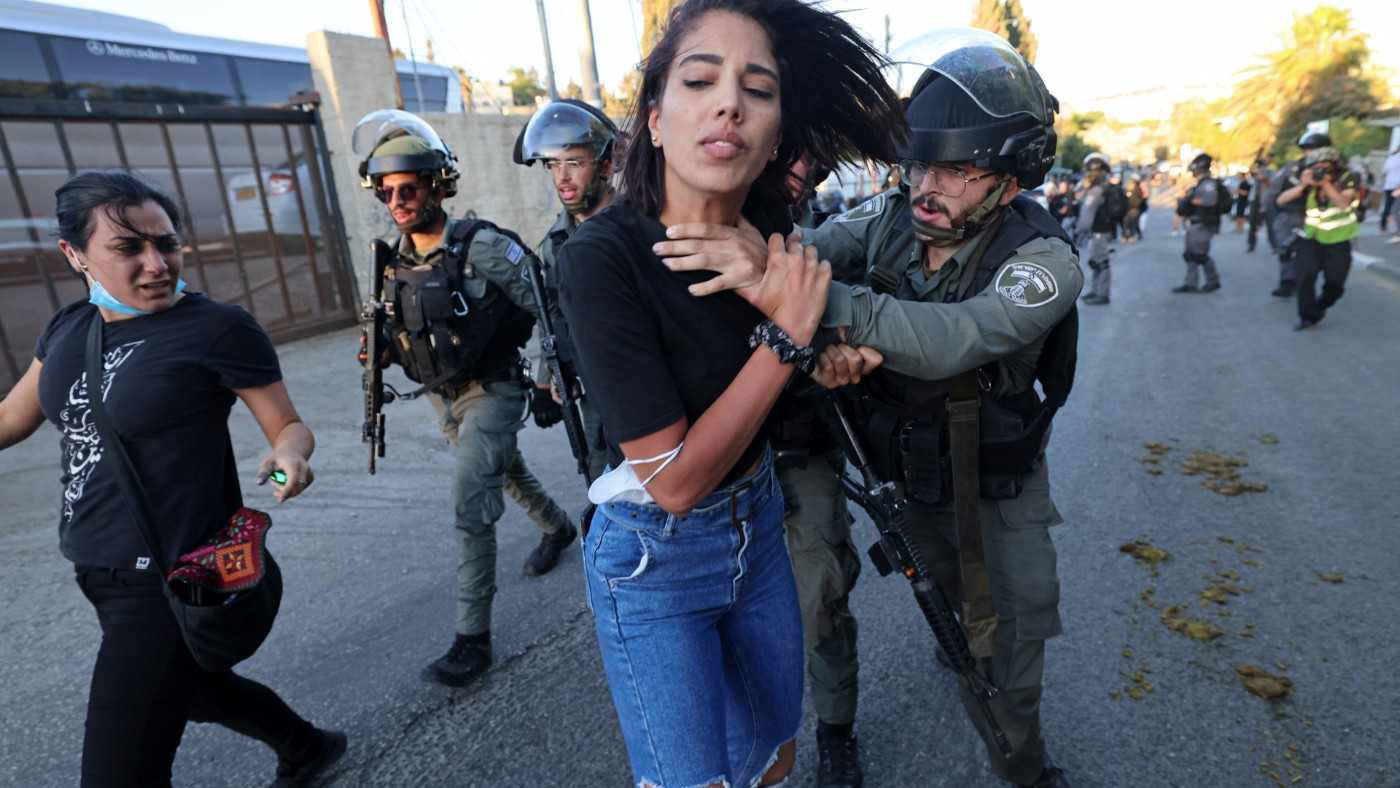

Ohr Somayach’s proposed 11-storey site in Sheikh Jarrah would be, one left-wing Israeli activist told MEE, “a significant settler stronghold in an area where settlers and the state are trying to displace dozens of Palestinian families”.
“Nobody knows where we would be transferred,” Diab said of the Palestinian families who would be forced out to make way for the building.
The land the yeshiva’s expansion is to be built on was once owned by the Palestinian Nashashibi family, which can trace its presence in Jerusalem back to the 15th century.
After Israel captured and occupied East Jerusalem in the 1967 war, the land was expropriated from the Nashashibis and, according to a zoning plan prepared by the Israeli state, was designated in the 1980s for the construction of a public building to serve the neighbourhood’s residents.
Instead, as detailed by Ir Amin, a non-profit group focused on inequality in Jerusalem, this land in Sheikh Jarrah was transferred from the Jerusalem Municipality to the Israel Land Authority, which allocated it - without payment ot tender - to the ultra-Orthodox Jewish organisation Ohr Somayach.
'In 2021, we stopped the settlers from taking our houses because the world was behind us'
- Saleh Diab, Sheikh Jarrah resident and activist
In 2020, advancement of the building plan was halted after a long campaign led by Palestinian residents and Ir Amin. A planning review highlighted the severe shortage of public infrastructure in the neighbourhood, including schools.
Then, suddenly, and with no explanation, the District Committee brought Ohr Somayach’s plan back to the table, with its approval granted in April.
“The [previous] planning authorities understood it was a ridiculous plan,” Aviv Tatarsky, a senior researcher at Ir Amin, told Jewish Currents in May. “The fact that it was revived and approved shows that this government is doing things that even the extreme previous government didn’t.”
The yeshiva, Tatarsky believes, is “a new mechanism” to continue settler expansion in East Jerusalem.
“In 2021, we stopped the settlers from taking our houses because the world was behind us,” Saleh Diab said. “But because of all the news now - in Gaza, Lebanon, Yemen… no one is with us now. This is what I am worried about. That we have been forgotten, and that we do not have any laws protecting us anymore.”
He is clear, though, that international action - particularly from the UK, whose consulate in Sheikh Jarrah Israel has ordered closed - can change the situation.
“Britain can stop this from being built,” Diab told MEE, of the 11-floor yeshiva expansion.
Eretz Yisrael
In a blog post from 2011 entitled “Whose land is it?”, Ohr Somayach’s co-founder Rabbi Mendel Weinbach, who was born in what is now Poland in 1933, wrote:
“One of the stickiest points in the Israel-Arab conflict is the stubborn refusal of the Palestinian Authority to recognize Israel as the homeland of the Jewish People.
“While this is not surprising in light of the historical persecution of Jews by radical Moslems, what is shocking is the attitude of some Jews in Israel and throughout the world that perhaps the Arabs are right in their claims.
“These radical, assimilated liberals unfortunately ignore the Divine promise which all synagogue-going Jews will hear this Shabbat: 'To your offspring I will give this land.'

“… It is the responsibility of every Jew to internalise that Eretz Yisrael was given to our people, and even if we have to make some compromises for the sake of survival, we must always keep in mind that it will be ours forever.”
For Weinbach and the institution he founded, Eretz Israel - the Land of Israel - naturally includes Sheikh Jarrah and East Jerusalem. It includes the West Bank and the rest of the occupied territory now considered illegal by the British government.
For Jake, the hero of the music video, who was adrift in New York, with its supposedly antisemitic business executives, a yeshiva on Israeli-occupied land offers a salve for his troubled soul, a home for him to grow.
His time at the yeshiva is depicted as both joyful and enriching. He is in a fraternal place. He has come home.
And after five years, Jake’s story comes full circle. At the end of the music video, as the credits roll, he knocks on a wooden door that reads “Goldstein Brothers Funding. Startup Department”.
Behind the door, a red-haired man with a beard and glasses welcomes him in. “Jake, I read through your proposal and I’ve got to tell you: I’m extremely excited about investing in your startup.”
Middle East Eye delivers independent and unrivalled coverage and analysis of the Middle East, North Africa and beyond. To learn more about republishing this content and the associated fees, please fill out this form. More about MEE can be found here.