
Gaza students return to makeshift schools after three years of genocide

After three years of Israeli genocide deprived him of a formal education, 13-year-old Akram Helles is finally back in the classroom.
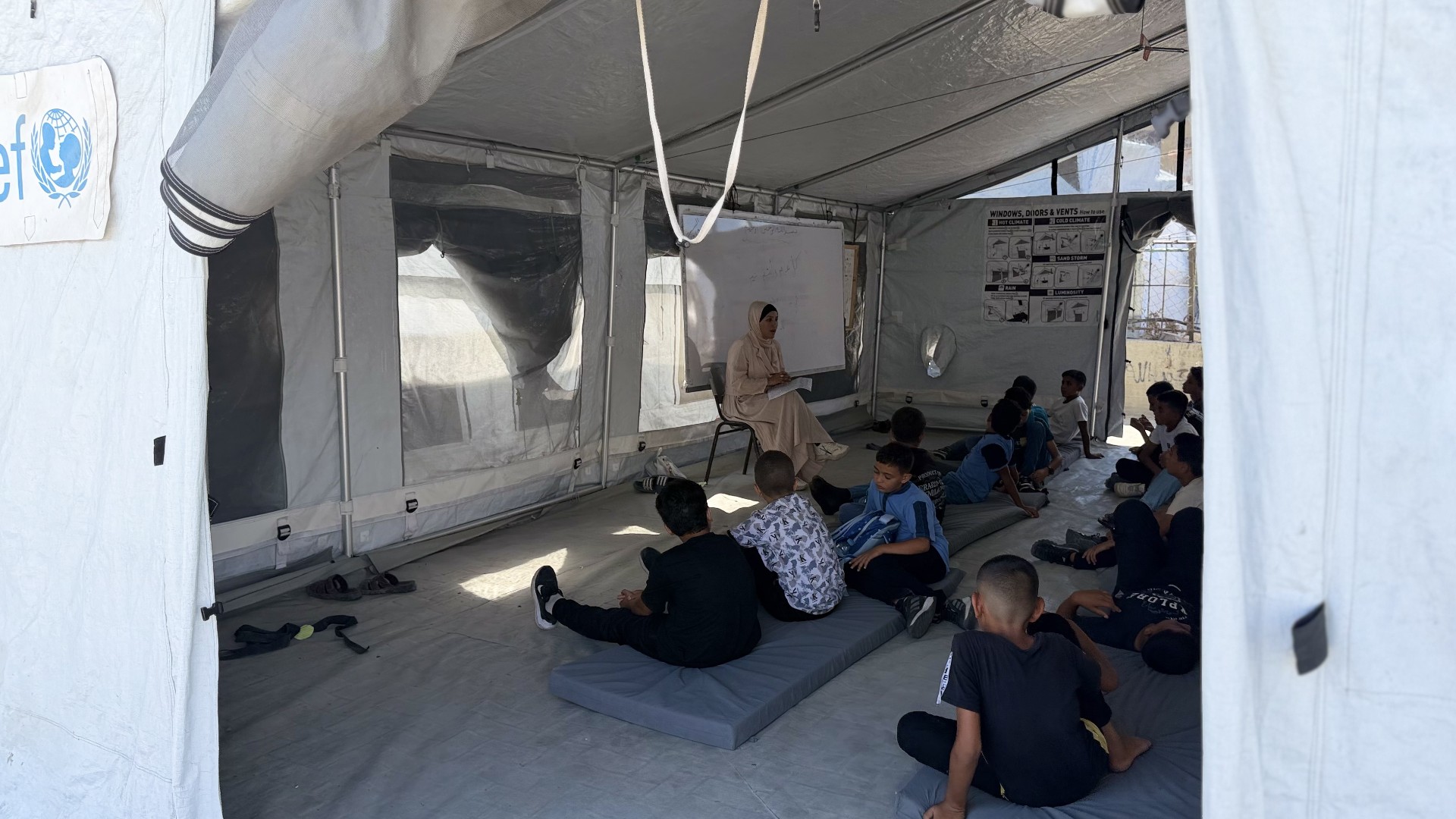
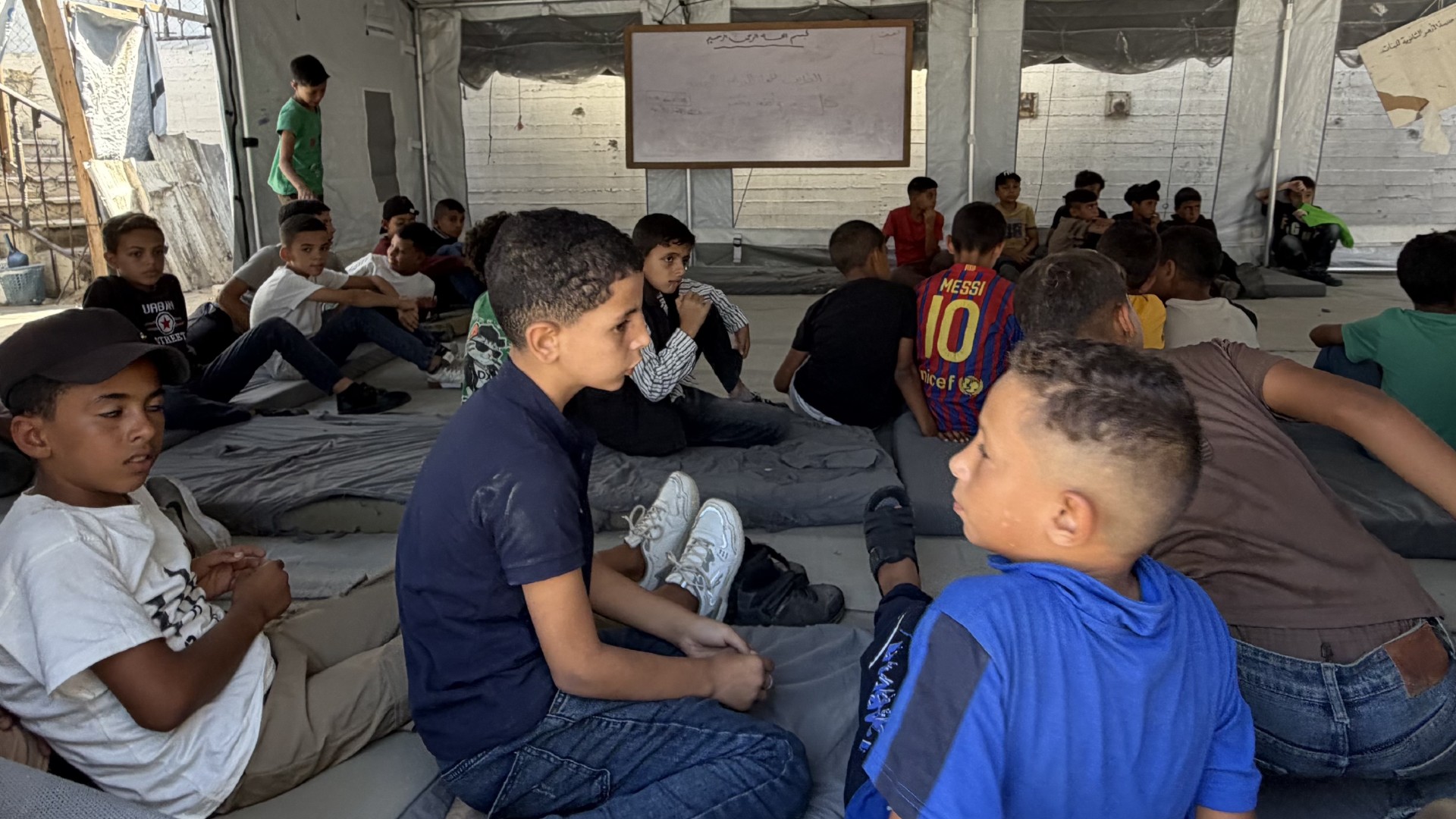
The Palestinian boy sits on a thin mattress alongside his seventh-grade classmates inside a white makeshift tent on their first day of the 2026 school year.
A large whiteboard stands at the front of the tent. Beside it is a single chair for their teacher at Gaza Municipality Preparatory School, set up in the Katiba area of the southern Rimal neighbourhood in western Gaza City.
The heat inside the tent is intense. The students sit on the bare ground. Yet Helles is excited to be back.
“We still cannot believe that Akram has finally been able to join a real school after everything we have been through,” his father, 38-year-old Mohammad Helles, told Middle East Eye.
New MEE newsletter: Jerusalem Dispatch
Sign up to get the latest insights and analysis on Israel-Palestine, alongside Turkey Unpacked and other MEE newsletters
“During the war, Akram and his siblings were out of education for long periods. It was not easy for them to keep up with online learning or enrol in private schools,” he added.
According to the United Nations International Children's Emergency Fund (Unicef), around 700,000 students have missed out on formal education since the genocide began in 2023.
On Sunday, around 500,000 students returned to education across Gaza for the first time since then - 350,000 in public schools and 150,000 in schools run by Unrwa, the United Nations agency for Palestinian refugees.
But the schools they return to bear little resemblance to those they knew before the war.
Around 98 percent of schools in the Gaza Strip have been damaged by the Israeli army, including around 80 percent directly hit, according to Unicef. Many of the remaining buildings have been turned into shelters for displaced Palestinians, making regular schooling impossible.
Working with partners including Unicef and Unrwa, the Ministry of Education has set up a limited number of classrooms in shelters and plastic-sheet tents, many of which lack desks, chairs and basic services.

Even under these makeshift conditions, not every student has been able to enrol.
“We went through a lot before we were finally able to enrol Akram and his siblings at an educational point near the camp where we live,” Helles said.
“We tried to enrol our children somewhere close because we are afraid of sudden bombardments and want to be near them. They also cannot travel to distant areas because transport is unavailable or too expensive.”
For Helles, finding a suitable school was only one of the obstacles.
He has also struggled to provide his three children with basic supplies, including clothes, school bags and stationery.
“Prices in the markets are extremely high, and I lost my job because of the war. I now work helping my brother at a small street stall, so I cannot afford everything my children need, especially since there is no uniform and they need several sets of clothes,” Helles said.
“Unlike in the years before the war, I only bought the bare essentials.”
Thousands of students left out
These are not the only differences between education before the war and today.
Instead of attending school every day, students now follow a rotational system introduced by Gaza’s Ministry of Education. Boys attend on Saturdays, Mondays and Wednesdays, while girls attend on Sundays, Tuesdays and Thursdays. Each day is divided into three shifts to accommodate as many students as possible.
While the Helles family is relieved to have enrolled their three children in free public schools, hundreds of families are still unable to find places for their children in state-run education.
Osama Ayta, 43, has struggled to enrol his two children, Maria and Thaer, because there is no free school near their home.
“The problem is that I cannot send my children, who are eight and 11 years old, to schools far away,” Ayta told MEE.

“It’s dangerous; the roads are unsafe and social conditions are unstable. I am afraid something could happen to them away from our area.”
Private schools are also out of reach. Ayta has no source of income and cannot afford their fees.
Dozens of private schools have opened across the Gaza Strip since the January 2025 ceasefire, but high tuition fees mean only a limited number of families can afford to enrol their children.
“I managed to place them in a nearby free educational centre, but the conditions there are extremely poor, and there are no facilities. At the same time, I am still looking for a better option for them,” Ayta said.
Struggles of families like Ayta’s expose the scale of the education crisis facing Gaza as the strip enters its first formal school year since 2023.
Schools pushed beyond capacity
Wafa Maqat, 57, the principal of Gaza Municipality Preparatory School, said that demand for school places has been overwhelming, while the challenges of running classes remain immense.
“We have very large numbers of students and overcrowded classrooms, while there is barely any school furniture. At our school, for example, there are no tables, chairs or cupboards,” Maqat told MEE.
According to the Ministry of Education, 208 government schools have reopened, but three times that number is needed to accommodate all students.
To ease the shortage, the ministry says it is working with international partners to establish additional temporary schools and learning spaces across the strip.
'There are too many students for four bathrooms, and there is not enough water'
- Wafa Maqat, school principal
Gaza Municipality Preparatory School offers a stark example of the strain facing schools across the strip.
It receives more than 350 students per shift, bringing the total enrolment to more than 2,100 students. Yet the school has just four bathrooms.
“The sanitation situation is extremely difficult. There are too many students for four bathrooms, and there is not enough water. We are constantly facing water shortages,” Maqat explained.
He added that the school also lacks a dedicated tank for drinking water, worsening the wider water crisis affecting families in displacement areas.
As schools struggle to cope inside tents, they are also bracing for the approaching winter.
“In winter, we face major problems, whether it is the darkness inside the tents because there is no electricity, or rainwater flooding the floors. This forces students to get up from their mattresses and attend lessons standing,” Maqat said.
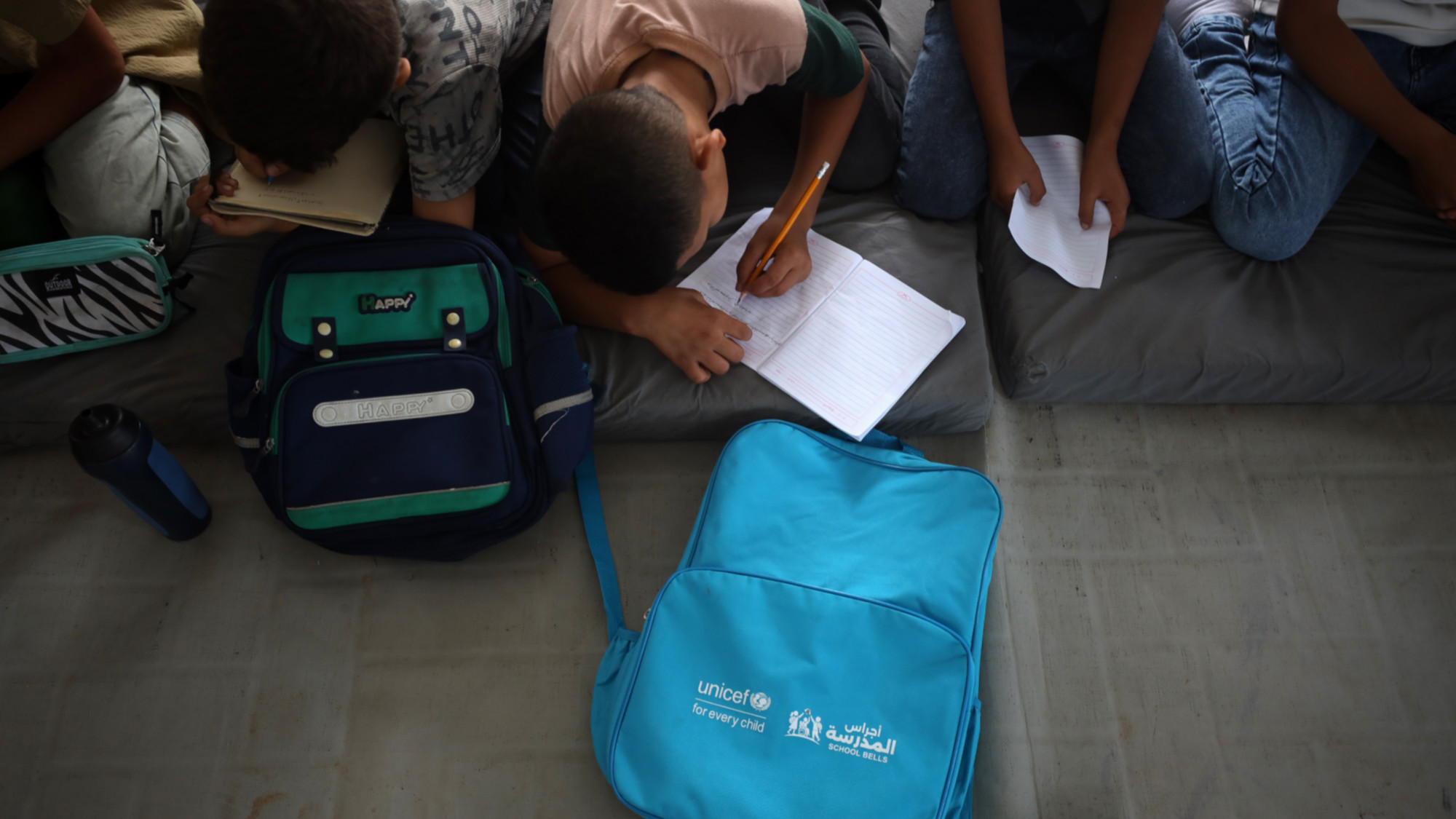
These conditions severely hamper learning for students already struggling with prolonged interruptions to their education.
“We are expected at this stage to make up for lost educational skills and bridge the gap. But the reality forces us to deal with basic survival problems on many levels simultaneously,” Maqat said.
The education ministry also cited shortages of stationery and whiteboards, along with low financial compensation for teachers, as further obstacles to restoring education in Gaza.
As education authorities grapple with the scale of the crisis, Ayta’s family remains caught in a daily search for a place where their children can learn safely.
“After everything my children have lost in skills over the past years, we simply cannot afford to let them lose any more,” Ayta said.
“I will keep searching until I ensure my children receive an education.”
Middle East Eye delivers independent and unrivalled coverage and analysis of the Middle East, North Africa and beyond. To learn more about republishing this content and the associated fees, please fill out this form. More about MEE can be found here.