Netanyahu's UAE visit highlights Arab leaders' dangerous gamble with Israel


As Israeli elections approach, Prime Minister Benjamin Netanyahu is under mounting pressure following media reports documenting his alleged failure to act on warnings about Hamas's attacks of 7 October 2023.
Haaretz sparked a storm on 8 September when it reported that UAE President Mohammed bin Zayed, perhaps Netanyahu's closest Arab ally, had delivered an "explicit warning" to the Israeli prime minister about 10 days before the attack.
The Atlantic then reported that Egyptian officials had repeatedly alerted Israel to an impending Hamas assault, with Egypt's then intelligence chief, Abbas Kamel, flying to Tel Aviv days before 7 October to deliver a warning in person.
The New York Times reported on 25 September that Netanyahu did not disclose the warnings to Israel's security chiefs during a high-level security meeting on 1 October 2023.
Just weeks from the 27 October election, Netanyahu turned to his old friend in Abu Dhabi, bin Zayed.
New MEE newsletter: Jerusalem Dispatch
Sign up to get the latest insights and analysis on Israel-Palestine, alongside Turkey Unpacked and other MEE newsletters
On Sunday, he flew to the UAE for what was supposed to be a secret meeting. Israeli media reported that the hour-long meeting took place at the airport and was followed by several hours of talks with officials from other Arab countries.
Neither side has disclosed a detailed account of the talks, but Israeli media reported a bombshell: Netanyahu had asked bin Zayed to deny the reports about the warning, and bin Zayed had declined, with the UAE unwilling to be drawn into Israeli politics before an election.
Key Arab governments continue to engage with Israel on a largely business-as-usual basis, even as Israel commits atrocities in Gaza, the West Bank, Lebanon, Syria and beyond
Netanyahu's office dismissed reports of the request as "fake news".
The following day, Netanyahu declared on X that "foreign and hostile states and actors, including Arab countries" were behind "false blood libels" aimed at toppling his government, despite his own reported appeal to the UAE president for help.
Meetings between top Israeli and Arab officials at a time of unprecedented Israeli aggression underscore a dynamic that has persisted for years: key Arab governments continue to engage with Israel on a largely business-as-usual basis, even as Israel commits atrocities in Gaza, the West Bank, Lebanon, Syria and beyond.
The expanded session in Abu Dhabi, which Israel's Kan broadcaster said included officials from countries without ties to Israel, reportedly focused on regional cooperation against Iran.
Kan noted that aircraft from Morocco, Libya and Qatar, whose capital Israel bombed only a year ago, landed in Abu Dhabi during Netanyahu's visit.
Arab governments nevertheless appear to believe that they can separate their relations with Israel from Israel's expansionist aggression and from Arab public opinion.
In other words, they would like to be left free to pursue normal diplomatic relations with Israel while occasionally condemning Israeli war crimes and organising aid deliveries to bereft Palestinians.
This is a dangerous game.
Business as usual
Netanyahu has used his dealings with Arab leaders to justify Israeli aggression.
Since the start of the Gaza genocide, he has sought to frame the war as one in line with broad Arab objectives of fighting terrorism, even suggesting that Arab leaders have told him privately that they agree with Israeli war policy.
In one meaningful way, then, Arab relations with Israel do more than simply undermine Palestinians: they actually enable Israeli aggression.
Israel's post-7 October genocide and expansionist aggression have not upended Israeli-Arab relations to the degree that some observers anticipated.
The UAE continues to expand its commercial and security ties with Israel: bilateral trade rose 11 percent to $3.2bn in 2024, and in May an Israeli-operated Iron Dome battery intercepted an Iranian missile over Emirati territory.
Egypt signed a $35bn natural gas supply deal with Israel in 2025, and Morocco and Israel announced on 16 September that they were upgrading their diplomatic relationship to full embassies and ambassadors.
The Abraham Accords countries, especially the UAE and Morocco, have maintained or deepened relations through Israel's destruction of Gaza.
Egypt and Jordan normalised relations with Israel decades before the accords were signed in 2020, and their continued ties reinforce the same point: normalisation has largely separated cooperation with Israel from its atrocities against Palestinians, Lebanese and others in the region.
There is even continued discussion, in both Israel and the United States, of expanding the accords to other Arab states.
US President Donald Trump and Netanyahu continue to set their sights on Saudi Arabia, with Trump declaring in July that a US-Saudi civil nuclear deal was "totally subject to" the kingdom joining the accords.
For its part, Saudi Arabia has repeatedly said that it will not accept a normalisation deal without the establishment of an independent, viable Palestinian state.
Importantly, though, Ynet and other Israeli outlets reported that Saudi Arabia and Jordan were among the countries represented at the "secret" meeting in Abu Dhabi.
A senior Saudi official flatly denied the claim, while Amman called the reports "false and baseless" and accused media close to Netanyahu of circulating them "for electoral purposes".
Fear of revolt
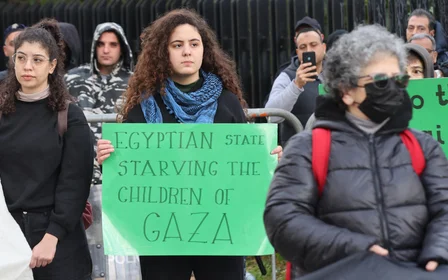
These relationships highlight a massive disconnect between Arab leaders and the Arab street. Recent polling suggests that Israel may be as disliked in the Arab world as it has ever been.
Arab Barometer's 2023 and 2024 polling found support for normalisation in single digits in most of the seven countries surveyed, and no more than 13 percent in any of them.
The 2025 Arab Opinion Index, meanwhile, found that 87 percent of respondents across 15 Arab countries opposed recognition of Israel. Only 6 percent said they would accept it, and half of that small minority made it conditional on a fully independent Palestinian state.

The juxtaposition between the polling data and Arab governments' relations with Israel is striking. Some Arab governments are preserving, and even expanding, relations with Israel even as their populations express rage at Israeli conduct.
It is impossible to separate Arab anger at Israel from frustrations over economic hardship, government repression and state corruption.
From the perspective of many Arabs, concerns over policy towards Israel overlap with broader concerns over government performance at home: the governments that repress their citizens and fail to deliver on economic promises are the same governments that engage diplomatically with Israel in ways that undermine Palestinians.
This mix is potentially combustible.
More than a decade and a half after the Arab Spring, regimes across the region continue to obsess over the possibility of mass revolt.
For the past several weeks in Egypt, government officials and prominent media personalities have warned against the harms of mass protest, often highlighting the economic cost of instability and invoking the 25 January 2011 uprising by name.
On 29 September, President Abdel Fattah el-Sisi himself told his prime minister, cabinet, governors and security chiefs that the 2011 uprising had "almost thrown" the state "into the unknown", and that the two years of economic contraction that followed had left the country needing "at least 10 to 15 years" to recover.
Elsewhere in the region, governments have announced economic initiatives or cracked down on dissent.
Public frustration can simmer under the surface for many years, and no one truly knows when anger might boil over
Amman has unveiled a raft of strategic economic projects to weather what Jordanian media call an "economic storm", while Bahrain targeted Shia critics in March during the war on Iran and Tunisia arrested journalists in September.
It is impossible to predict whether or when another Arab Spring might occur. Public frustration can simmer under the surface for many years, and no one truly knows when anger might boil over.
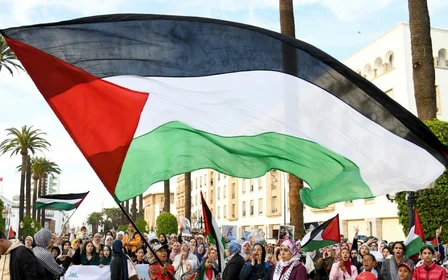
In late September, little more than a week after the embassy announcement, protests against normalisation erupted across Moroccan cities.
In Tangier, where the authorities had banned the demonstration, security forces moved quickly to disperse hundreds of protesters and detained more than a dozen.
Amid a good deal of uncertainty, one thing is sure: Arab governments continue to engage with Israel at their own risk.
The views expressed in this article belong to the author and do not necessarily reflect the editorial policy of Middle East Eye.
Middle East Eye delivers independent and unrivalled coverage and analysis of the Middle East, North Africa and beyond. To learn more about republishing this content and the associated fees, please fill out this form. More about MEE can be found here.