
ICC confirms Middle East Eye reporting on Afghanistan arrest warrants

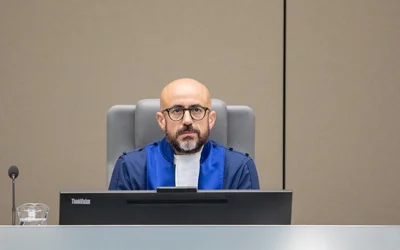
The International Criminal Court (ICC) decided on Monday to make public two additional arrest warrants for members of the Taliban that were issued secretly last year.
As previously revealed by Middle East Eye, the two warrants were issued confidentially by a panel of three judges in September 2025 and came two months after public warrants were issued for two leaders of the group, which now forms the government of Afghanistan.
The four are facing charges of the crime against humanity of persecution on gender and political grounds, allegedly committed by the Taliban as the de facto government authority in Afghanistan from at least 15 August 2021 until at least 20 January 2025.
In July 2025, the ICC issued public arrest warrants for the Taliban's supreme leader Hibatullah Akhundzada and Abdul Hakim Haqqani, Afghanistan’s chief justice.
The court has now named the two other suspects as Afghanistan’s minister of education, Habibullah Agha, and acting minister of higher education Neda Mohammad Nadim.
New MEE newsletter: Jerusalem Dispatch
Sign up to get the latest insights and analysis on Israel-Palestine, alongside Turkey Unpacked and other MEE newsletters
The ICC said on Monday that the four Taliban members are accused of criminal responsibility for ordering or soliciting the crime against humanity of persecution on gender grounds against girls, women and other persons non-conforming with the group’s policy on gender, gender identity or expression.
It added that they are also accused of persecution on political grounds against persons perceived as “allies of girls and women”.
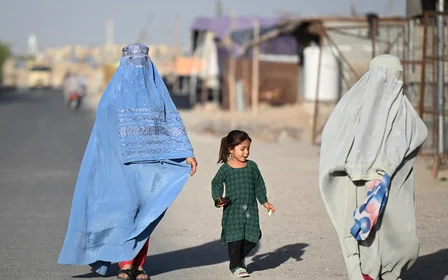
“While the Taliban have imposed certain rules and prohibitions on the population as a whole, they have specifically targeted girls and women by reason of their gender, depriving them of fundamental rights and freedoms,” the court said.
“Specifically, the Taliban severely deprived, through decrees and edicts, girls and women of the rights to education, privacy and family life and the freedoms of movement, expression, thought, conscience and religion,” it added.
“In addition, other persons were targeted because certain expressions of sexuality and/or gender identity were regarded as inconsistent with the Taliban’s policy on gender.”
The four warrants set a historic precedent under international law. They mark the first time the ICC or any other international tribunal has recognised LGBTQ+ victims.
The charge of gender persecution is also very rare under international law, and there has never been a conviction on it. The charge has been prosecuted just once by the ICC, in the Al Hassan case, but never led to a conviction.
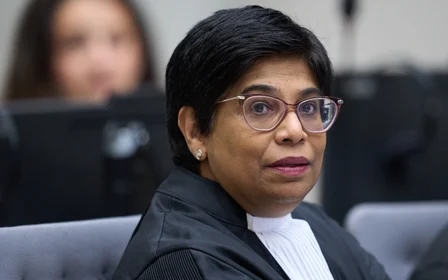
The four applications were prepared under the leadership of former prosecutor Karim Khan and Nazhat Shameem Khan, the ICC's deputy prosecutor, who oversees the Afghanistan investigation. The team has been guided by Lisa Davis, a special adviser who authored the office’s policy on gender persecution.
In April last year, judges ordered the prosecutor’s office not to publicise any requests for arrest warrants unless authorised by a chamber.
But according to the court’s amended regulations, chambers may decide on a case-to-case basis to make warrants public to stop or deter the commission of criminal acts or to improve chances of arrest.
US pressure on ICC
Meanwhile, as also previously reported by MEE, the court has made public a request by the judges for the office of the prosecutor to open a standalone investigation into allegations of gender persecution by the Taliban, separating it from the court's long-running Afghanistan war crimes probe that covered US nationals.
If prosecutors proceed, the Taliban investigation will effectively be split from a broader Afghanistan inquiry looking into alleged war crimes committed since 2003 by Afghan National Security Forces, the US military and CIA personnel, in addition to the Taliban and the Islamic State-Khorasan Province (IS-K) group.
The move is likely to raise questions about whether the court is seeking to ease tensions with Washington by signalling that it will no longer pursue allegations against US forces and their allies.
The chamber's communication came days after US Secretary of State Marco Rubio threatened to “dismantle the ICC, brick by brick”, in remarks referencing the court's 2020 decision authorising an investigation into alleged crimes committed in Afghanistan.
Since February 2025, the US has imposed retaliatory financial and visa sanctions on court officials in connection with the Afghanistan and Palestine investigations, citing efforts to prosecute nationals or allies of the US.
The first target was Karim Khan, the former prosecutor of the ICC, who was controversially removed by member states in July after an 18-month-long misconduct probe.
Also targeted were nine judges, three of whom - Kimberly Prost, Solomy Bossa and Luz Ibanez - were members of the 2020 Appeals Chamber that authorised the Afghanistan investigation.
The sanctions came despite the decision by Khan in 2021 to deprioritise the strand of the Afghanistan probe concerning US military and CIA personnel, as well as former Afghan government forces, in order to focus the investigation on the Taliban and the Islamic State-Khorasan Province.
MEE reported in December that diplomats at the ICC's annual Assembly of States Parties meeting in The Hague said the Trump administration had pressed the court to drop its investigations into Afghanistan and Palestine as a condition for lifting sanctions.
It also demanded that states amend the ICC’s founding treaty - the Rome Statute - to prevent the prosecution of nationals from countries that aren’t members of the court, such as the US and Israel.
At the end of its meeting, however, the assembly issued a declaration resisting those demands and rejecting calls to amend the Rome Statute, without naming the US directly.
Middle East Eye delivers independent and unrivalled coverage and analysis of the Middle East, North Africa and beyond. To learn more about republishing this content and the associated fees, please fill out this form. More about MEE can be found here.