
Navi Pillay, eminent South African jurist, awarded the 2026 Nobel Peace Prize

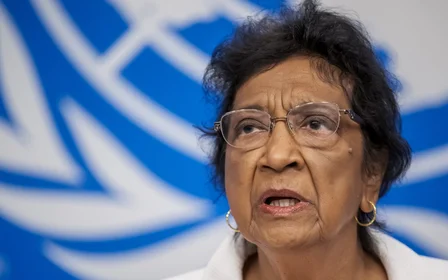
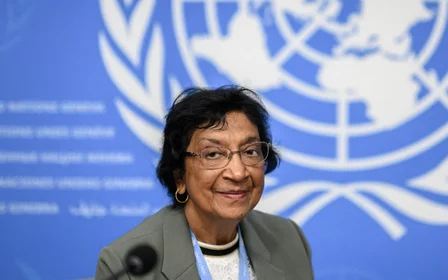
Navi Pillay, the eminent South African jurist who co-authored the United Nations report accusing Israel of committing genocide in Gaza, has been awarded the 2026 Nobel Peace Prize, the Norwegian Nobel Committee announced on Friday.
The committee said Pillay had been chosen "for her efforts to promote peace and international law".
"The Nobel Peace Prize for 2026 goes to a person who with exceptional courage and integrity has led the way towards a more comprehensive global legal order. This year’s laureate has been instrumental in ensuring that war crimes, crimes against humanity and genocide are prosecuted," the committee said.
Pillay, 85, is one of the most influential figures in international criminal justice and human rights law, and is South Africa’s most prominent international judge.
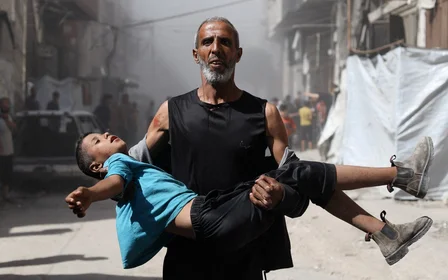
In her first reaction to the announcement, Pillay noted her last work as the the chair of the UN Independent International Commission of Inquiry on the Occupied Palestinian Territory, which concluded in an authoritative report last year that Israel is responsible for genocide in Gaza.
New MEE newsletter: Jerusalem Dispatch
Sign up to get the latest insights and analysis on Israel-Palestine, alongside Turkey Unpacked and other MEE newsletters
"The last thing I did is the report on Gaza naming what is happening there as genocide," she told a gathering of friends and colleagues at courtroom 600 at the Nuremberg Palace of Justice in Germany. "One of the main reactions to that report [was] paying tribute to me for my courage.. why would you need courage to speak the truth?" she said at the historic venue which hosted the post-World War II war crimes trials of the Nazis.
A former UN high commissioner for human rights from 2008 to 2014, Pillay was nominated by Nelson Mandela, then the president of South Africa, in 1995 to serve on the UN's International Criminal Tribunal for Rwanda (ICTR), where she served as a judge and president (1999-2003). Pillay's work at the ICTR produced the first genocide convictions in history.
She was also one of the founding judges of the International Criminal Court, and currently serves as an ad hoc judge at the International Court of Justice (ICJ), which is due to determine whether the Myanmar committed genocide against the Rohingya.
As the president of the ICTR, Pillay helped establish that rape and sexual violence can constitute genocide, setting a historic precedent in the jurisprudence on genocide.
In a wide-ranging interview with Middle East Eye's Expert Witness podcast last year, Pillay said that as a UN expert investigating genocide in Gaza she found "a lot of similarities" with her previous work on sexual violence as a form of genocide.
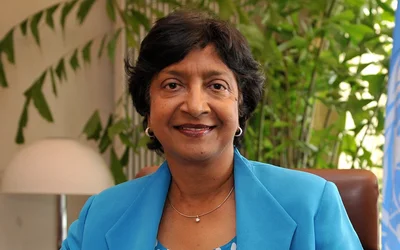
"The commission finds a lot of similarities in the Akayesu case and what is currently unfolding in Gaza," she told MEE, referring to the landmark ICTR case that delivered the first conviction where rape was recognised as an act of genocide.
"We found that the widespread and gender-based violence was instrumentalised, not only as punishment against the individuals, but as part of a pattern of collective punishment to fracture, humiliate, and subjugate the Palestinian population in its entirety," she said.
"I was recognised for having delivered that first judgment and for writing that portion of it. That jurisprudence is directly applicable to the Gaza situation."
The Nobel prize committee recognised Pillay's work at the UN commission, as well as her contribution to setting precedents at international court cases.
"History has shown that a world operating without the rule of law is unjust, unwise and inhumane. The judges - those who guard the thin red line between order and chaos - are therefore highly deserving of our praise," said the committee.
"But today, as these same judges are sanctioned, and their institutions are attacked, we need people of courage, vision and determination - qualities that Navi Pillay demonstrates in her work on the bench."
Middle East Eye delivers independent and unrivalled coverage and analysis of the Middle East, North Africa and beyond. To learn more about republishing this content and the associated fees, please fill out this form. More about MEE can be found here.