Turkey moves to defuse Azerbaijan headscarf row after Aliyev's rebuke

Turkey will not respond to Azerbaijani President Ilham Aliyev's veiled criticism of Ankara following protests in Turkey over an informal headscarf ban introduced in Azerbaijani schools last month, multiple Turkish officials told Middle East Eye.
In September, the Azerbaijani government decided to prohibit clothing in schools that it said violated the principle of secularism, but stopped short of explicitly banning headscarves.
After the rule was announced, however, some schools began preventing students wearing headscarves from attending classes, triggering a social media campaign and subsequent protests in Turkey.
Turkish government-aligned media drew parallels with Turkey’s own headscarf ban in the late 1990s.
They said the restrictions in Azerbaijan recalled measures imposed in 1997, during what is known as the 28 February "post‑modern coup", by Turkish generals and the state bureaucracy as part of efforts to topple the democratically elected Islamist government of the time.
New MEE newsletter: Jerusalem Dispatch
Sign up to get the latest insights and analysis on Israel-Palestine, alongside Turkey Unpacked and other MEE newsletters
Many social media users in Turkey also criticised Azerbaijan for keeping a representative in the UN General Assembly hall during Israeli Prime Minister Benjamin Netanyahu’s speech last month.
The Turkish delegation joined representatives from many other countries in walking out in solidarity with victims in Gaza.
Translation: "28 February is being resurrected in Baku: Mass protest in Istanbul against the headscarf ban in Azerbaijan!"
In an address to his New Azerbaijan Party’s convention in Baku on 2 October, Aliyev criticised unnamed actors for interfering in Azerbaijan’s domestic affairs.
“Everyone should know their place; they should not interfere in our affairs, stick their noses into our way of life, or tell us what to do. Everyone should mind their own nation and state,” he said.
Aliyev added that Baku did not need anyone’s help or patronage. He said Azerbaijan had received no assistance when it had to care for a million refugees from Nagorno-Karabakh, which was under Armenian control until a few years ago.
“We paid for everything we acquired. This includes all the weapons we purchased - right down to the last bullet - at global market prices,” he said.
“We were not granted a discount of even a single manat or dollar. In fact, at times, we were charged prices many times higher than global market rates, and we were forced to turn a blind eye to it.”
Translation: "Following the new dress code regulation that came into effect in Azerbaijan, new footage has also emerged from the Jalilabad region after Sumgayit. Students who wanted to enter classrooms wearing headscarves, citing the 'principle of secularism' and 'school uniform integrity' as reasons, were turned away from school gates."
Turkey was Azerbaijan’s leading backer during the second Nagorno-Karabakh war in 2020, providing drones, arms and ammunition, as well as deploying F-16s and special forces to help Baku win the war.
'A misunderstanding'
Aliyev’s remarks were widely interpreted in Ankara as a direct attack on Turkey, even though no Turkish official had publicly commented on the headscarf restrictions.
One Azerbaijani source suggested that Aliyev might have been responding to Turkish President Recep Tayyip Erdogan’s UN address on 23 September, in which he said Muslim women and girls had faced increasing discrimination in recent years.
“We regard the headscarf ban introduced in schools by certain countries as an attack on women's most fundamental rights,” Erdogan said.
However, Erdogan’s remarks came a week before the first reported incident involving headscarf restrictions in Azerbaijan.
Two Turkish officials told MEE that his comments were directed at France, where right-wing parties have campaigned for a general ban on headscarves in public, and Austria.
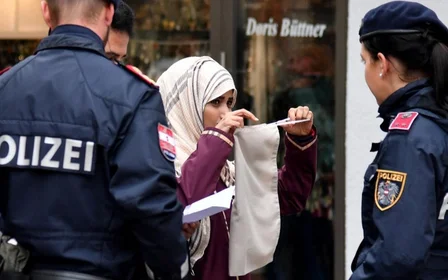
Since 1 September, Austria has banned headscarves for girls under 14 in state and private schools. Repeated breaches could result in fines of €150 to €800 ($168 to $ 896) for parents.
A senior Turkish official told MEE Ankara had no intention of interfering in Azerbaijan’s domestic affairs and that no official statement suggested otherwise.
“We believe this is a misunderstanding,” the official said, adding that Ankara had conveyed this message at the highest levels to reassure Baku.
Multiple Turkish officials said Ankara would not respond to the indirect criticism and would instead seek to ease tensions.
The senior official described Azerbaijan as a “kin country”, highlighting the strategic energy, transport and military investments the two states had jointly developed and implemented. The official said the spat was inconsequential and that further engagement would ease tensions, as in the past.
Omer Celik, spokesperson for Turkey’s ruling AK Party, said in televised remarks on Wednesday that Erdogan and Aliyev shared a “true brotherly relationship”.
“There may be differences in their assessments regarding domestic and foreign policy,” he said. “When we have disagreements on these issues, we continue on our path by discussing them as two brotherly countries, sharing all of this openly and honestly.”
Celik added that certain groups or factions in Turkey were unfairly targeting Azerbaijan.
“There is absolutely no connection between these actions and our party or government; those involved are acting on their own initiative,” he said.
“We will not tolerate any attempts to create the impression of a rift between Turkey and Azerbaijan, nor will we allow a shadow to be cast that might harm our brotherhood. We view this situation with great displeasure.”
Middle East Eye delivers independent and unrivalled coverage and analysis of the Middle East, North Africa and beyond. To learn more about republishing this content and the associated fees, please fill out this form. More about MEE can be found here.