Attack on Riyadh airport leaves 12 dead, more than 300 injured

At least 12 people were killed and 309 others injured in an attack on Saudi Arabia's King Khalid International airport in Riyadh as Iran-backed Houthis escalated the campaign they launched this summer against the kingdom.
The General Authority of Civil Aviation (GACA) said in a statement on Sunday that four Saudi citizens, two Bangladeshis, one American, one Egyptian, one Jordanian, one Syrian, one Palestinian and one Sudanese were killed in the attack on late Saturday.
The authority said some of the injured were in critical condition and that all were receiving medical care at several hospitals. Hospitals were flooded with wounded brought by ambulance and helicopter, people briefed on the matter told Reuters.
Jordan's foreign ministry said in a statement on Saturday that two injured Jordanians were discharged from hospital while two others were still receiving treatment.
One eyewitness at the airport on Saturday reported seeing an explosion and then multiple people lying injured on the ground inside. More than a dozen ambulances were seen rushing towards the facility. A video verified by Reuters showed ambulances at the airport.
New MEE newsletter: Jerusalem Dispatch
Sign up to get the latest insights and analysis on Israel-Palestine, alongside Turkey Unpacked and other MEE newsletters
An injured traveller told Reuters they saw something fly across the sky outside the airport before part of the ceiling near a departure gate collapsed.
Saturday's attack, the deadliest in the kingdom in more than a decade, occurred without warning, with no alert issued by Saudi Arabia's threat warning system.
This week's two previous attacks on the airport left four people dead and caused heavy damage to a Saudi commercial plane parked on the tarmac.
All flights were diverted from Riyadh on Saturday, and operations at the airport that serves a city of roughly 8 million people were temporarily suspended, the Saudi civil aviation authority said.
The Iran-backed group, which is yet to claim responsibility for the latest attack, has aviation companies to avoid using Saudi airspace, saying any aircraft operating there – except over the holy cities of Mecca and Medina – is a target.
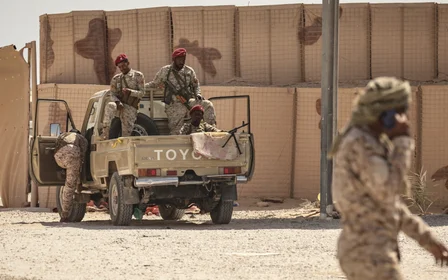
The attack on the airport comes amid escalating fighting between Yemen’s internationally recognised government forces and Houthis. Majed Abdullah al-Nuzaili, spokesman for the government forces, said more than 1,900 operations carried out in the past 24 hours targeted weapons and ammunition depots, camps and military positions, reinforcements and other “military objectives deep within areas controlled” by the Houthis.
The coalition called the attack a 'war crime' and said it will respond firmly to the attack on the airport, Reuters reported.
Riyadh due to hold major summits
Flight-tracking site flightradar24 showed all flights to Riyadh had either been diverted or cancelled, with only a helicopter hovering over the airport at one point.
Houthi attacks on Thursday and earlier in the week had already prompted a number of carriers to suspend or cancel services to the Saudi capital, shortly before Riyadh is due to host major energy and investment conferences, including the World Petroleum Conference.
Organisers of those conferences said ahead of the strikes on Saturday they would go ahead as planned, according to Reuters.
Advisories issued
In an advisory issued earlier on Saturday, King Khalid airport urged passengers to contact their airlines directly and check their flight status before heading to the airport amid reports of disruptions to air traffic, without specifying the cause of the disruptions.
Saudi Arabia’s Ministry of Foreign Affairs also instructed Saudi citizens travelling to the kingdom to contact local embassies if their travel itineraries have been disrupted following the attack.
At the same time, foreign embassies in Riyadh, including those of the US, the United Kingdom, Ireland and Canada, issued advisories on social media to their citizens in Saudi Arabia.
The US mission said it was “aware of attacks on King Khalid International Airport in Riyadh” and “strongly recommends” all US citizens avoid the airport and surrounding areas.
The UK and Irish embassies advised their nationals about “a serious incident” at the airport. Canada’s embassy advised citizens in Riyadh to avoid all travel to the airport, noting “ongoing military activity”.
US may join Saudi strikes on Houthis, Trump says
Following reports of the latest attack, United States President Donald Trump was asked by reporters outside the White House whether Washington planned to join the Saudi strikes on the Houthis.
“We may. We’re going to look at it. We just found out about the recent attack, so we’ll make a decision. We move very quickly,” he said.
“I think it’s terrible. The Saudis are good fighters but I think the attack was a terrible thing,” the US president said.
Trump said he planned to speak to Saudi Crown Prince Mohammed bin Salman about it. He said the US had communication with the Houthis and added that “what they did was very bad”.
US Secretary of State Marco Rubio said that the United States strongly condemns recent attacks on Saudi Arabia. He said an American citizen was killed in the strikes.
"These reprehensible attacks demonstrate a blatant disregard for innocent civilian life. They must stop now," Rubio wrote on X.
The attack was widely condemned, with Qatar’s Ministry of Foreign Affairs calling it “a direct threat to the security of the region”.
Qatar’s former prime minister says today’s attack on King Khalid airport shows that it is “more urgent than ever” to stand with Saudi Arabia in a “practical and decisive” manner.

“It has now become clear that Iran is our primary adversary”, Hamad bin Jassim bin Jaber Al Thani said in a post on X, adding that the Gulf Cooperation Council today confronts “several hostile plots and conspiracies” that require “unity and profound foresight”.
He said it has become “more urgent and evident” that Qatar stands with Saudi Arabia against the “threat from within Yemen” that is being “plotted and directed from outside [Yemen]”.
The situation “necessitates setting aside all peripheral disputes” among Gulf Cooperation Council members and “demonstrating unity” instead, he said.
Japan’s embassy also “strongly” condemned Houthi attacks on airports and other Saudi civilian facilities.
Kuwait Airways said it was cancelling flights because the airport had closed due to a “security situation”.
Egypt's Ministry of Foreign Affairs, Egypt expressed its “profound denunciation of these blatant attacks”, their “flagrant violation” of international law, and the “disregard” for the safety of citizens that they entail.
Saudi Arabia entered the Yemen war in 2015 at the head of an Arab coalition to try to force the Houthis out of the Yemeni capital Sanaa. The Houthis had stormed Sanaa the previous year, pushing out government forces.
The war was fought to a bloody stalemate, with hundreds of thousands of Yemenis killed by fighting and famine. Saudi Arabia struck a 2022 deal with the Houthis, freezing the conflict.
That ceasefire unravelled over the summer, culminating in a lightning Houthi advance that took the Red Sea chokepoint of Bab el-Mandeb from Saudi-backed government forces.
The Saudi-backed Yemeni government began an offensive this week to try to retake that territory, which has so far made slow gains, even as the Houthis put the country's third-largest city, Taiz, under siege.
Middle East Eye delivers independent and unrivalled coverage and analysis of the Middle East, North Africa and beyond. To learn more about republishing this content and the associated fees, please fill out this form. More about MEE can be found here.