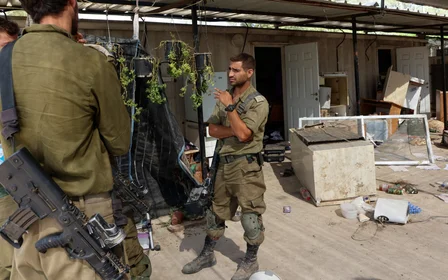
Israel demolishes Bedouin Palestinian homes leaving 250 homeless

Israeli forces demolished between 50 and 80 homes and a mosque belonging to a Bedouin Palestinian clan on Monday, leaving about 250 people homeless.
The Israeli newspaper Haaretz reported that the demolitions began late on Sunday near the southern city of Rahat after an Israeli court rejected a request to postpone the orders.
The newspaper reported that the Abu Wadi clan, who had lived in the area for decades, were forced to dismantle their own homes and had not been provided with alternative housing.
One resident described the experience of destroying his own home as "catastrophic, impossible to describe".
"This is the hardest day I've ever …[had] of my life," he told Haaretz.
New MEE newsletter: Jerusalem Dispatch
Sign up to get the latest insights and analysis on Israel-Palestine, alongside Turkey Unpacked and other MEE newsletters
"I have no roof over my head. I don't know where I'll be tomorrow, there are no plans," he added, saying that rent in Rahat was too expensive for many members of the clan.
Another resident said she was devastated as she watched her home being destroyed.
"I feel like I have nothing left," she said, adding that she did not know where her family would spend the night. "We'll probably sleep under a tree."
A young mother told Haaretz that it was "very hard to survive like this with two small children", saying her family had nowhere to go.
"No one is thinking of leaving," the neighbourhood, she said. Her sister added: "We will stay under the trees. We won't move from here."
Election issue
The demolition of the Abu Wadi neighbourhood comes amid what Palestinian representatives describe as an intensifying Israeli campaign against Bedouin communities in the Negev, known as the Naqab in Arabic.
The campaign has been led by far-right National Security Minister Itamar Ben Gvir and Settlements Minister Orit Strook, who have pursued policies targeting Palestinian communities in the region.
Palestinian political figures have accused the government of exploiting the demolitions for electoral gain ahead of Israel's 27 October elections.
Talal Alkernawi, the mayor of Rahat, described the destruction as "a crime and a disgrace of the Israeli government" and called on the Israeli opposition to condemn the policy.
'This is the election campaign of Otzma Yehudit and Ben Gvir here in the Negev: to demolish and leave families without a roof over their heads'
- Waleed Alhwashla, Ra'am
Taleb el-Sana, chair of the Higher Steering Committee of the Arabs of the Negev, told Haaretz that the destruction resembled "scenes of war, of an earthquake".
"A village that has been struck by a disaster, except that here it is a disaster of racism," he said.
El-Sana accused the government of making home demolitions part of its election campaign, vowing to continue fighting "for full equality and justice".
Waleed Alhwashla, a Knesset member from the Palestinian-led Islamist party Ra'am, also accused Ben Gvir's far-right Otzma Yehudit party of using the demolitions to mobilise voters.
"This is the election campaign of Otzma Yehudit and Ben Gvir here in the Negev: to demolish and leave families without a roof over their heads," Alhwashla said.
According to reports, Israeli authorities had offered the 250 Bedouins the option of moving to another part of Rahat, but residents warned that the proposed relocation could trigger clashes with other clans.
Wider housing crisis
Sundays demolitions are part of a wider housing crisis facing Bedouin Palestinians in the Negev, where communities have long faced home demolitions, restrictions on construction and inadequate infrastructure.
About 320,000 Bedouin live in the region, making them one of Israel's most economically marginalised communities.
Around 100,000 live in 36 villages that Israel does not recognise, leaving locals without access to basic services, including electricity and running water, according to the figures cited in the original report.

The Regional Council for Unrecognised Bedouin Villages in the Negev (RCUV) said Israeli authorities had demolished 19,300 structures and facilities in Bedouin communities over the past three years, including 2,900 residential homes.
The council said the demolitions had inflicted substantial financial losses on families, estimating that the destruction of a single home could cost a household 100,000 shekels.
Based on that estimate, the RCUV put the financial losses suffered by Bedouin families since 2023 at about 290 million shekels. It also warned that repeated demolitions were taking a psychological toll on residents, particularly women.
During Monday's operation, bulldozers also buried a shelter containing puppies under soil, the council said. Local residents managed to rescue the animals.
Before the state of Israel was established, an estimated 65,000 to 100,000 Bedouin lived in the Negev. Only about 11,000 have remained.
Last month, Finance Minister Bezalel Smotrich announced plans to expand Jewish settlement in the Negev and Galilee as part of his election campaign, saying he wanted to replicate policies he had pursued in the occupied West Bank.
"The goal: one million additional Jews in the Negev and Galilee," the minister said.
Middle East Eye delivers independent and unrivalled coverage and analysis of the Middle East, North Africa and beyond. To learn more about republishing this content and the associated fees, please fill out this form. More about MEE can be found here.