Berlin: Social Democrats and Greens want pro-Israel stance for coalition with The Left

Germany’s Social Democrats and Greens have made commitments to Israel a condition for coalition talks with the left-wing party Die Linke to form Berlin’s next government.
The parties were due to continue talks on Friday after a dispute over pro-Palestinian politician Vanessa Emde interrupted negotiations earlier this week.
Die Linke ("The Left") won 25.7 percent of the vote in the 20 September election, becoming the largest party in the capital’s parliament.
Its leading candidate, Elif Eralp, is seeking to become Berlin’s governing mayor but needs the Social Democrats (SPD) and Greens to form a majority coalition.
The two parties have made Die Linke’s position on Israel a central issue in negotiations, demanding commitments before discussions on governing the city could begin.
New MEE newsletter: Jerusalem Dispatch
Sign up to get the latest insights and analysis on Israel-Palestine, alongside Turkey Unpacked and other MEE newsletters
On 8 October, the SPD and Greens required Die Linke to agree to a joint document as a condition for opening exploratory talks.
The agreement declared “Israel’s right to exist” non-negotiable and rejected general boycotts against Israel.
It “condemned” the Hamas-led attacks of 7 October 2023 while it “recognised” the “suffering, hardship and destruction endured by Palestinian civilians in Gaza and the West Bank”.

Although it backed Palestinian self-determination and a two-state solution, the document contained no equivalent declaration of a Palestinian state’s right to exist.
Its passage acknowledging Palestinian suffering did not identify who was inflicting it, namely Israel.
The agreement also provided for disciplinary measures, including possible expulsion, against members who breach its principles.
'Antisemitism [is] the weapon of choice'
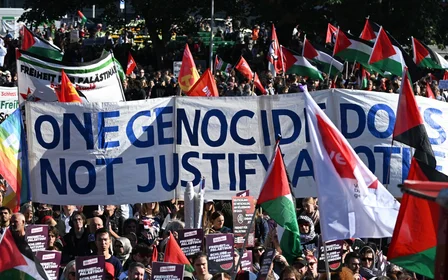
Die Linke stands out in German politics for its criticism of Israel’s war crimes against Palestinians over the past three years.
On 19 June, the party formally described Israel’s actions in Gaza as genocide.
'It shows that accusations of antisemitism are the weapon of choice for discrediting left-wing politicians'
- Wieland Hoban, Jewish Voice for a Just Peace
Its national executive had already condemned crimes against humanity and Israeli efforts to ethnically cleanse Palestinians from Gaza. Regional branches have also denounced Israeli apartheid in the occupied territories.
These positions have drawn accusations of antisemitism.
Josef Schuster, president of the Central Council of Jews in Germany, declared that “left-wing ‘anti-Zionism’ is poorly concealed antisemitism”.
Andre Bock, a politician from Chancellor Friedrich Merz’s ruling CDU, called on the domestic intelligence agency to “examine” whether Die Linke should become an organisation under suspicion.
“It shows that accusations of antisemitism are the weapon of choice for discrediting left-wing politicians,” said Wieland Hoban, chair of Jewish Voice for a Just Peace in the Middle East.
“Since a critical view of Israel is a natural left-wing position, and Die Linke is the only party that has even dared to use the word 'genocide', the popular conflation of Jews and Israel is used as a basis to call the party antisemitic,” Hoban told Middle East Eye.
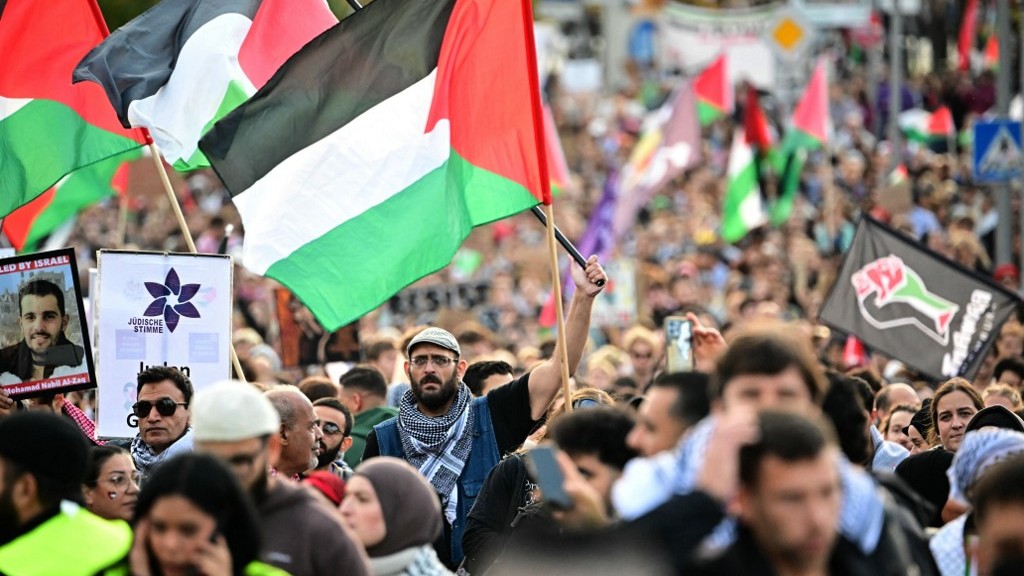
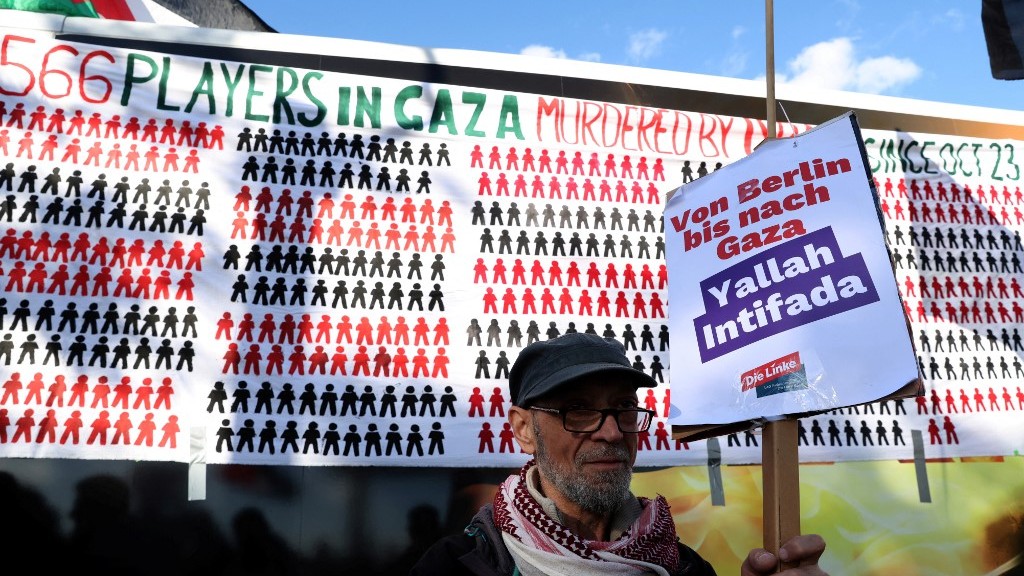
While Germans face housing and cost-of-living crises, “there are people who have a vested interest in avoiding a discussion of those actual problems and would rather have ridiculous debates about whether the word 'intifada' is antisemitic,” he said.
“They want to put the party on the defensive, and hope that it will dilute its politics in order to be accepted by coalition partners - or be destroyed in the process,” he added.
'There is no right to exist for states'
On 13 October, Die Linke admitted Emde, who won approximately 46 percent of the vote in her Neukolln constituency, to its parliamentary group. The SPD and Greens subsequently suspended negotiations.
During the election campaign, Emde had said: “There is no right to exist for states - people have a right to exist.”
On Thursday, she described that position as an obvious principle of international law and said: “I stand by my statements and I am not retracting a single one of them.”
Green leaders maintained that keeping Emde outside Die Linke’s parliamentary group had been a condition for the talks. Die Linke denied agreeing to exclude her, and the written document did not name her.
Hoban described Emde’s position as “a completely factual statement that's uncontroversial in international law”.
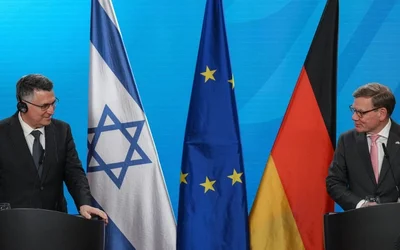
“No state has a 'right to exist'. But the political and media establishment insists on this mantra because it's central to the moral narrative with which Germany justifies its support for Israel and its participation in US-led imperialism,” Hoban told Middle East Eye.
Emde has also received support within her party. Jorinde Schulz, Die Linke’s Neukolln district chair, rejected accusations that Emde had made antisemitic statements.
“We naturally assume that Vedi Emde will be part of the future Left parliamentary group.”
In a joint statement, around 120 Die Linke politicians and officials criticised their negotiators for accepting the preconditions to coalition talks. They accused the SPD and Greens of introducing “mechanisms of discipline and division into Die Linke from outside”.
The agreement allows coalition partners to trigger an expert assessment of antisemitism accusations, although each parliamentary group retains responsibility for deciding consequences.
“The distinction between antisemitism and opposition to Israel is quite simple: antisemitism is directed at Jews simply for being Jews, while Israel is a state - an occupying apartheid state that has been committing genocide for three years,” Hoban told MEE.
“At the same time, this politically motivated hostility is different from antisemitism as racism towards Jews, and the graver Israel's crimes become, the more anger there will be towards Jews everywhere, many of whom still support Israel, unfortunately,” Hoban added.
Middle East Eye delivers independent and unrivalled coverage and analysis of the Middle East, North Africa and beyond. To learn more about republishing this content and the associated fees, please fill out this form. More about MEE can be found here.