Albania's Rama uses culture to artwash Israel's genocide and growing repression

In May 2026, residents of Zvernec, near Vlora, woke to find a coastline they had long accessed freely enclosed by barbed wire.
When one of them was dragged away by masked private security guards in front of Albanian police, who stood by without intervening, images of the incident spread quickly, sparking public anger.
Protests have since spread across Albania and its diaspora, with demonstrations in Tirana continuing for more than four months.
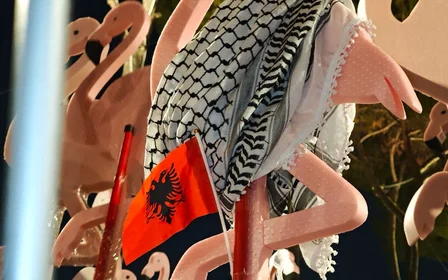
The movement, known as the Flamingo Revolution, takes its name from the pink flamingos of the Narta lagoon, a protected wetland being cleared for a multibillion-dollar luxury tourism development linked to Jared Kushner and Ivanka Trump and backed by Prime Minister Edi Rama.
Then, in October, the protests escalated. Student-led demonstrations in Tirana calling for Rama's resignation have been met with rubber bullets, water cannon and teargas since 13 October. By 18 October, 272 people, including 169 police officers, had been injured, according to Albania's health ministry.
New MEE newsletter: Jerusalem Dispatch
Sign up to get the latest insights and analysis on Israel-Palestine, alongside Turkey Unpacked and other MEE newsletters
Kushner's Affinity Partners, which promotes investment links between Israel and the Arab world, is linked to the resort in Albania, and Kushner is also involved in the "redevelopment" of Gaza "after" the genocide.
Albania is also among the five countries preparing to deploy troops to Gaza as part of the US-led International Stabilization Force.
Less than 10km from Zvernec, Israel's largest defence company, Elbit Systems, is revitalising the Albanian Aviation School in partnership with the controversial state-owned military company Kayo, as part of broader military cooperation.
Holocaust museum protests
Two kilometres further, in Vlora's old town, the Albanian Jewish Museum is being built, honouring Albanians who saved Jews during World War Two.
The project has sparked sustained protests in Vlora, where citizens and activists oppose the establishment of the museum in the Ethnographic Museum, a building of national cultural significance.
Their objections centre on two issues: the call for an embargo on Israel rather than the expansion of cultural ties amid its war against Palestinians, and the concern that the project overshadows local history in favour of the government's geopolitical and private interests.
Memory is mobilised as a soft power tool to normalise genocide on the other side of the Mediterranean
Opposition has extended beyond Vlora, with demonstrations also taking place in Tirana, including outside Albania's culture ministry.
The Flamingo Revolution has argued that the Vlora museum reflects a broader pattern of cultural diplomacy driven by political interests rather than heritage preservation.
This cross-section of Vlora shows how luxury resorts on one side of the shore, militarisation nearby and cultural diplomacy inland are intertwined, and how memory is mobilised as a soft power tool to normalise genocide on the other side of the Mediterranean.
States have long used culture, art and heritage to project moral legitimacy while pursuing their strategic interests.
Israel has long invested in soft power, but it experienced a significant decline in the 2025 Global Soft Power Index, alongside a rise in boycotts and protests targeting its cultural institutions worldwide.
Improving its reputation is therefore a high priority. Cultural initiatives and funding have intensified to enhance its international image, alongside artwashing that aims to deflect attention from or legitimise state violence.
Intensified cultural ties with Albania offer Israel symbolic affirmation amid global criticism, while allowing the Albanian government to present its alignment as historically and morally grounded.
Bilateral cooperation between Israel and Albania acquired greater political salience after October 2023. As Israel faced growing international protest, boycotts and diplomatic and legal scrutiny, Albania expanded cultural, memorial, educational and tourism cooperation.
The memory of Albania's rescue of Jews during the Holocaust, increasingly articulated through the concept of besa, an Albanian code of honour, was central to this expansion.
Until recently, Holocaust memory in Albania had not developed institutional frameworks comparable to those elsewhere in Eastern Europe.
The story of Albanians protecting Jews through the cultural code of besa was usually invoked more as a patriotic-cum-cultural narrative than as a subject of rigorous historical engagement.
Once peripheral to global Holocaust memory, Albania is now emerging as a newly "discovered" site for commemoration. Following the collapse of state socialism, the story of Albanians' protection of Jews was rediscovered and elevated as evidence of Albania's European moral credentials.
Holocaust memory as diplomacy
Albania's rescue narrative has been materialised through museums, memorials, street renamings, educational programmes and cooperation with Israeli and transnational Holocaust institutions.
The Solomon Museum opened in Berat in 2018 and the Holocaust Memorial in Tirana in 2020, and Jews' Alley in Vlora has been incorporated into Albania's heritage landscape.
Two new museums dedicated to the history of Albanian protection of Jews have also been announced. The Besa Museum in Tirana is funded by the Israeli philanthropist Alexander Machkevitch in collaboration with the culture ministry and designed by Oppenheim Architecture.
The Albanian Jewish Museum in Vlora is funded by the Albanian-American Development Foundation and designed by Tel Aviv-based architects.

Descendants of Jewish families once sheltered by Albanian households have taken part in commemorative projects that transform sites of refuge into places of remembrance and tourism.
The "Qarrishta for the Jews" project, for example, commemorates the Bicaku family's sheltering of 26 Jews, combining a memorial site with guided tours, hiking and re-enactments of besa-based hospitality.
The repeated invocation of besa is significant. An ethical obligation under Albanian customary law to protect a guest at all costs, besa has become a privileged explanatory device for Albanian exceptionalism during the Holocaust.
Its contemporary mobilisation risks transforming a historically and socially situated practice into a political tool, presenting Albania's wartime protection of Jews as an enduring moral bond with Israel.
The conflation of Jews as a historical and religious community with Israelis as citizens of a contemporary state is especially revealing.
In Albanian, the word izraelit can mean both Israelite, an older term for Jews, and Israeli, which makes the slippage easy.
Josef Jakoel's history of Albania's Jews, Izraelitet ne Shqiperi, written in the late 1980s and published in Albanian in 2020, uses izraelit in its older sense.
Yet an English-language account of the book renders its title as "Israelis in Albania" and the Jakoels as an "Israeli family".
Such slippage retrospectively nationalises Jewish victims as Israeli subjects and subtly transforms the memory of rescuing Jews into a narrative of historical affinity with the state of Israel.
Culture as cover
The rescue narrative is reinforced through educational and cultural programming, including teacher training, exhibitions and conferences framed around antisemitism prevention and "never again" discourses.
These initiatives appear to align Holocaust remembrance with foreign policy priorities rather than respond to an established local problem.
Albania has no significant history of antisemitism, a point celebrated by Israeli writers who heartily promote the country for tourism. Even the planned Albanian Jewish Museum states: "There has never been any trace of discrimination against Jews in Albania."
Since October 2023, Israeli-sponsored exhibitions, book launches, film screenings, lectures and cultural weeks have multiplied in Tirana, often hosted in central and symbolic state-adjacent venues.
These activities, together with sponsored visits to Israel for Albanian journalists, projected an image of cultural normality and mutual appreciation at a moment when Israeli cultural institutions elsewhere faced cancellations, protests and boycott campaigns.
Tourism extended this normalisation. The launch of direct flights between Tel Aviv and Tirana in April 2025 was staged as a high-level diplomatic event.
Rama welcomed the inaugural passengers at the Palace of Brigades, alongside senior ministers, Israeli tour operators, journalists and social media influencers, framing Albania as a safe and welcoming Muslim-majority destination.
Rama, an artist himself, has often instrumentalised cultural projects as part of a broader strategy of artwashing, using museums, architectural spectacles and cultural branding to project Albania as a modern, tolerant and pro-western country.
This strategy has helped him consolidate political power by shaping international perceptions, attracting foreign attention and deflecting criticism of democratic backsliding and outright authoritarian practices.
Dissent is portrayed as anti-modern, parochial or hostile to development. Critics of such projects are frequently marginalised or delegitimised, cast as obstacles to Albania's inevitable integration into global circuits of capital and culture. Faced with the October protests, Rama blamed a "foreign hand".
This model allows the government to aestheticise politics while deflecting attention from its own authoritarian practices and corruption.
Selective memory
The hypocrisy of the government's professed commitment to fighting antisemitism was starkest in July when, at the height of the Flamingo Revolution, it allocated 4m euros ($4.5m) in public funds for a custom-built stadium to host Kanye West (Ye), despite his open antisemitic declarations.
Rama said the money was spent "to avoid embarrassing Albania in the eyes of nearly 25,000 foreign visitors". It was yet another attempt to portray the protesters as backward, unable to see Albania's supposed destiny as a centre of the music world.
Albania's wartime protection of Jews is presented as an enduring moral bond with Israel
We began in Vlora, where barbed wire cut off a coastline residents had always known as open, and where a fenced lagoon, a militarised aviation school and a museum honouring Albania's rescue of Jews sit within a few kilometres of one another, compressed into a single stretch of shore.
Vlora also offers a counterpoint. On 21 August, three boats from the Global Sumud Flotilla arrived at the city's port, retracing in reverse the Adriatic crossing made 35 years earlier by the cargo ship Vlora to Bari, in Italy. The 1991 exodus remains etched into Albanian memory.
Where the government's cultural diplomacy selectively remembers besa as an inherited bond with the state of Israel, the flotilla's arrival recalled a different, older solidarity, one that linked Albania's own history of flight and refuge to the Palestinian struggle for the right to return to the land.
In the same city where the fences went up, that arrival stood as a quiet refusal: a reminder that memory, like the coastline itself, is still being contested, and that whoever controls its telling controls far more than the past.
The views expressed in this article belong to the authors and do not necessarily reflect the editorial policy of Middle East Eye.
Middle East Eye delivers independent and unrivalled coverage and analysis of the Middle East, North Africa and beyond. To learn more about republishing this content and the associated fees, please fill out this form. More about MEE can be found here.