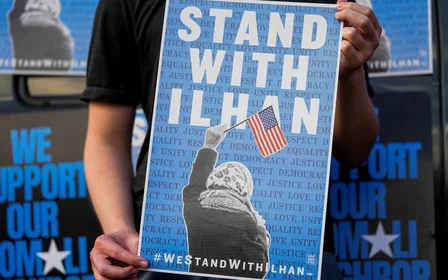
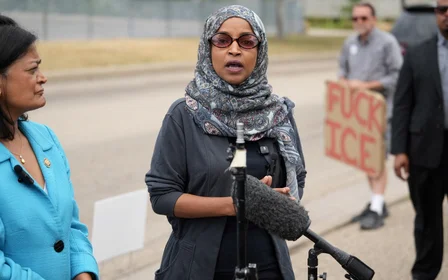
Trump's attacks on Ilhan Omar highlight concerns about normalisation of racism in US politics

Speaking at the White House on Tuesday, US President Donald Trump once again singled out Ilhan Omar, a naturalised US citizen who has represented Minnesota in Congress since 2019.
Asked whether the Congresswoman could face deportation over questions concerning her immigration records, Trump replied that she could also face imprisonment.
“I think she's a sick, a very dishonest person, but who hates our country. And she comes from a country that is essentially not even a country, Somalia. It's a real shithouse,” Trump said.
He went on to question Omar's understanding of constitutional rights and suggested that Somali immigrants had damaged Minnesota, the state she represents.
The comments marked another escalation in Trump's longstanding campaign against Omar, but also highlighted a broader concern about the extent to which racist and xenophobic rhetoric has become a routine feature of American political discourse.
New MEE newsletter: Jerusalem Dispatch
Sign up to get the latest insights and analysis on Israel-Palestine, alongside Turkey Unpacked and other MEE newsletters
The president called an African country a ‘shit house’ on camera. I remember the old days - his first term! - when calling African countries ‘shit holes’ was a huge controversy that had to be denied. We have normalized his Neo-Nazism now. Lucky us.
— Mehdi Hasan (@mehdirhasan) October 21, 2026
From political insults to threats of deportation
Omar, who fled Somalia as a child and arrived in the US as a refugee in 1995, became an American citizen in 2000.
As one of the first Muslim women elected to Congress, she has frequently been targeted by Trump and his political allies, particularly over her criticism of his immigration policies and foreign policy positions.
During his first presidency, Trump repeatedly suggested that Omar and other progressive congresswomen should return to the countries they came from, despite holding American citizenship.
His 2019 attacks on four Democratic congresswomen, widely known as "the Squad", sparked widespread accusations of racism. At a campaign rally that year, supporters chanted “send her back”, referring to Omar.
Trump has also repeatedly used derogatory language about predominantly non-white countries and immigrant communities. In 2018, he faced international condemnation over reported remarks describing certain African nations and Haiti as “shithole countries”.
During Trumps first term his whole White House denied that he used this language to describe foreign countries, now he just says it on camera
— Zaid Jilani (@ZaidJilani) October 20, 2026
His latest comments about Somalia echoed that earlier controversy, but came in a significantly different political context: his administration is now actively investigating whether Omar's citizenship could be challenged.
Federal investigation
Federal authorities searched Omar's Washington, DC, home on 12 October as part of an investigation into her immigration and naturalisation records.
Investigators are examining whether Omar or family members provided inaccurate information when entering the US as refugees or obtaining citizenship, reports say.
The investigation has also renewed scrutiny of longstanding allegations that Omar married her brother, Ahmed Nur Said Elmi, to facilitate immigration fraud.
Omar has repeatedly denied those allegations, which have circulated for years in conservative political circles without being substantiated.
On Monday, The New York Post reported, citing unnamed sources, that federal prosecutors were examining DNA evidence potentially relevant to the allegations. However, the reported evidence has not been publicly established as proof of wrongdoing, and no judicial finding has yet substantiated the claim that Omar married her brother.
The Washington Post also reported that officials in Trump's first administration had examined Omar's immigration history in 2019 but found insufficient evidence to pursue a full investigation.
The renewed inquiry has therefore raised questions about whether federal law enforcement is being used to pursue a political opponent.
Omar's legal representatives have rejected the investigation as politically motivated, while the Justice Department maintains that its investigative actions complied with legal requirements.
Democrats face questions over their response
Trump's increasingly aggressive rhetoric has also brought renewed scrutiny to the Democratic Party's response.
Critics of Democratic leadership have questioned whether the party is doing enough to confront attacks directed at Omar, particularly when they involve her race, religion, immigrant background and citizenship.
The silence from @DNC regarding this situation with @Ilhan proves they are spineless cowards and frauds.
— shut up, josh (@ChiefJosheola) October 20, 2026
However, Democratic leaders have not remained entirely silent.
Following the federal search of Omar's home, House Democratic leader Hakeem Jeffries and other senior Democrats issued a joint statement condemning the operation and accusing the Trump administration of using federal powers against political adversaries.
Former President Barack Obama also criticised the administration's suggestion that Omar could be stripped of her citizenship, warning of the wider implications.
The debate is therefore not simply whether Democrats have defended Omar, but whether their response has been sufficiently forceful and sustained in the face of Trump's repeated attacks.
Has racist rhetoric become normalised?
For years, Trump's language about immigrants, Muslim Americans and political opponents has generated controversy. Yet remarks that might once have triggered prolonged national headlines increasingly seem absorbed into the daily news cycle.
His latest comments about Omar illustrate the stakes of that shift.
The president is not only questioning a political opponent's patriotism but also casting doubt on the legitimacy of her citizenship and her right to participate in American democracy.
Are we all seriously just letting him talk about imprisoning a SITTING duly elected member of Congress because he doesn't like her?
— WTAF, America?! (@FightingForDem7) October 20, 2026
With the November midterm elections approaching, critics say the federal investigation into Omar has intensified concerns about political intimidation, the independence of law enforcement and the treatment of minority elected officials.
Middle East Eye delivers independent and unrivalled coverage and analysis of the Middle East, North Africa and beyond. To learn more about republishing this content and the associated fees, please fill out this form. More about MEE can be found here.