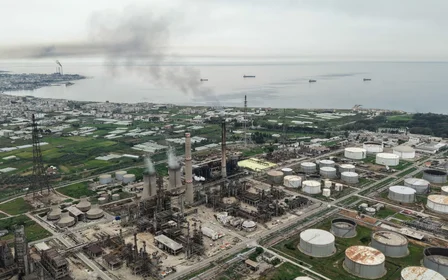
Gulf exports more oil than it did before Iran war despite surge in Hormuz attacks

The Middle East is now exporting more oil than it did before the US-Israeli war on Iran began on 28 February, posing a challenge to the Islamic Republic as it looks to cement its control over the Strait of Hormuz and as the US and Israel threaten a new attack.
Gulf countries exported 24.6 million barrels per day (bpd) in the week ending 18 October, surpassing prewar levels of 23.3 million bpd, according to data released by energy analytics firm Kpler.
The surge in exports comes at a time when Iran's attacks on vessels in the Strait of Hormuz have also surged.
At least 12 attacks took place last week, according to the United Kingdom Maritime Trade Operations (UKMTO).
A fully-laden container ship owned by the UAE sank last week in the Strait of Hormuz after likely being hit by a projectile.
New MEE newsletter: Jerusalem Dispatch
Sign up to get the latest insights and analysis on Israel-Palestine, alongside Turkey Unpacked and other MEE newsletters
Gulf states are relying on ship-to-ship transfers, by which smaller vessels enter the Gulf to load crude and then ferry it onto very large crude carriers, called VLCCs, waiting outside the Strait.
In many cases, Gulf states are using their own national carriers to do the heavy lifting because of insurance costs and safety concerns from private ship owners.
Red Sea bypass defies the Houthis
Saudi Arabia has also been exporting more oil via the Red Sea.
The kingdom was sending oil to Asia via the Bab el-Mandeb Strait, located by Yemen on the other side of the Arabian Peninsula. But when the Houthis declared an embargo on Saudi vessels, they used an alternative pipeline route to the Mediterranean via Egypt.
Shipments through the Strait of Hormuz are still more than a third lower than before the war, according to Kpler data.
This suggests Iran is still discouraging transits, but that workarounds are bearing fruit, limiting Iran’s leverage over the maritime space.
Kpler estimated that in September, about 40 percent of the non-Iranian crude shipped out of the Gulf bypassed the Strait of Hormuz, compared with 17 percent before the war.
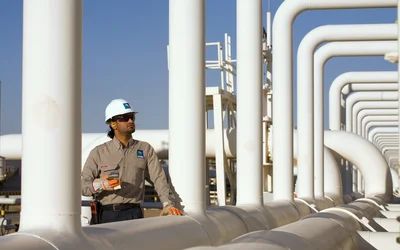
Middle Eastern states are also eyeing more permanent bypasses. Iraq, the second-largest producer in the oil cartel Opec, signed a deal with Syria in July to rehabilitate a pipeline from its northern oil fields to Syria’s Mediterranean coast. Middle East Eye was the first to reveal the project and its US backing.
Despite the surge in exports, Brent, the international benchmark, is still hovering at around $109 per barrel, and the price of refined products, especially diesel, has surged.
Part of the rising cost is due to surging shipping rates. Due to workarounds around Hormuz, there is more demand for vessels taking longer journeys, limiting supply.
The surge in exports could have real consequences as the US and Israel weigh resuming attacks on Iran.
Israeli Prime Minister Benjamin Netanyahu said on Wednesday that he was dedicated to overthrowing the Islamic Republic and claimed that Tehran was restarting its nuclear programme.
In his endorsement of Netanyahu for Israel’s general elections earlier this month, US President Donald Trump said he wanted Netanyahu to help him “finish the job” against Iran.
Middle East Eye delivers independent and unrivalled coverage and analysis of the Middle East, North Africa and beyond. To learn more about republishing this content and the associated fees, please fill out this form. More about MEE can be found here.