Where does Iran get its weapons, and can the US really stop the flow?

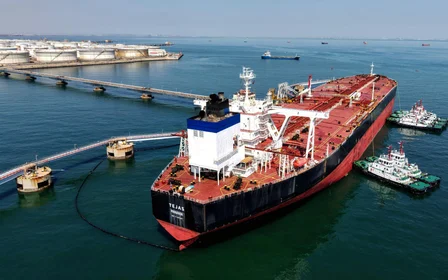
The US has stepped up its efforts to choke Iran’s military supplies with the announcement of Task Force Iron Gate, a new unit aimed at blocking imports of weapons entering the Islamic Republic overland and via the Caspian Sea.
Washington and Tehran are locked in negotiations to end the current war, which has now lasted over eight months, crashed global markets, and has no clear end in sight.
While Iran produces the bulk of its weapons domestically, it has looked increasingly towards military imports from the north, amid the ongoing US naval blockade of its southern ports, which has brought its usual maritime trade routes to a near-standstill.
Arms and their components have entered Iran through Russia and Central Asia, while there is also growing evidence of sales from China.
Deliveries of the parts used in Iran’s home-produced missiles and drones have also been traced to manufacturers in countries opposed to the Islamic Republic, including the US itself.
New MEE newsletter: Jerusalem Dispatch
Sign up to get the latest insights and analysis on Israel-Palestine, alongside Turkey Unpacked and other MEE newsletters
Operational details are scarce about how the 20-person unit, inaugurated by US Admiral Brad Cooper of US Central Command in Tampa, Florida, will operate.
The task force also seeks to further block Iranian exports, the most lucrative being oil, which Washington has sanctioned and blockaded in its bid to curb what it calls Iran's "illegal revenue streams".
Here’s everything you need to know about how Iran acquires its weapons and the US strategy to cut them off.
What weapons is Iran using?
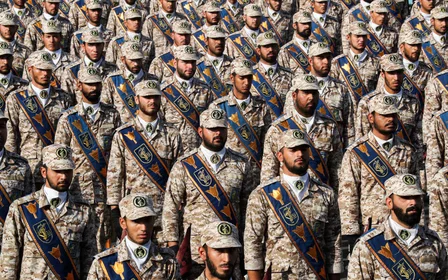
Iran has one of the most powerful militaries in the Middle East. It has used missiles and drones to strike Israel, Gulf states, regional US bases and ships in the Strait of Hormuz since the US and Israel launched Operation Epic Fury in February.
Some of its missiles, including the Sejjil, have ranges of around 2,000km (1,240 miles) and payloads of at least 500kg, putting much of the Middle East and parts of southern Europe within reach.
The extent of Iran’s weapons stockpile is not known, but the war has provided a glimpse of its scale.
Unlike the US, Israel and others, Iran does not have nuclear weapons. But its nuclear ambitions have long been a source of contention: inspectors from the International Atomic Energy Agency say that it possesses stockpiles of uranium enriched far beyond the levels needed for civilian uses, pointing to a probable weapons program.
What arms supplies does Tehran need?
Iran produces the majority of its weapons at home amid US sanctions and UN Security Council arms embargoes imposed over its nuclear programme.
Pieter Wezeman, a senior researcher at the Stockholm International Peace Research Institute, told Middle East Eye that “Iran is aware that sustaining its own arms industry is the best way for it to have a secure weapons supply in light of the arms embargoes imposed on it over the years.”


Much of this domestic industry has focused on missiles and drones, the development of which has far outpaced other Iranian military technology, such as combat aircraft and land equipment, which it occasionally bolsters through imports.
But Tehran is unable to produce complex components such as motors, microchips and semiconductors for its missiles and drones, and so turns to imports.
These parts, which can also be used for civilian purposes and are classified as “dual-use” goods, are only manufactured by a handful of countries in North America, Europe and East Asia.
Is Russia selling arms to Iran?
For decades Russia has been Iran's principal arms-trading partner, dating back to Tehran and Moscow’s mutual isolation during the Soviet era and the aftermath of the 1979 Iranian revolution.
The full extent of arms trade between the two countries, which are separated only by the Caspian Sea, is unclear. But Tehran has been open about deals in recent months. Army spokesman Mohammad Akraminia said on 31 October that the Islamic Republic had bought an unspecified number of Russian Su-35 fighter jets, adding that delivery was expected after the war with the US and Israel had ended.
There is also evidence that Russia agreed to sell six Yak-130 jets to Iran in 2023 and has agreed to sell thousands of advanced shoulder-fired missiles, to be delivered between 2027 and 2029.
Wezeman emphasised that the scale of these arms sales is dwarfed by the extent of Iran’s domestic weapons production.

For example, Moscow arranged to sell Tehran 90 helicopter-mounted missile launchers in 2024 and 2025.
But Wezeman said: “These are just just a few, relatively minor short-range missiles that you can stick on an attack helicopter, which Iran probably would not dare to fly around, and might now have already been destroyed by the US or Israel.
“So while this is evidence that Iran still acquires some weapons abroad, from what we can see this is only in very small numbers, and is really nothing compared to the numbers of drones and missiles that it is deploying."
Weapons have also moved in the other direction across the Caspian Sea, with Iranian arms being used by Russia in its war on Ukraine.
These include Iran’s Shahed attack drones and its Fath-360 ballistic missiles, sold to Russia in 2022 and 2023.
Does China sell weapons to Tehran?
China, Iran’s largest trading partner, has long been believed to be supplying arms to Iran. The two states have cordial relations, although Beijing is balancing its ties with Tehran against those elsewhere in the region, including with Saudi Arabia and the UAE, which Iran has targeted during the war.
The sales predate current fighting. MEE revealed exclusively in July 2025 that China had supplied surface-to-air missile batteries to Iran following its 12-day war with Israel the previous month, according to an Arab official briefed on the deliveries.
On 24 February, as the US was positioning its forces around Iran in the run-up to the current war, Reuters reported that the Islamic Republic was set to purchase anti‑ship cruise missiles from China, citing six sources with knowledge of negotiations.
Regional intelligence officials, speaking under conditions of anonymity to MEE, added that China had also sent Tehran loitering munitions, better known as Kamikaze drones.
Then, in July, amid Iran’s short-lived truce with the US, Reuters reported that Tehran was to receive up to 400 Chinese-made shoulder-fired air-defence missile launchers (known as manpads) via a Hong Kong-based intermediary, citing three sources familiar with the $60m-$70m deal.

None of the sales can be independently verified as having taken place, and are frequently denied by China, whose involvement would risk violating the UN arms embargo on Iran.
Responding to reports of the manpads sale, US President Donald Trump said that the deal “would be surprising”, given assurances he had received from Chinese President Xi Jinping that China would not participate in the war. His comments appeared at odds with the US State Department, which itself raised concerns about sales of Chinese manpads to Iran in June, just a month earlier.
The US has also criticised China for selling to Iran the means to manufacture drones and missiles, such as chipmaking technology and dual-use components like sodium perchlorate, the key chemical precursor for rocket propellants.
Central to Tehran and Beijing’s relationship is China’s long-standing role as the principal buyer of Iranian oil, purchased covertly and at knock-down rates amid US sanctions.
These sales have given Tehran an economic lifeline amid isolation from the western-dominated international financial system, but have been effectively halted by the US naval blockade of Iran’s southern coastline since April.
How else is Iran getting arms components?
The dual-use components that underpin Iran’s missiles and drones have been sourced from a variety of countries.
Inexpensive circuit boards, some manufactured in the US, are sourced via a complex, opaque network of intermediaries across dozens of countries including firms based in Iranian adversaries such as the UAE.
Components identified in Iran’s weaponry, or via trade data, have also been traced to Japan, Germany and other countries in the EU. These goods are often imported under the guise of civilian use, with layers of middlemen concealing the Iranian Ministry of Defence as the final buyer.
In other cases, the full picture of how electronic components and other dual-use goods get to Iran is obscured by complex supply chains and incomplete customs data.
But there is evidence that land routes from the Caucuses, Turkmenistan and elsewhere in Central Asia play a role in these transfers, along with aerial deliveries and cargo shipments across the Caspian Sea.
What have the US and Israel done to stop the trade so far?
Besides blockading Iranian naval ports, the US has also put pressure on Iran’s seven land neighbours - Iraq, Turkey, Armenia, Azerbaijan, Turkmenistan, Afghanistan, and Pakistan - to curb border traffic.
In recent weeks, Washington has demanded that Iraq tighten its 1,600km border with Iran, according to diplomats with knowledge of the talks cited by the New York Times.

Pakistan appeared to cede to similar pressure last month when it halted trade with Iran at two border crossings, leaving road traffic stranded.
The US has also targeted land transit routes within Iran. In July, it bombed a remote bridge in Iran’s northeastern Golestan province on a railway line linking the country to Turkmenistan. Iran claimed to have rebuilt the bridge days later.
And on the Caspian Sea, Israel struck the port of Bandar Anzali in March. Ukraine hit an Iranian shipping tanker travelling between Iran and Russia in July, citing its role in Russia’s war.
What might stop the US halting arms sales to Iran?
Dual-use goods such as semiconductors, which are widely used for multiple purposes, are employed in electronic devices ranging from children’s toys to missiles and are notoriously difficult to trace.
Damien Spleeters, CEO of Heimdall, an investigative firm specialising in supply chains, told Middle East Eye: “Manufacturers often struggle to identify the ultimate end user once their products pass through several intermediaries.”
Cooperation with Iran’s neighbours, Spleeters says, “will be key to the task force’s success in curbing diversion across their borders”.
But Serhan Afacan, associate professor at Marmara University's Institute of Middle East and Islamic Countries, told Middle East Eye that the US lacks the necessary leverage to coax all of Iran’s neighbours into cutting their trade with Iran.
“The new task force effectively extends US pressure to countries that deliberately maintained neutrality during the war,” he said. “These states have little incentive to abandon that position, particularly when doing so could jeopardise their relations with Tehran.”

Iran has extensive trade with Pakistan, which has become increasingly dependent on black market imports of Iranian petrol and diesel across the two countries’ porous borderlands. Islamabad has also sought to position itself as a neutral mediator between Tehran and Washington.
“Active participation in the Iron Gate initiative would undermine Islamabad’s credibility as a mediator,” said Afacan, adding that means Pakistan has “strong incentives to avoid becoming directly involved in a campaign designed to intensify Iran’s economic isolation”.
Iraq imports much of the gas it uses to power its energy grid from Iran. It has so far refused US demands to close all but two of its border crossings, given potential repercussions from Tehran and public disapproval at home.
Washington will also be unable to persuade the Taliban in Afghanistan, who have limited control over the country’s borders and forced the US to retreat in 2021, to tighten export controls.
The US has no military presence in the Caspian Sea, a major route for Iranian arms traffic: a 2018 treaty prohibits countries other than those adjoining the body of water from military operations in the region.
Afacan said that Azerbaijan, like other states adjoining the Caspian, were taking a cautious approach to the issue of policing the sea.
“Azerbaijan has an interest in maintaining its relations with Washington,” he said, “but it also has strong reasons to avoid measures that could undermine the Caspian’s established legal arrangements or unnecessarily aggravate its relations with Iran.”
Any attempt to develop a military presence would especially antagonise Moscow. Wezeman says: “Russia considers the Caspian Sea its backyard, so I really don’t see the US staging any operations where it attempts to board ships there – and certainly not those coming directly from Russia itself.”
And he doubts Iron Gate will substantially hurt Iran’s arsenal. “Twenty extra personnel is not going to do much, as far as I can see,” he says, amid existing efforts to thwart procurement.
What have Iran, Russia and China said about Iron Gate?
Iran has shrugged off the new US taskforce. “The Iron Gate plan is merely wordplay,” Hossein Mohebbi, spokesperson for Iran’s Revolutionary Guards Corps, said on 8 November.
“The Americans cannot achieve their objectives of imposing severe economic pressure to cause economic collapse in Iran through this approach,” he said, recalling how, at the start of the war, Washington predicted Iran’s economic collapse within two weeks.
Iran’s Deputy Foreign Minister Kazem Gharibabadi met the Russian ambassador to Iran on 10 November to discuss, as he put it, “how to counter unilateral US actions, and the so-called Iron Gate plan”.
Gharibabadi also later said: “Tehran and Moscow emphasise the need for coordination and cooperation in the face of common threats.”
The following day, a spokesperson for Russia’s foreign ministry declared Moscow’s “full support for the position of the Iranian authorities. We consider this latest escalatory and provocative step a blatant violation of the norms of international law,” the ministry said of the new US taskforce.
China has not commented on the US plans.
Middle East Eye delivers independent and unrivalled coverage and analysis of the Middle East, North Africa and beyond. To learn more about republishing this content and the associated fees, please fill out this form. More about MEE can be found here.